- Plants
- ›Vascular Plants
- ›flowering plants
- ›Dicots
- ›magnolias, nutmegs, and allies
- ›custard-apples
- ›Malmeoideae
- ›Miliuseae
- ›Pseuduvaria
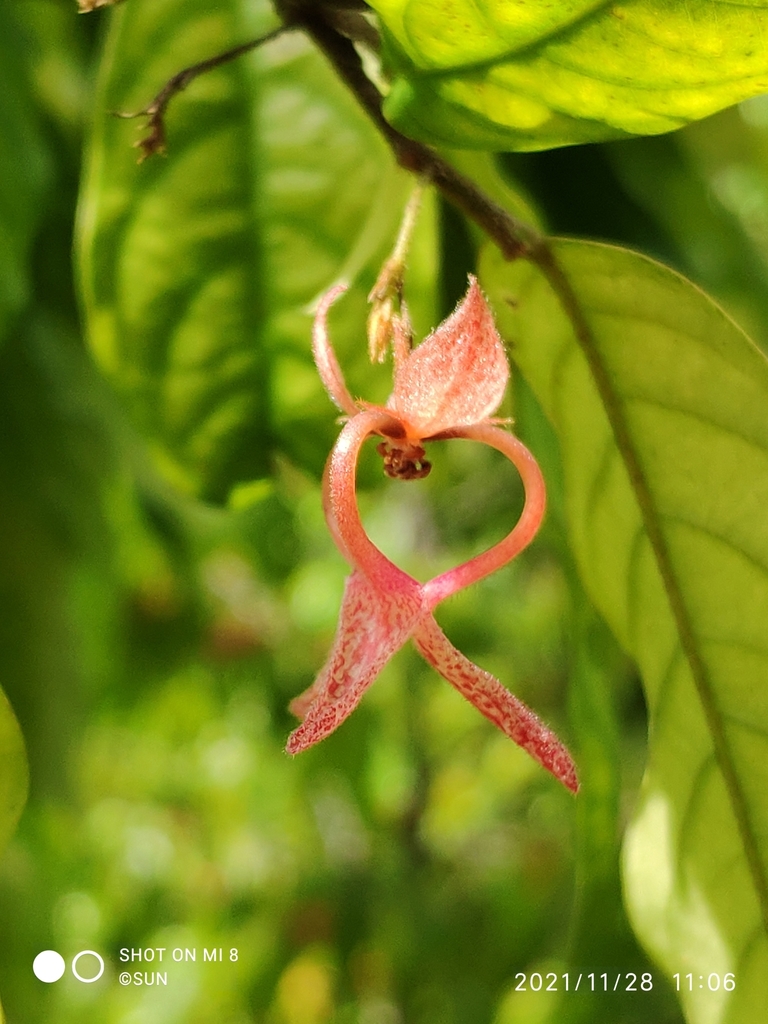
Pseuduvaria luzoniensis
Pseuduvaria luzoniensis is a species of plant in the family Annonaceae. It is native to The Philippines. Elmer Drew Merrill, the American botanist who first formally described the species using the synonym Orophea luzoniensis, named it after Luzon in the province of Battan, Philippines where the specimen he examined was collected along the Lamao River.
From the article Pseuduvaria luzoniensis on Wikipedia (CC BY-SA), quoted section by section
Description
It is a tree reaching 10 meters (33 ft) in height. The young, yellow-brown to black branches are densely hairy, but become hairless when mature. The branches also have sparse lenticels. Its elliptical, papery to leathery leaves are 10–27 by 3–8.5 centimeters. The leaves have pointed to wedge-shaped bases and tapering tips, with the tapering portion 5–19 millimeters long. The leaves are hairless on their upper surfaces and sparsely hairy on their lower surfaces. The leaves have 10–18 pairs of secondary veins emanating from their midribs. Its very densely hairy petioles are 4–12 by 1–3 millimeters with a broad groove on their upper side. Its Inflorescences occur alone or in pairs on branches, and are organized on indistinct peduncles. Each inflorescence has 1–2 flowers. Each flower is on a very densely hairy pedicel that is 12–30 by 0.3–0.8 millimeters. The pedicels are organized on a rachis up to 5 millimeters long that have 2–3 bracts. The pedicels have a medial, very densely hairy bract that is 0.5–1.5 millimeters long. Its flowers are unisexual. Its flowers have 3 oval sepals, that are 1.5–2.5 by 1.5–2.5 millimeters. The sepals are hairless on their upper surface, very densely hairy on their lower surface, and hairy at their margins. Its 6 petals are arranged in two rows of 3. …
Range & habitat
It has been observed growing in lowland forests at elevations of 90–100 meters (300–330 ft).
== References ==
Wikipedia: “Habitat and distribution”
Where it lives
Recorded sightings
—
geo-referenced records in GBIF, from museums, herbaria and field observers.
Drag the globe to turn it. Dots are where records exist, not a range map; darker means more records.
In the stacks
Searching the stacks…
Every page naming Pseuduvaria luzoniensis in the Biodiversity Heritage Library →
This page is assembled live from iNaturalist, GBIF, Wikipedia, the Source Library and the Internet Archive. It is not yet part of the hand-edited codex. iNaturalist taxon 1370072.