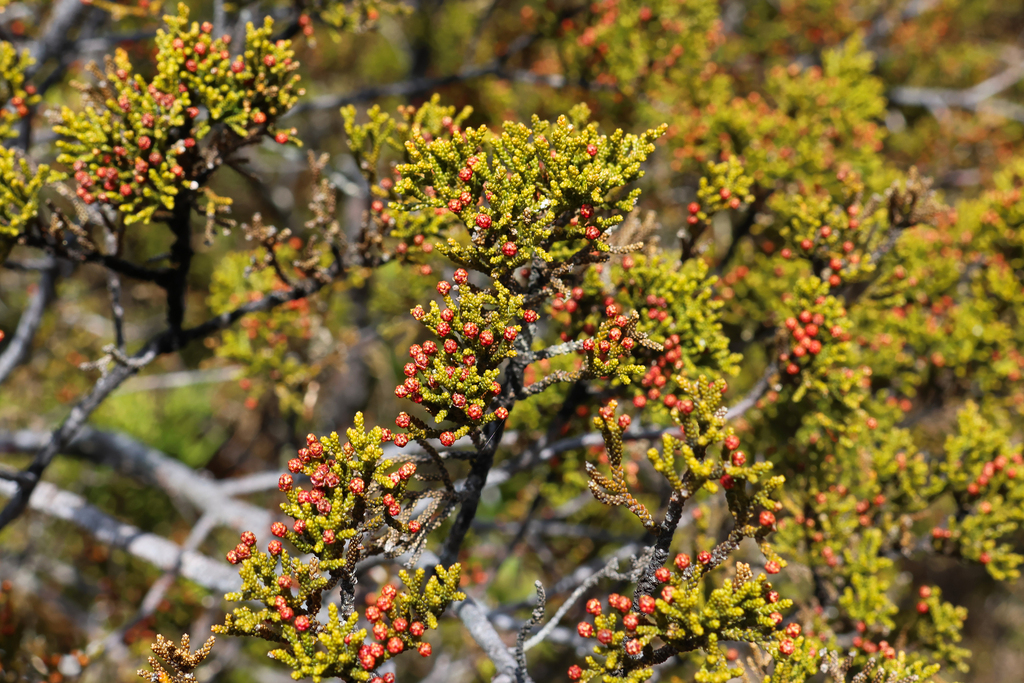
Mount Mawson pine
Pherosphaera hookeriana
Pherosphaera hookeriana, the Mount Mawson pine, is a shrubby conifer in the family Podocarpaceae, endemic to Tasmania, at elevations above 600 meters. There are roughly 30 known sites, with population numbers in the tens of thousands. The species occurs in a range of habitats typically in areas near water bodies, mostly on dolerite derived soils. The species is highly fire sensitive and an increase in fire events associated with climate change may lead to local extinction and fragmentation of habitat.
From the article Pherosphaera hookeriana on Wikipedia (CC BY-SA), quoted section by section
Description
Pherosphaera hookeriana is a densely-branched erect shrub or small tree growing to heights of 5 meters, branches are often small and rigid with leaves arranged spirally and fully appressed to the stem. Individual leaves can measure up to 1.5 mm long, and 1 mm wide, leaves are thick, blunt and concave with a rounded keel. Male flowers form in compressed, terminal globular cones, ranging from 1–5 mm in diameter, with 8 to 15 fertile scales, each scale has two pollen sacs on the abaxial surface. Female flowers occur in cones on short branches that usually droop (hence the old common name). The flowers are globular, 2–4 mm long and have 3-8 fertile scales, with a single ovule on the upper surface of each. When the seed is ripe it has a hard, glossy brown coat and is approximately 1 mm in diameter (Curtis & Morris 1975, Hill 1998).
Range & habitat
Pherosphaera hookeriana is endemic to Tasmania's west, southwest and central plateau. The current distribution of the species is most likely to be a reflection of post-glacial expansion from refugia and subsequent fire events (Kirkpatrick & Dickinson 1984). Pherosphaera hookeriana grows from 600 to 1300 meters elevation in a wide range of habitats from alpine to Sphagnum bogs, the common element through the environments the species inhabits is the high soil moisture content and annual rainfall. Confirmed records indicate that the species ranges from the Walls of Jerusalem National Park in the north to Mt La Perouse in Southwest National Park (Tasmanian threatened species guide 2016) – about 12 kilometers from Tasmania's south coast. Most populations of the species occurs on soils derived from Jurassic dolerite, with an exception being a stand in Artichoke Valley near Frenchmans Cap, which grows on sedimentary deposits.
Wikipedia: “Distribution and habitat”
What it does
Pherosphaera hookeriana is a dwarf conifer that has been recorded to grow up to 5 meters, but in exposed and harsh environments it may only attain a height of 0.5 meters (Minchin 1983). The foliage of Pherosphaera hookeriana is well adapted to the high elevations it occupies, with small imbricate scale leaves, the stomata are restricted to the adaxial surface and protected by a marginal leaf frill (Hill and Brodribb 1999). The species is generally dioecious, with the reproductive organs occurring on specialised leaves arranged in cone like structures. Pollen is wind dispersed and seed ripening occurs by late April (Wood & Rudman 2015). It is unclear if the plant produces seed annually or produces mass seed every few years (mast seeding). Germination appears to happen only rarely and is restricted to moist, shady areas. The seed is noted as having a dormant period, which could potentially result in a soil-stored seed bank with germination being staggered over several years. It is unknown how long the seed is viable in the soil for, but preliminary studies show that the seed requires warm stratification and then cold stratification to elicit germination; so the earliest it can take place is in the second spring/summer following dispersal (Wood & Rudman 2015). The seedlings superficially resemble small lycopods, with narrow spreading leaves. …
Wikipedia: “Identification and ecology”
Where it lives
Recorded sightings
—
geo-referenced records in GBIF, from museums, herbaria and field observers.
Drag the globe to turn it. Dots are where records exist, not a range map; darker means more records.
In the stacks
Searching the stacks…
Every page naming Pherosphaera hookeriana in the Biodiversity Heritage Library →
This page is assembled live from iNaturalist, GBIF, Wikipedia, the Source Library and the Internet Archive. It is not yet part of the hand-edited codex. iNaturalist taxon 136632.