- Plants
- ›Vascular Plants
- ›flowering plants
- ›Dicots
- ›Gentians, Dogbanes, Madders, and Allies
- ›Dogbane Family
- ›milkweeds
- ›Asclepiadeae
- ›Cynanchinae
- ›Cynanchum
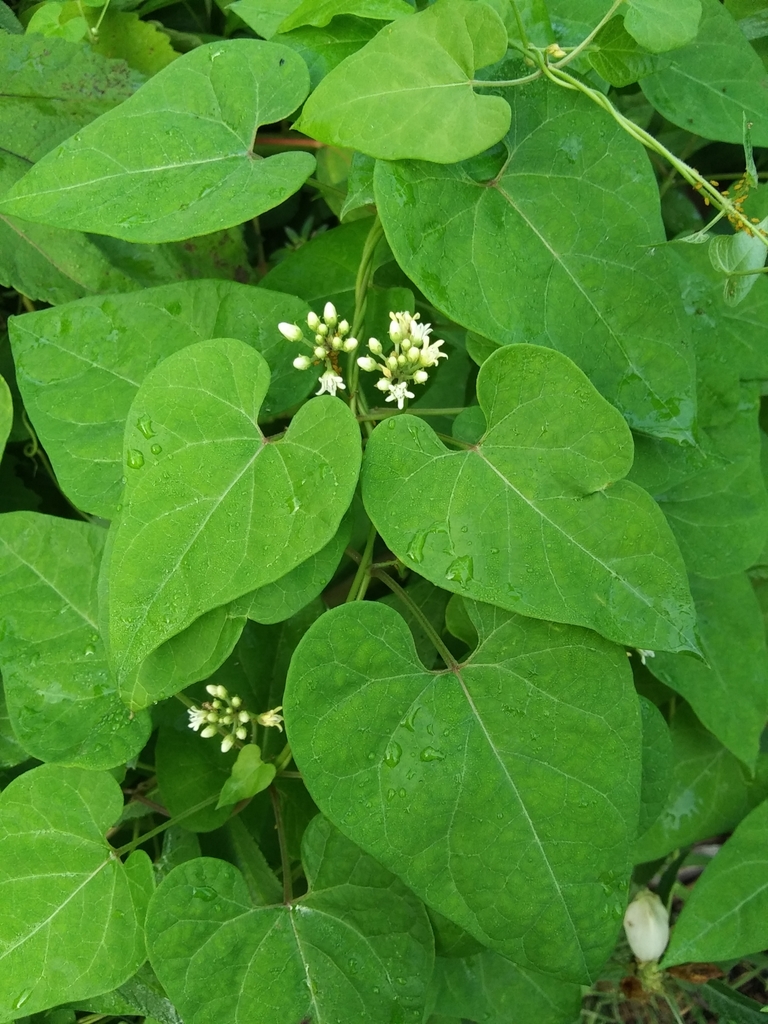
honey-vine climbing milkweed
Cynanchum laeve
Cynanchum laeve is a vining perennial herb native to eastern and central U.S. states and Ontario. Common names include sand vine, honeyvine, honeyvine milkweed, bluevine milkweed, climbing milkweed, and smooth swallow-wort. The root system of C. laeve can cause it to be very difficult to eradicate, especially in agricultural fields. It is a larval food of monarch butterflies and milkweed tussock moth larvae. C. laeve can cause eye irritation if touched and can be toxic to humans and livestock if consumed in large quantities.
From the article Cynanchum laeve on Wikipedia (CC BY-SA), quoted section by section
Description
Cynanchum laeve is a twining vine with heart-shaped leaves and commonly found in roadsides, fence rows, fields, and disturbed areas. C. laeve is easily recognized as a member of the Apocynaceae by its opposite leaves, milky sap, and distinctive flowers and follicles ("milkweed pods"). The seeds are wind dispersed and can travel long distances. Each plant can produce up to 50 follicles. The root system is fleshy and brittle with a large taproot with other lateral roots, these roots can grow up to 6 feet deep. Developing stems are a light pink and produce a milky sap when broken. Vase-shaped flowers have 5 white petals. These occur in clusters on short stalks. C. laeve flowers from June through September.
Range & habitat
Cynanchum laeve occurs in the eastern and central United States and Ontario, Canada. C. laeve can be found in wetland areas in the arid West, Atlantic and Gulf Coastal Plain, Eastern mountain and Piedmont, the Great Plains, Midwest, and the North Central and North Eastern United States. Cynanchum laeve typically lives in disturbed habitats such as thickets, low moist fields, riverbanks, fence rows, and cultivated fields.
Wikipedia: “Distribution and habitat”
How it is grown
Hay fed to livestock can contain C. laeve which can be toxic when consumed in large quantities. Most animals will not eat C. laeve due to its bitter taste. It is recommended by the US Fish and Wildlife Service to take precautionary steps. These steps include not grazing hungry animals in pastures containing C. laeve, eradicating it from driveways and trails, and closely observing livestock that have just been introduced to areas containing C. laeve. C. laeve can be very difficult to eradicate from fields because of its deep, extensive root system. This vine climbs on other plants, and this can cause problems in crop harvesting.
== References ==
Wikipedia: “Agricultural use”
Where it lives
Recorded sightings
—
geo-referenced records in GBIF, from museums, herbaria and field observers.
Drag the globe to turn it. Dots are where records exist, not a range map; darker means more records.
In the stacks
Searching the stacks…
Every page naming Cynanchum laeve in the Biodiversity Heritage Library →
This page is assembled live from iNaturalist, GBIF, Wikipedia, the Source Library and the Internet Archive. It is not yet part of the hand-edited codex. iNaturalist taxon 136381.