- Plants
- ›Vascular Plants
- ›conifers
- ›conifers
- ›cypress family
- ›Cypresses, Cedars, Junipers, and Allies
- ›Cupressus
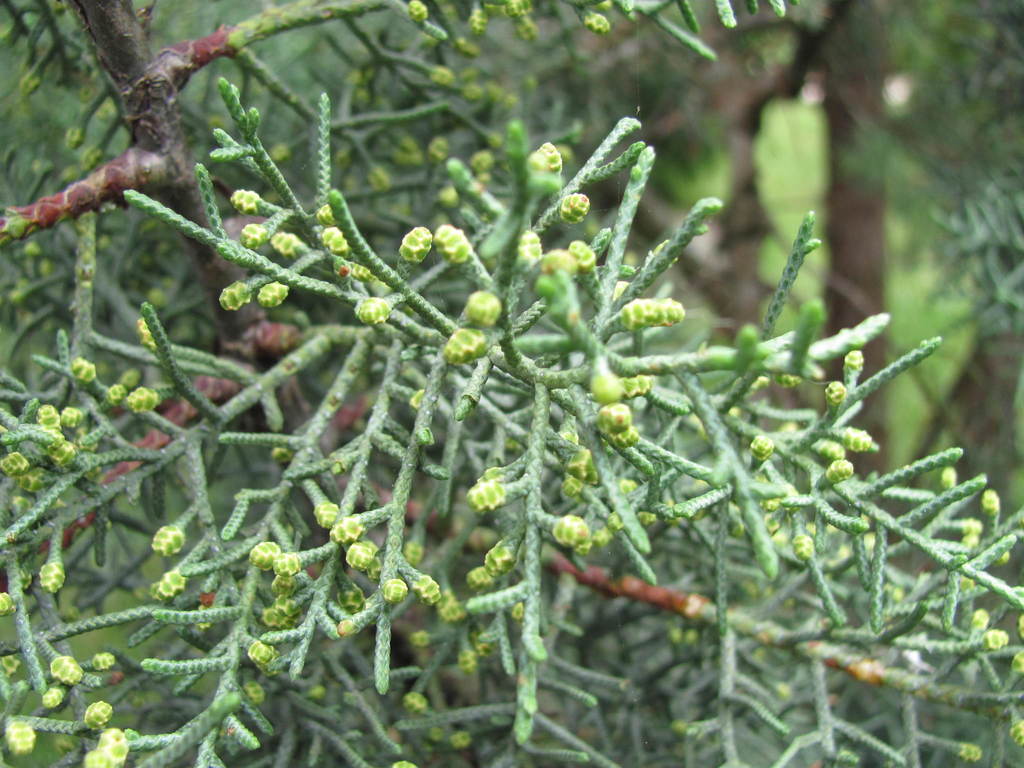
Bhutan cypress
Cupressus cashmeriana
Cupressus cashmeriana, the Bhutan cypress or Kashmir cypress, is a species of evergreen conifer native to the eastern Himalaya in Bhutan and adjacent areas of Arunachal Pradesh in northeastern India. [ Now in vulnerable category, IUCN list retrieved in 2006 ]. It is also introduced in China and Nepal. It grows at moderately high altitudes of 1,250–2,800 metres (4,100–9,190 ft).
From the article Cupressus cashmeriana on Wikipedia (CC BY-SA), quoted section by section
Description
Cupressus cashmeriana is a medium-sized to large tree growing 20–45 metres (66–148 ft) tall, rarely much more, with a trunk up to 3 metres (9.8 ft) diameter. The foliage grows in strongly pendulous sprays of blue-green, very slender, flattened shoots. The leaves are scale-like, 1–2 mm long, up to 5 mm long on strong lead shoots; young trees up to about 5 years old have juvenile foliage with soft needle-like leaves 3–8 mm long. The seed cones are ovoid, 10–21 mm long and 10–19 mm broad, with 8–12 scales, dark green, maturing dark brown about 24 months after pollination. The cones open at maturity to shed the seed. The pollen cones are 3–5 mm long, and release pollen in early spring. A tree of 95 metres (312 ft) tall has recently been reported, but the measurements await verification.
How it is grown
Cupressus cashmeriana is widely grown horticulturally as an ornamental tree, both within its native region and internationally in temperate climates. It is planted in private gardens and public parks, although generally regarded as sensitive to drought and wind. Many of the plants available outside of its native range are named cultivars, selected for particular forms, textures, or foliage colours, such as very pendulous branching or shoots, a fastigiate or columnar shape, or a particularly bright blue or silvery glaucous foliage. This plant has gained the Royal Horticultural Society's Award of Garden Merit (confirmed 2017). It is fully hardy only in relatively mild or coastal areas of the UK. Some healthy specimens have been reported in Canberra, Australia.
Wikipedia: “Cultivation”
In human culture
The Bhutan cypress is the official national tree of Bhutan, where it is often associated with Buddhist religious places. It has been widely planted around Vihara monasteries and Buddhist temples there for centuries.
Wikipedia: “Symbolism”
Where it lives
Recorded sightings
—
geo-referenced records in GBIF, from museums, herbaria and field observers.
Drag the globe to turn it. Dots are where records exist, not a range map; darker means more records.
In the stacks
Searching the stacks…
Every page naming Cupressus cashmeriana in the Biodiversity Heritage Library →
This page is assembled live from iNaturalist, GBIF, Wikipedia, the Source Library and the Internet Archive. It is not yet part of the hand-edited codex. iNaturalist taxon 136152.