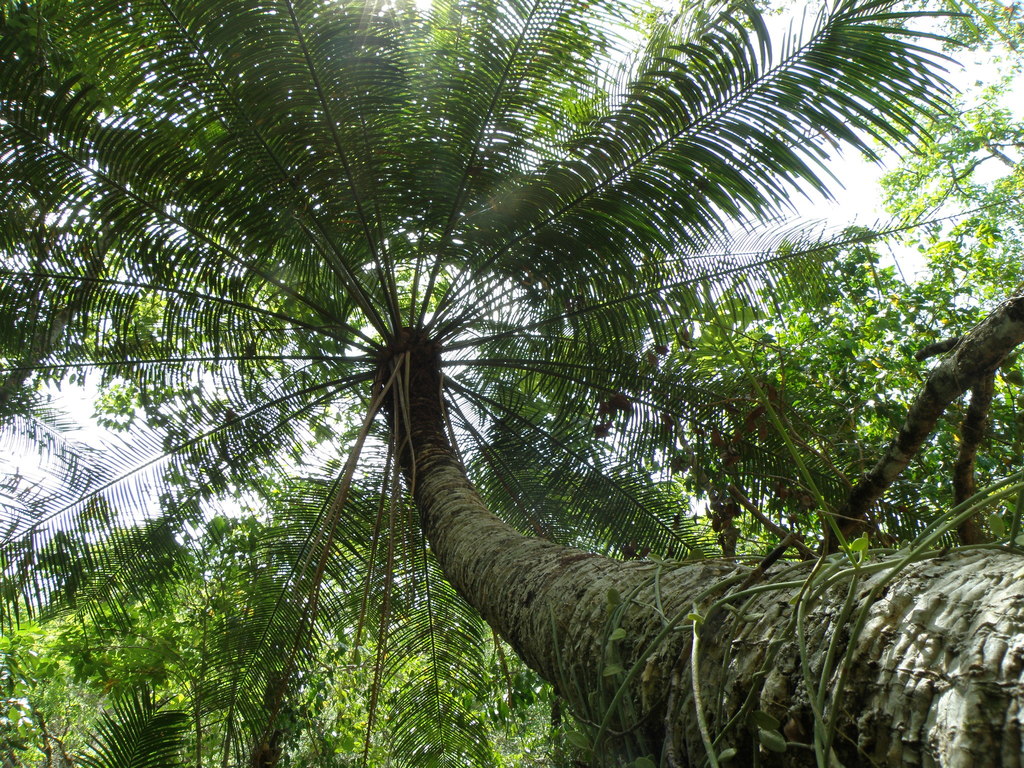
queen sago
Cycas rumphii
Cycas rumphii, commonly known as queen sago or the queen sago palm, is a dioecious gymnosperm, a species of cycad in the genus Cycas native to Indonesia, New Guinea and Christmas Island. Although palm-like in appearance, it is not a palm.
From the article Cycas rumphii on Wikipedia (CC BY-SA), quoted section by section
Description
The cycad is a small tree, growing to about 10 m (33 ft) in height, with a trunk diameter of up to 40 cm (16 in). The bark is grey and distinctively fissured into rectangular, or diamond-shaped, segments. The leaves grow from the crown – bright green, glossy, palm-like fronds, 1.5–2.5 m (4.9–8.2 ft) long, with 150–200 leaflets on each frond. The spiny petiole is 35–60 cm (14–24 in) long. The male plant's strobilus, or cone, is oblong-ellipsoidal, 30–60 cm (12–24 in) long, orange in colour and foetid in odour. The female's megasporophylls are about 30 cm long, fleshy, brown and densely hairy, with the fertile area about 35 mm (1.4 in) wide. The seeds are 45 mm long and 30 mm wide, ripening from green to an orange- or reddish-brown colour. In the Solomon Islands, and perhaps elsewhere, the tree can "quite commonly" produce as many as a dozen major adventitious limbs.
Range & habitat
The cycad's range is centred on the Maluku Islands, extending northwards to Sulawesi, eastwards to New Guinea, and westwards to Java and southern Borneo. It also occurs on Christmas Island, an Australian territory in the Indian Ocean 300 km (190 mi) south of Java, in Australia's Top End (Darwin), and in Western Australia. It is cultivated in Fiji and Vanuatu. It is largely a species of tropical closed forest or woodland on calcareous soils in coastal habitats. It is often found on stabilised dunes formed of coralline sand and limestone.
Wikipedia: “Distribution and habitat”
At the table
The trunk of the cycad contains a starchy pith from which sago can be prepared by drying, grinding and washing. The seeds contain a toxic glucoside, pakoein, but can be treated to become edible by pounding, repeated washing, and cooking. The bark, seeds and sap are used in poultices to treat sores. Called Namwele in the Kastom culture of Pentecost, Vanuatu, the plant is sacred, a symbol of peace and status.
Wikipedia: “Uses”
In human culture
'Queen sago' alludes to the name 'king sago' given to the related Cycas revoluta, as well as to its use as a source of edible starch. The specific epithet rumphii honours the German-born Dutch naturalist Georg Eberhard Rumphius (1628–1702), who served first as a military officer with the Dutch East India Company in Ambon, then with the civil merchant service of the same company.
Wikipedia: “Etymology”
Where it lives
Recorded sightings
—
geo-referenced records in GBIF, from museums, herbaria and field observers.
Drag the globe to turn it. Dots are where records exist, not a range map; darker means more records.
In the stacks
Searching the stacks…
Every page naming Cycas rumphii in the Biodiversity Heritage Library →
This page is assembled live from iNaturalist, GBIF, Wikipedia, the Source Library and the Internet Archive. It is not yet part of the hand-edited codex. iNaturalist taxon 136017.