- Plants
- ›Vascular Plants
- ›conifers
- ›conifers
- ›cypress family
- ›Cypresses, Cedars, Junipers, and Allies
- ›Juniperus
- ›Sabina
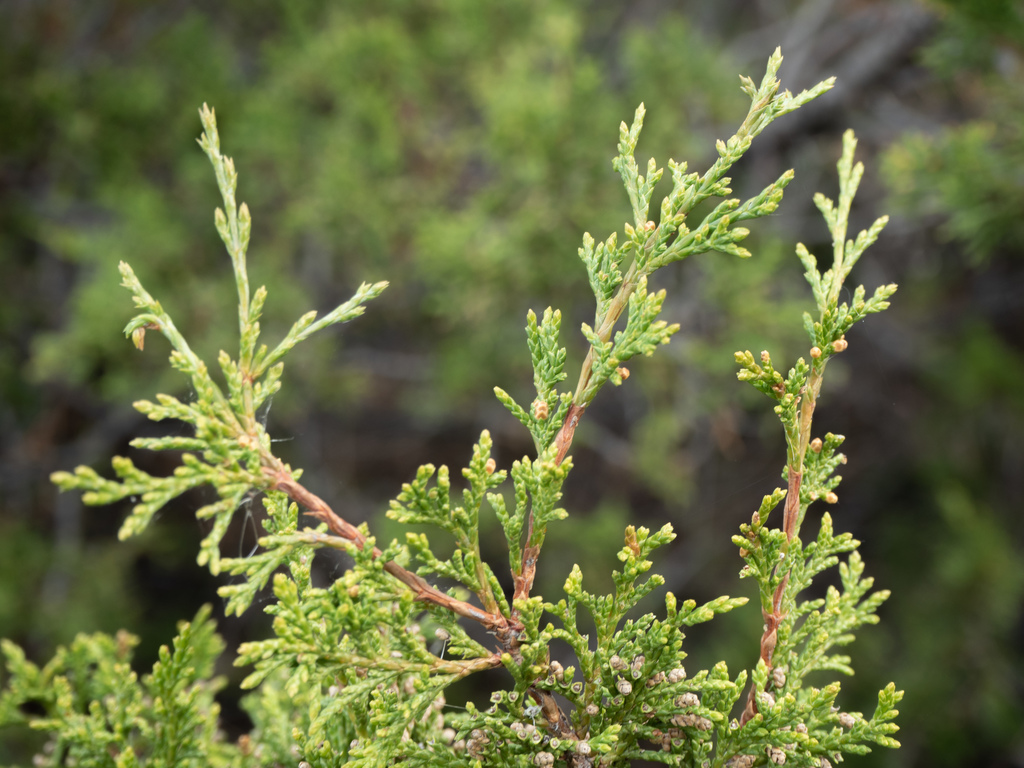
Rocky Mountain Juniper
Juniperus scopulorum
Juniperus scopulorum, the Rocky Mountain juniper, is a species of juniper native to western North America, from southwest Canada to the Great Plains of the United States and small areas of northern Mexico. They are the most widespread of all the New World junipers. They are relatively small trees, occasionally just a large bush or stunted snag. They tend to be found in isolated groves or even as single trees rather than as the dominant tree of a forest. Though they can survive fires, they are vulnerable to them especially when young and this is one of the factors that can limit their spread into grasslands.
Rocky Mountain junipers provide habitat and food for wildlife. They provide cover to a range of species, from small birds and mammals to deer and bighorn sheep. Their berry-like cones are eaten by many animals and their scaly leaves and small twigs are browsed in small amounts by large herbivores. The primary human use is in landscaping for aesthetic purposes, to shelter habitations, or attract fruit-eating birds. They are also used in small amounts for their insect repellent and rot-resistant wood or as firewood for heating.
From the article Juniperus scopulorum on Wikipedia (CC BY-SA), quoted section by section
Description
Juniperus scopulorum is a small evergreen tree that in favorable conditions may reach as much as 20 metres (66 feet) in height. However, on sites with little water or intense sun it will only attain shrub height, and even those that reach tree size will more typically be 4.6–6.1 metres (15–20 feet) tall in open juniper woodlands. Younger trees have a narrow pyramidal shape, but develop into a rounded, oval, or spreading and irregular crown when older. They may either have a single trunk or multiple stems. Trunks can be large on mature trees, 38–76 centimetres (15–30 inches) in diameter. When the subsoil is difficult to penetrate and lacks moisture the roots of Juniperus scopulorum spread out. They are numerous and fibrous in the upper part of the soil. When soils are deep and well drained they will grow to a greater depth. On twigs between 5 and 10 millimetres (3⁄16 and 13⁄32 in) in diameter the bark is smooth. On larger twigs and branches it becomes rough, coming off in thin strips. Juniperus scopulorum has red-brown bark on branches that can weather to grey on the trunk. The texture of the bark is rough and comes away in shreds on the trunk with brown bark showing in the cracks at times. Branches tend to grow outwards a short distance and then curve to growing upwards (ascending). In sheltered to somewhat shady locations the branches may hang downwards and be quite slender. …
Range & habitat
Rocky Mountain junipers are found across a wider range than any other new world juniper species, though it is almost nowhere a common species. More often they are scattered widely across the landscape in isolated groups, grove, or stands. The species is native to western North America, in Canada in south British Columbia and southwest Alberta, in the United States sporadically from Washington east to North Dakota, south to Arizona and also locally western Texas, and northernmost Mexico from Sonora east to Coahuila. It grows at elevations of 500–2,700 m (1,600–8,900 ft) on dry soils, often together with other juniper species. It requires at least 25 centimetres (10 in) of annual precipitation, though the average for its range is 38–46 centimetres (15–18 in) and it survives on Vancouver Island with as much as 66 centimetres (26 in) of precipitation. Though it grows in very dry environments in western North America and has great drought endurance, it is not as adapted to dry conditions as other western juniper species. The trees are very numerous in the lower mountains and foothills where grasslands or scrublands transition to low forests. In the Southern Rocky Mountains, the Colorado Plateau, and parts of Nevada Juniperus scopulorum is associated with the various species of piñon pine as a key species of the piñon-juniper woodland. …
Wikipedia: “Distribution and habitat”
What it does
At lower elevations, in the absence of fire, Juniperus scopulorum may be considered a climax species, one that comes late in the succession of plant species, and perhaps more adapted to stable environments. At higher elevations of the Intermountain West dominated by Douglas fir (Pseudotsuga menziesii), it may be considered more of a pioneer species. Rocky Mountain juniper is a relatively slow growing species with an average age (at one site) of eight years for saplings 30 centimeters in height. As a species they have difficulty becoming established on constantly dry sites and have greater success establishing in areas that catch temporary water, such as rocky crevices and slight depressions. Until they are approximately 50 years old Rocky Mountain junipers are vulnerable to fire due to thin bark and relatively large concentrations of resins and oils. Trees that are burned have no ability to regenerate from the roots. Older trees are still vulnerable to fires, but may survive if they lack lower branches for a ground fire to climb into the crown of the tree. Because of this, fire is sometimes used as a method to control junipers in rangeland, but if there is not enough fuel on the ground the fire is less effective in killing trees targeted for removal. Most older trees show signs of having survived four to six fires in their lifetimes. …
Wikipedia: “Ecology and conservation”
At the table
The primary uses of Rocky Mountain juniper are as an ornamental tree in landscaping. It is also used for firewood, as a herb, and for its rot resistant wood.
Cultivation. Rocky Mountain juniper is quite frequently used in gardens when a moderate to small-sized tree is needed for a location with medium moisture (mesic) to dry soil and low soil productivity. The tree is sometimes planted as a windbreak in the west and on the plains. It is also moderately popular subject of bonsai cultivation in the United States. There are over 100 named cultivars of the species in the plant trade. 'Blue arrow' is a cultivar with a narrow and erect (fastigiate) growth habit. At full growth it will be 3.6 to 4.5 meters tall and just 60 centimeters wide. It has a blue-gray cast, but is not as blue as the variety usually called 'skyrocket'. It is a recipient of the Royal Horticultural Society's Award of Garden Merit.
'Blue heaven' is another of the many fastigiate type cultivars. It has the typical blue-white cast to its foliage in summer, but it is more green colored in winter months. Size when full grown will be 4–5 meters tall and 90–120 centimeters in width. Like most varieties derived from Rocky Mountain juniper it is intolerant of hot, humid weather and constantly wet conditions and will usually succumb to root rots in muggy climates. 'Skyrocket' is a very frequently mentioned cultivar. …
Wikipedia: “Uses”
Where it lives
Recorded sightings
—
geo-referenced records in GBIF, from museums, herbaria and field observers.
Drag the globe to turn it. Dots are where records exist, not a range map; darker means more records.
In the stacks
Searching the stacks…
Every page naming Juniperus scopulorum in the Biodiversity Heritage Library →
This page is assembled live from iNaturalist, GBIF, Wikipedia, the Source Library and the Internet Archive. It is not yet part of the hand-edited codex. iNaturalist taxon 135883.