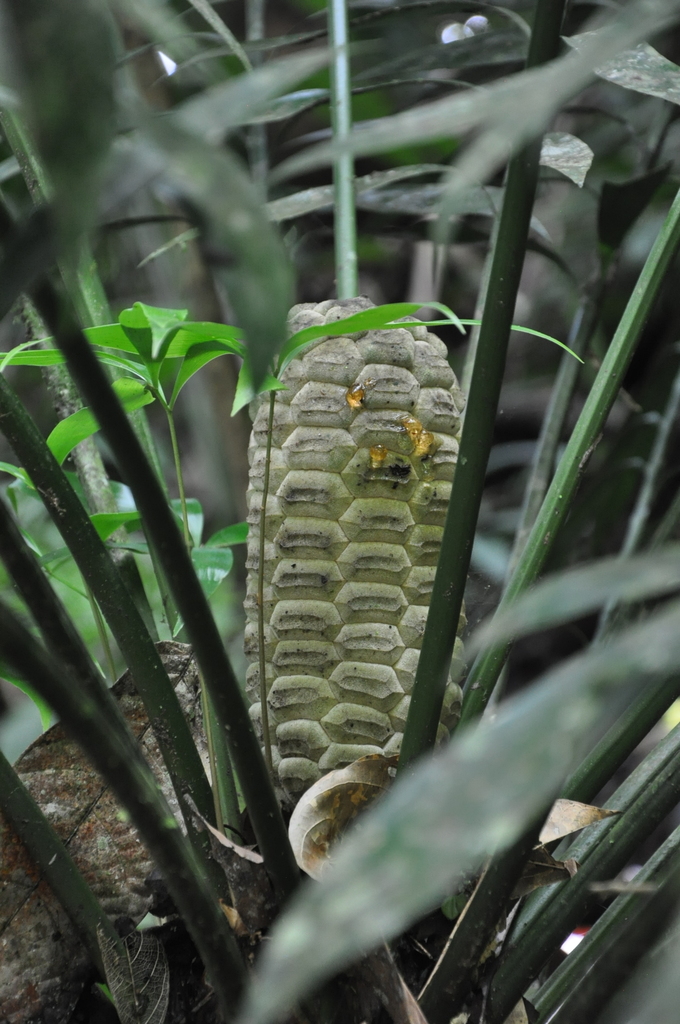
Zamia elegantissima
Zamia elegantissima is a species of cycad in the family Zamiaceae. It is found on the Atlantic Coast of Colón Province, Panama.
From the article Zamia elegantissima on Wikipedia (CC BY-SA), quoted section by section
Description
Zamia elegantissima plants are tree-like, with the trunk standing upright, and are up to 3 metres (9.8 ft) tall. There are many upright compound leaves, up to 30 on cultivated plants. The leaves are up to 170 centimetres (67 in) long. leaflets are lanceolate, 20 to 22 centimetres (7.9 to 8.7 in) long and 2.5 to 4 centimetres (0.98 to 1.57 in) wide. The outer half of leaflets are toothed, the teeth being 0.5 to 1.5 millimetres (0.020 to 0.059 in) long. Leaves are apple-green when growing, bright green and shiny when mature. petioles (leaf stalks) are 43 to 44 centimetres (17 to 17 in) long, and may have some small prickles. Emergent leaves of Z. elegantissima are bright yellow. Like all cycads, Zamia elegantissima is dioecious, with plants being either male or female. Male strobili (cones) are cylindrical and beige-yelloe to light brown in color, with green undertones. They stand upright on peduncles (stalks) that are covered with hairs. Female strobili are cylindrical with a large pointed or rounded top, and are tan to light brown with green undertones. Strobili and peduncles are covered with hairs. Seeds are 2.8 to 3 centimetres (1.1 to 1.2 in) long, 1.6 to 1.8 centimetres (0.63 to 0.71 in) wide, and bright red.
Range & habitat
Zamia elegantissima is found north of the Panama Canal in Colón Province and in the indigenous region of Guna Yala, in Panama. It is found in lowland rainforest and disturbed areas. Plants in areas with direct exposure to sunlight, along streams and in treefall gaps are more likely to have strobili (cones).
Wikipedia: “Distribution and habitat”
In human culture
Robert Louis Dressler referred in the late 1970s to the species now named Zamia elegantissima by the informal term Zamia pseudo-pseudoparasitica, but expressed an intention to name it after the botanist A. G. B. Fairchild when he had formally described the species. In 1982, another botanist named a species found in Costa Rica Z. fairchildiana, honoring David Fairchild, A. G. B.'s father. In 1993, the range of Z. fairchildiana was given as from southeastern Costa Rica to Guna Yala in eastern Panama. It was soon recognized that the population in Panama was not the species Z. fairchildiana, and there were no known populations of either species between Costa Rica and Colon. The new species in Panama was described and named Z. elegantissima in 1998 by Schutzman, Vovides, and Adams. The initial description was deemed invalid because the authors had not identified the holotype and isotype of the species. The authors corrected the defect later that year. Schutzman, Vovides, and Adams associated Zamia elegantissima with a Z. fairchildiana species group, which included several other species. In 2012, Taylor Blake and Holzman described a new species found in the area around the Panama Canal, Z. stevensonii, based on plants that had previously been confused with Z. elegantissima. A 2019 molecular genetics study using DNA and a 2024 study using transcriptomes both placed Z. …
Wikipedia: “Phylogenetic history”
Where it lives
Recorded sightings
—
geo-referenced records in GBIF, from museums, herbaria and field observers.
Drag the globe to turn it. Dots are where records exist, not a range map; darker means more records.
In the stacks
Searching the stacks…
Every page naming Zamia elegantissima in the Biodiversity Heritage Library →
This page is assembled live from iNaturalist, GBIF, Wikipedia, the Source Library and the Internet Archive. It is not yet part of the hand-edited codex. iNaturalist taxon 135564.