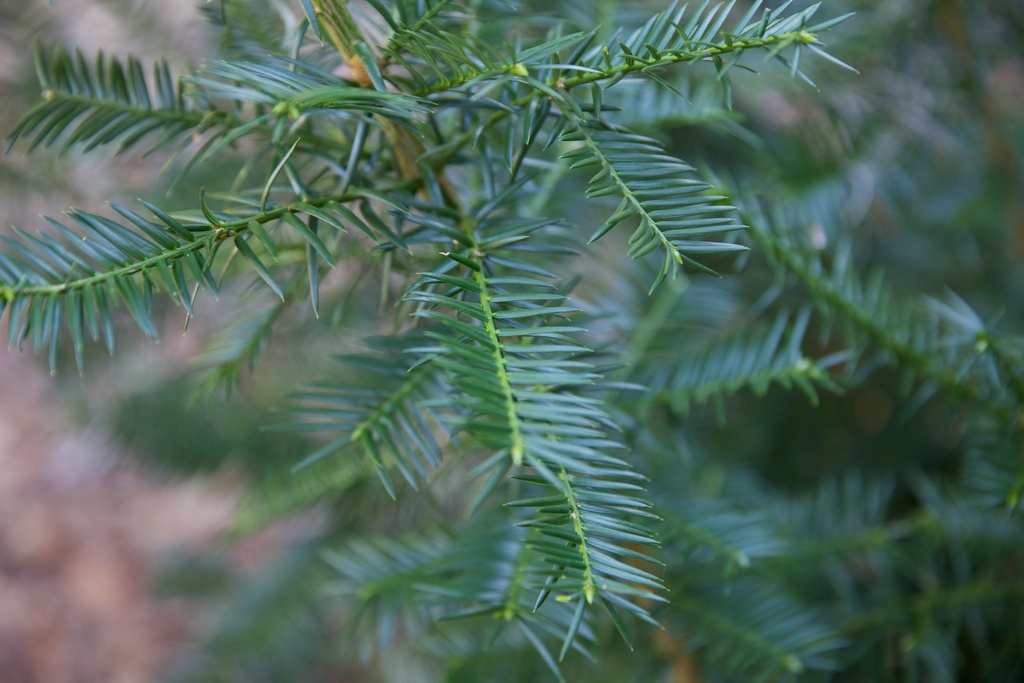
Florida torreya
Torreya taxifolia
Torreya taxifolia, commonly known as Florida torreya or stinking-cedar, but also sometimes as Florida nutmeg or gopher wood, is an endangered coniferous subcanopy tree of the yew family, Taxaceae. It is native to only a small glacial refugium in the southeastern United States, at the state border region of northern Florida and southwestern Georgia.
From the article Torreya taxifolia on Wikipedia (CC BY-SA), quoted section by section
Range & habitat
Torreya taxifolia is a member of an ancient genus at least 160 million years old. Fossil evidence indicates genus Torreya was widely distributed across the Northern Hemisphere beginning in the Jurassic period and as recently as the Pliocene. Like other globally disjunct genera of the Arcto-Tertiary Geoflora, Torreya was forced southward during the cooling of the Plio-Pleistocene epochs. In North America, the genus found refuge as numerous, but small and isolated, populations in California's coastal mountains and the west slope of the Sierras, which still constitute the native range of Torreya californica. Glacial advance was far greater on the eastern side of North America. But there, no mountains offered refuge as far south as the genus apparently needed to retreat. Hence, the only refuge that maintained Torreya through the coldest episodes of the Pleistocene yet also during the warming Holocene were ravines along the east shore of the Apalachicola River of northern Florida. Today, this location entails the entirety of the native range of Torreya taxifolia, thus making it a paleoendemic.
Each of the U.S. Fish and Wildlife Service official documents pertaining to Torreya taxifolia portrays this species as a glacial relict. …
Wikipedia: “Prehistoric distribution”
Toxicity
Globally, Torreya taxifolia has been listed as a "critically endangered" species on the IUCN Red List of Threatened Species since 1998. Determinations made by the International Union for the Conservation of Nature primarily affect international trade prohibitions. Within-habitat restrictions and commercial trade are promulgated and administered in the United States by the federal government and relevant states.
In 1984, the U.S. Fish and Wildlife Service listed Torreya taxifolia as endangered, in accordance with the Endangered Species Act of 1973, as amended prior to that time. This action was preceded by several federally sponsored overviews of plants for early consideration, and finally by a proposal to list the species, published in the Federal Register in 1983. The federal proposal included information on existing state regulations in Florida and in Georgia that offered protection for the species, and the additional protection that federal listing would provide: "Torreya taxifolia is offered protection under Florida Law, Chapter 65—426, Section 865.06 which includes prohibitions concerning taking, transport, and the selling of plants listed under that law. Torreya taxifolia is also included under Georgia's Wild Flower Preservation Act of 1973 which prohibits taking from public lands and intrastate transport and sale of certain rare plant species. …
Wikipedia: “List the species as endangered”
How it is grown
When the original recovery plan for Torreya taxifolia was produced in 1986, it was known that this species had attracted horticultural plantings over many decades — not only in Florida, but also in states outside of the historically native range. A number of such sites are listed on page 7 of the plan. Maclay State Gardens in Tallahassee, Florida, was listed as being "severely affected" by pathogens. But two horticultural sites in Georgia (Columbus and Fort Gaines) and three sites in North Carolina (Highlands, Asheville, and Norlina) "appear to be in good health." "Inventory plantings at botanical gardens and arboreta" was one of the recovery actions specified in 1986 because "Information on where the plants are, and how they are thriving, could be valuable in planning future plantings." A related action, "Supplement existing plantings" was proposed because it "could eventually lead to greater genetic diversity in the seeds produced at these sites." A tabular form of "Record of Actions" maintained by the federal agency is available online. (It can be accessed via the main listing page of Torreya taxifolia as the link titled "View implementation progress.") As of June 2024, both of the above actions are listed. …
Wikipedia: “Document early horticultural plantings”
Where it lives
Recorded sightings
—
geo-referenced records in GBIF, from museums, herbaria and field observers.
Drag the globe to turn it. Dots are where records exist, not a range map; darker means more records.
In the stacks
Searching the stacks…
Every page naming Torreya taxifolia in the Biodiversity Heritage Library →
This page is assembled live from iNaturalist, GBIF, Wikipedia, the Source Library and the Internet Archive. It is not yet part of the hand-edited codex. iNaturalist taxon 135555.