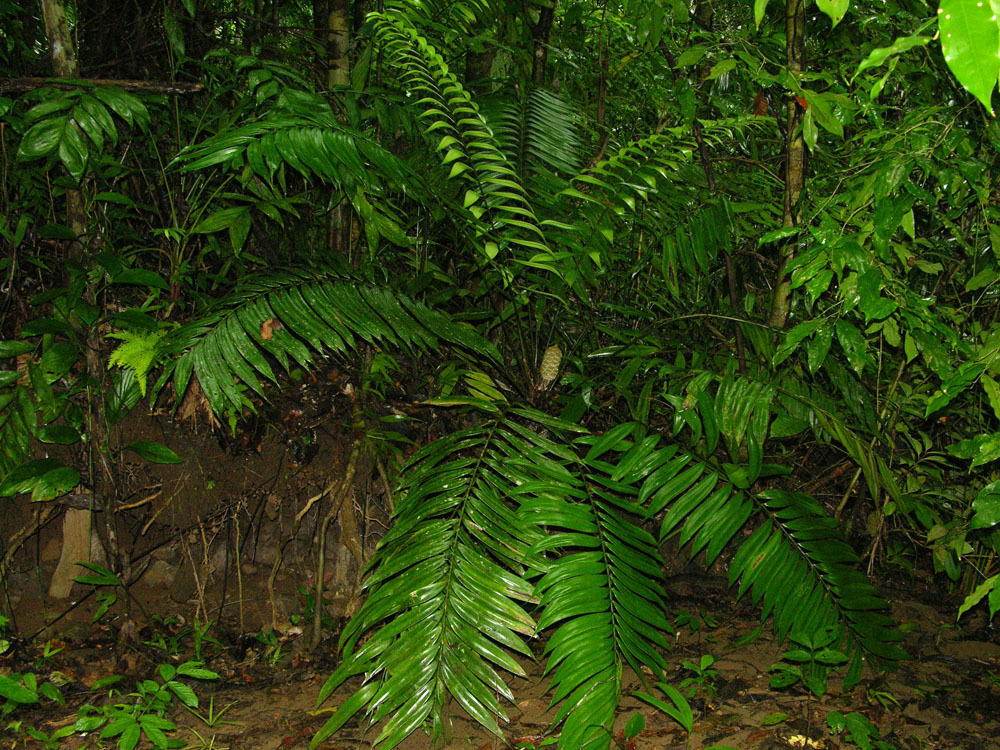
Zamia fairchildiana
Zamia fairchildiana is a species of plant in the Zamiaceae family. It is found in southeastern Costa Rica and Panama. In Costa Rica, it is found around the Sierpe River and Claro River, and on Burica Peninsula, Puntarenas Province. Its natural habitats are subtropical or tropical moist lowland forests and subtropical or tropical moist montane forests. It is threatened by habitat loss.
From the article Zamia fairchildiana on Wikipedia (CC BY-SA), quoted section by section
Description
The stem of Zamia fairchildiana is erect (tree-like), 0.5 to 1 metre (1 ft 8 in to 3 ft 3 in) tall, and 6 to 15 centimetres (2.4 to 5.9 in) in diameter. It has three to ten compound-leaves on the apex of the stem. Leaves are 0.7 to 2 metres (2 ft 4 in to 6 ft 7 in) (exceptionally 2.5 metres (8 ft 2 in)) long. Petioles (leaf stalks) are 0.3 to 0.5 metres (1 ft 0 in to 1 ft 8 in) (exceptionally 0.8 metres (2 ft 7 in)) long and densely covered with prickles. The lower third of the rachis (leaf mid-rib) also has prickles. There are 10 to 30 pairs of leaflets on a leaf. The leaflets are oblong, somewhat sickle shaped, with acute points, and have a few fine teeth near the tip of the leaflet. Like all cycads, Zamia fairchildiana is dioecious, with individual plants being either male or female. Male strobili (cones) are cylindrical, 10 to 40 centimetres (3.9 to 15.7 in) long and 2 to 5 centimetres (0.79 to 1.97 in) in diameter, and cream to yellow in color. Female strobili are cylindrical, 20 to 30 centimetres (7.9 to 11.8 in) long and 6 to 10 centimetres (2.4 to 3.9 in) in diameter, and yellow-green to light brown in color. Seeds are ovoid, 1 to 1.5 centimetres (0.39 to 0.59 in) long, and red in color.
Range & habitat
The type site for Zamia fairchildiana is in Costa Rica, It is reported to be abundant around the Golfo Duce in Puntarenas Province on the southern Pacific coast of Costa Rica. A small population of Zamia fairchildiana is in Chiriquí Province in Panama. It is found in rainforests with about 5,000 millimetres (200 in) of average annual rainfall.
Wikipedia: “Distribution and habitat”
What it does
Unlike some species of Zamia, most Zamia fairchildiana plants produce reproductive cones even when growing in shade. Ripe seeds are visible in Z. fairchildiana female cones before the cones start breaking down, in contrast to seeds of Z. elegantissima, which are not visible until cones do break down.
Wikipedia: “Reproduction”
In human culture
The epithet fairchildiana, refers to either the botanist David Fairchild, or his son, the entomologist A. G. B. "Sandy" Fairchild.
Wikipedia: “Etymology”
Where it lives
Recorded sightings
—
geo-referenced records in GBIF, from museums, herbaria and field observers.
Drag the globe to turn it. Dots are where records exist, not a range map; darker means more records.
In the stacks
Searching the stacks…
Every page naming Zamia fairchildiana in the Biodiversity Heritage Library →
This page is assembled live from iNaturalist, GBIF, Wikipedia, the Source Library and the Internet Archive. It is not yet part of the hand-edited codex. iNaturalist taxon 135535.