- Plants
- ›Vascular Plants
- ›flowering plants
- ›Dicots
- ›Mints, Plantains, Olives, and Allies
- ›olive family
- ›Jasminum
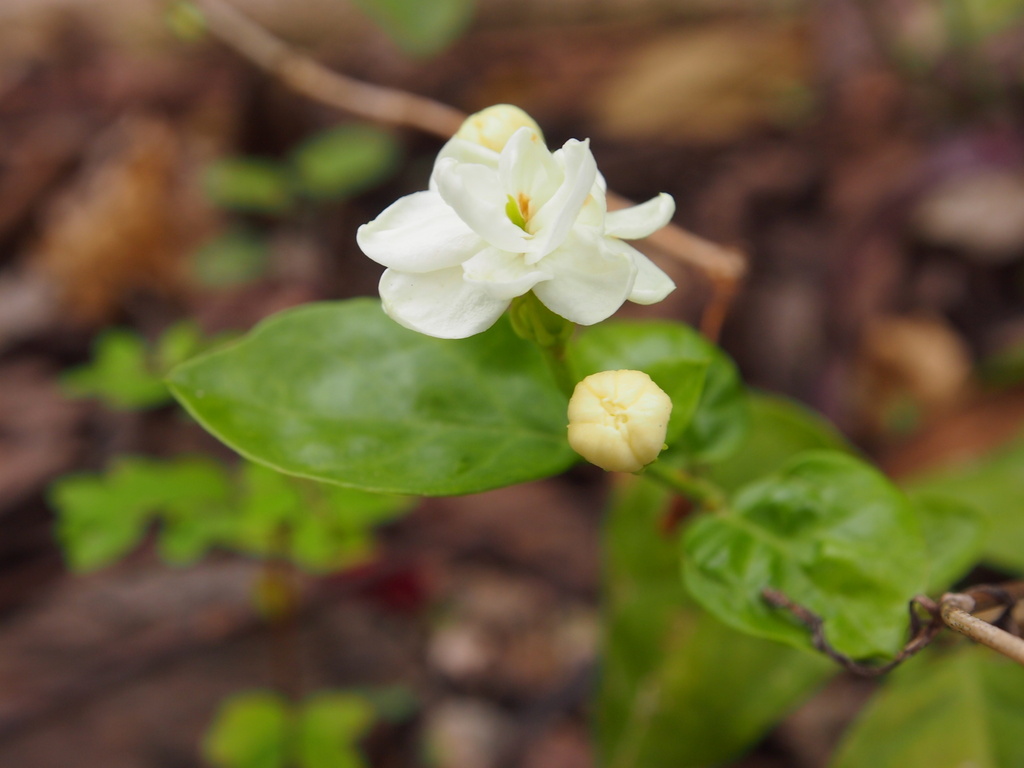
Arabian Jasmine
Jasminum sambac
Jasminum sambac (Arabian jasmine or Sambac jasmine or Mogra) is a species of jasmine native to Bhutan and India. It is cultivated in many places, especially West Asia, South Asia and Southeast Asia. It is naturalised in many scattered locales: Mauritius, Madagascar, the Maldives, Christmas Island, Chiapas, Central America, southern Florida, the Bahamas, Cuba, Hispaniola, Jamaica, Puerto Rico, and the Lesser Antilles.
Jasminum sambac is a small shrub or vine growing up to 0.5 to 3 m (1.6 to 9.8 ft) in height. It is widely cultivated for its attractive and sweetly fragrant flowers. The flowers may be used as a fragrant ingredient in perfumes and jasmine tea. It is the national flower of the Philippines, where it is known as sampaguita, as well as being one of the three national flowers of Indonesia, where it is known as melati putih.
From the article Jasminum sambac on Wikipedia (CC BY-SA), quoted section by section
Description
Jasminum sambac is an evergreen vine or shrub reaching up to 0.5 to 3 m (1.6 to 9.8 ft) tall. The species is highly variable, possibly a result of spontaneous mutation, natural hybridization, and autopolyploidy. Cultivated Jasminum sambac generally do not bear seeds and the plant is reproduced solely by cuttings, layering, marcotting, and other methods of asexual propagation. The leaves are ovate, 4 to 12.5 cm (1.6 to 4.9 in) long and 2 to 7.5 cm (0.79 to 2.95 in) wide. The phyllotaxy is opposite or in whorls of three, simple (not pinnate, like most other jasmines). They are smooth (glabrous) except for a few hairs at the venation on the base of the leaf. The flowers bloom all throughout the year and are produced in clusters of 3 to 12 together at the ends of branches. They are strongly scented, with a white corolla 2 to 3 cm (0.79 to 1.18 in) in diameter with 5 to 9 lobes. The flowers open at night (usually around 6 to 8 in the evening), and close in the morning, a span of 12 to 20 hours. The fruit is a purple to black berry 1 cm (0.39 in) in diameter.
How it is grown
The sweet, heady fragrance of Jasminum sambac is its distinct feature. It is widely grown throughout the tropics from the Arabian Peninsula to Southeast Asia and the Pacific Islands as an ornamental plant and for its strongly scented flowers. Numerous cultivars currently exist. Typically, the flowers are harvested as buds during early morning. The flower buds are harvested on basis of color, as firmness and size are variable depending on the weather. The buds have to be white, as green ones may not emit the characteristic fragrance they are known for. Open flowers are generally not harvested as a larger amount of them is needed to extract oils and they lose their fragrance sooner. J. sambac does not tolerate being frozen, so in temperate regions must be grown under glass, in an unheated greenhouse or conservatory. It has an intense fragrance which some people may find overpowering. In the UK this plant has gained the Royal Horticultural Society's Award of Garden Merit.
Cultivars. There are numerous cultivars of Jasminum sambac which differ from each other by the shape of leaves and the structure of the corolla. The cultivars recognized include:
'Maid of Orleans' – possesses flowers with a single layer of five or more oval shaped petals. It is the variety most commonly referred to as sampaguita and pikake. …
Wikipedia: “Cultivation”
Where it lives
Recorded sightings
—
geo-referenced records in GBIF, from museums, herbaria and field observers.
Drag the globe to turn it. Dots are where records exist, not a range map; darker means more records.
In the old herbals & bestiaries


In the stacks
Searching the stacks…
Every page naming Jasminum sambac in the Biodiversity Heritage Library →
This page is assembled live from iNaturalist, GBIF, Wikipedia, the Source Library and the Internet Archive. It is not yet part of the hand-edited codex. iNaturalist taxon 135425.