- Plants
- ›Vascular Plants
- ›flowering plants
- ›Dicots
- ›saxifrages, stonecrops, and allies
- ›sweetgum family
- ›Liquidambar
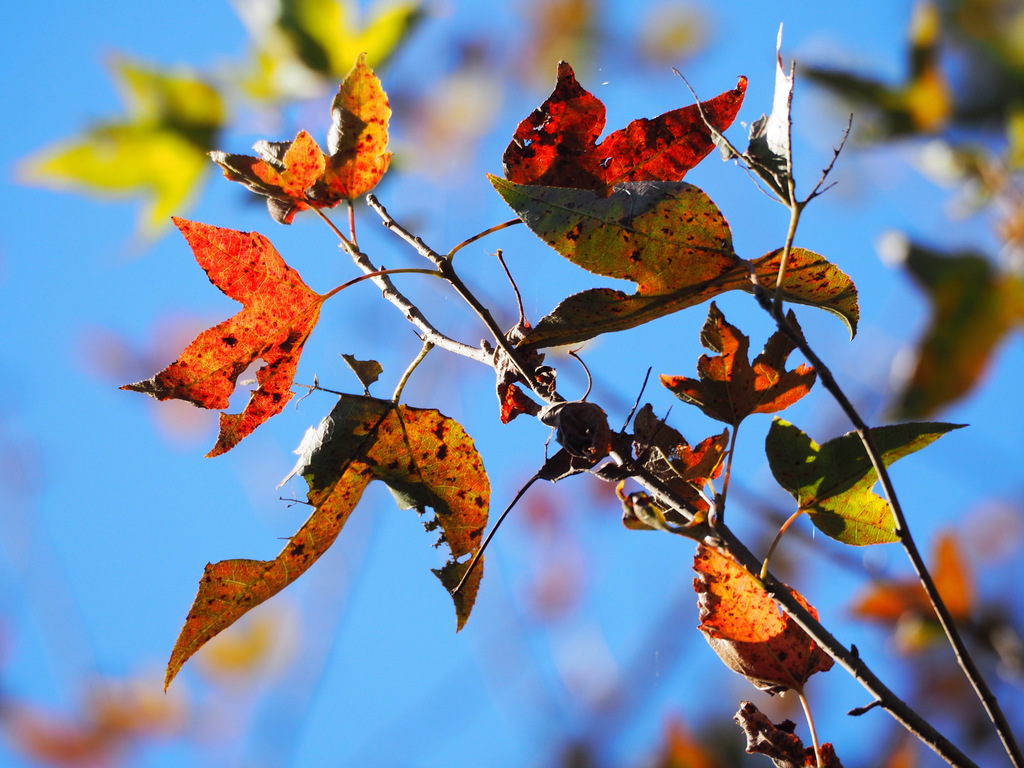
Chinese Sweetgum
Liquidambar formosana
Liquidambar formosana, commonly known as the Formosan gum, Chinese sweet gum and Formosa sweet gum, is a species of tree in the family Altingiaceae native to East and Southeast Asia.
From the article Liquidambar formosana on Wikipedia (CC BY-SA), quoted section by section
Description
Liquidambar formosana is a large deciduous tree that grows up to 30-40m tall. The leaves are 10~15 cm wide, and are three-lobed unlike five- to seven-lobed leaves of most American Liquidambar species. The foliage of the L. formosana turns a very attractive red color in autumn. Leaves grow in an alternate arrangement, and are simple, palmately-veined, with serrated margins. Roots can be aggressive and branches are usually covered with corky projections. The individual flowers of L. formosana are unisexual. However, both sexes can be found in the same plant (monoecious). Male flowers are in catkins, female flowers form dense spherical heads, and the fruit is burr-like because of the persistent styles.
Range & habitat
Liquidambar formosana grows mostly in woodland in warm temperate zones. It requires moist soil and can grow in light to no shade areas. It is found in Hong Kong, Central and Southern China, South Korea, Taiwan, Laos and Vietnam.
Wikipedia: “Distribution and habitat”
At the table
Liquidambar formosana is rare in cultivation but in its native regions the wood is used for making tea chests and the leaves to feed silk worms.
Wikipedia: “Other uses”
In medicine
Liquidambar formosana has many medicinal uses. The leaves and roots are used in the treatment of cancerous growths. The stem bark is used in the treatment of fluxes and skin diseases. The fruits used in the treatment of arthritis, lumbago, oedema, oliguria, and decreased milk production and skin diseases. The resin from the stems is used to treat bleeding boils, carbuncles, toothache and tuberculosis. The trunk of this tree can be used for aromatic resin. The extract of this resin is used to promote blood circulation and relieve pain.
Wikipedia: “Medicinal”
Where it lives
Recorded sightings
—
geo-referenced records in GBIF, from museums, herbaria and field observers.
Drag the globe to turn it. Dots are where records exist, not a range map; darker means more records.
In the old herbals & bestiaries

In the stacks
Searching the stacks…
Every page naming Liquidambar formosana in the Biodiversity Heritage Library →
This page is assembled live from iNaturalist, GBIF, Wikipedia, the Source Library and the Internet Archive. It is not yet part of the hand-edited codex. iNaturalist taxon 135413.