- Plants
- ›Vascular Plants
- ›flowering plants
- ›Dicots
- ›proteas, lotuses, planes, and allies
- ›Protea family
- ›Paired Proteas
- ›Banksieae
- ›Banksiinae
- ›Banksia
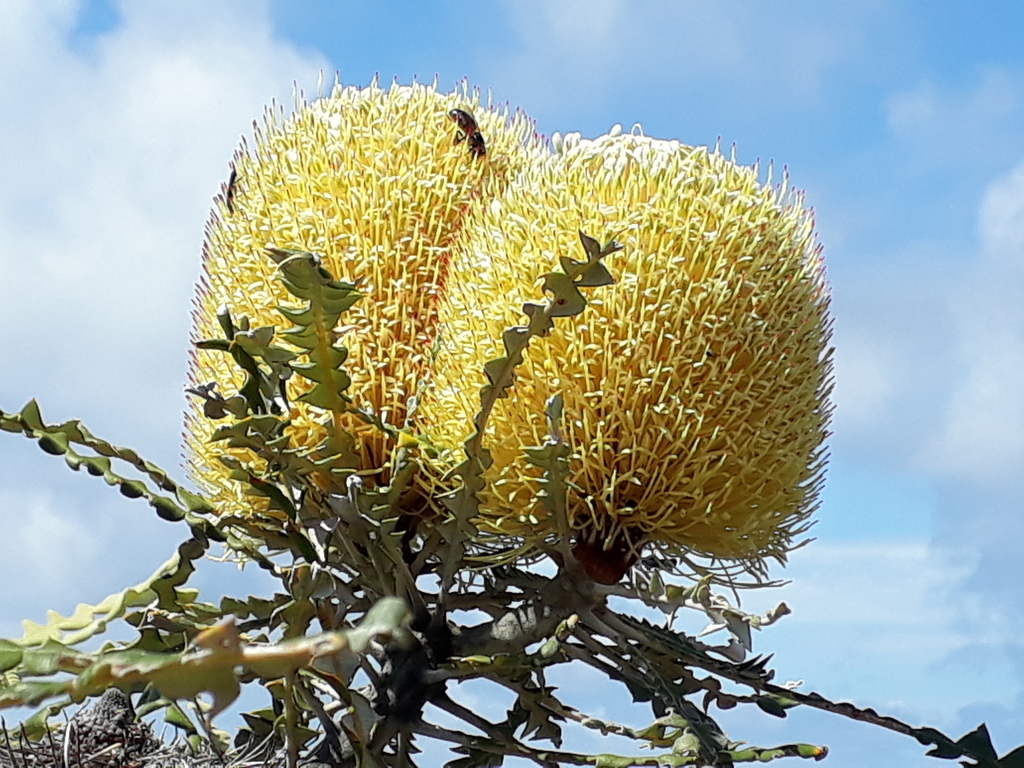
Showy Banksia
Banksia speciosa
Banksia speciosa, commonly known as the showy banksia, is a species of large shrub or small tree in the family Proteaceae. It is found on the south coast of Western Australia between Hopetoun (34° S 120° E) and Point Culver (33° S 124° E), growing on white or grey sand in shrubland. Reaching up to 8 m (26 ft) in height, it is a single-stemmed plant that has thin leaves with prominent triangular 'teeth' along each margin, which are 20–45 cm (7.9–17.7 in) long and 2–4 cm (0.8–1.6 in) wide. The prominent cream-yellow flower spikes known as inflorescences appear throughout the year. As they age they develop up to 20 follicles each that store seeds until opened by fire. Though widely occurring, the species is highly sensitive to dieback and large populations of plants have succumbed to the disease.
Collected and described by Robert Brown in the early 19th century, B. speciosa is classified in the series Banksia within the genus. Its closest relative is B. baxteri. B. speciosa plants are killed by bushfire, and regenerate from seed. The flowers attract nectar- and insect-feeding birds, particularly honeyeaters, and a variety of insects. In cultivation, B. speciosa grows well in a sunny location on well-drained soil in areas with dry summers. It cannot be grown in areas with humid summers, though it has been grafted onto Banksia serrata or B. integrifolia.
From the article Banksia speciosa on Wikipedia (CC BY-SA), quoted section by section
Description
B. speciosa grows as a shrub or small tree anywhere from 1 to 6 or rarely 8 m (4–26 ft) high. It has an open many-branched habit, arising from a single stem or trunk with smooth grey bark. Unlike many banksias, it does not have a lignotuber. The plant puts on new growth, which is covered in rusty-coloured fur, in summer. The long thin leaves are linear, 20–45 cm (8–17.5 in) long and 2–4 cm (0.8–1.6 in) wide. They are bordered with 20 to 42 prominent triangular lobes that have a zigzag pattern. The lobes are 1–2 cm (0.4–0.8 in) long and 1–2.5 cm (0.4–1.0 in) wide, while the V-shaped sinuses between intrude almost to the midrib of the leaf. The leaf margins are slightly recurved. On the underside of each lobe, there are 3–10 nerves converging on the lobe apex. The midrib is raised on the leaf undersurface; it is covered with white hair when new but brownish hair when mature. The cream to yellow flower spikes, known as inflorescences, can appear at any time of year. They arise on the ends of one- or two-year-old stems and are roughly cylindrical in shape with a domed apex, measuring 4–12 cm (1.6–4.7 in) high and 9–10 cm (3.5–3.9 in) wide at anthesis. Each is a compound flowering structure, with a large number of individual flowers arising out of a central woody axis. A field study on the southern sandplains revealed an average count of 1369±79 on each spike. …
Range & habitat
B. speciosa occurs on coastal dunes and sandplains in the Esperance Plains and Mallee biogeographic regions on the south coast of Western Australia, from East Mount Barren in the Fitzgerald River National Park and the vicinity of Hopetoun eastwards to Israelite Bay, generally within 50 km (30 mi) of the coast. The range extends inland to Mount Ragged and 25 km (16 mi) southwest of Grass Patch. There is an outlying population to the east at Point Culver on the Great Australian Bight. B. speciosa grows on flat or gently sloping ground on deep white or grey sand. It is often the dominant shrub in shrubland, commonly found with such species as Lambertia inermis, Banksia pulchella, and B. petiolaris.
Wikipedia: “Distribution and habitat”
What it does
The prominent flower spikes are visited by many birds and insects. Honeyeaters are common visitors, particularly the New Holland honeyeater, as well as the fuscous honeyeater, western wattlebird and western spinebill. Other birds recorded foraging include the grey butcherbird and species of thornbill. Insects recorded include ants, bees, wasps, butterflies, moths, flies and beetles. The short-billed black cockatoo breaks off old cones with follicles to eat the seed, often doing so before the seed is ripe. B. speciosa is serotinous, that is, it has an aerial seed bank in its canopy in the form of the follicles of the old flower spikes. These are opened by fire and release seed in large numbers, which germinate and grow after rain. Seed can last for many years; old spikes 11 to 12 years old have been found to have 50% viable seed. Flower spikes appear to have similar numbers of follicles regardless of the age of the parent plant. Young plants begin flowering three years after regenerating from bushfire and store progressively larger numbers of old flowerheads (and hence seed) in the canopy. In one study, decade-old plants averaged around 3.5 old cones, whereas 21-year-old plants had 105, and were calculated as having over 900 viable seeds per plant. Plants appear to have a life span of at least 40 years, as healthy and vigorous individuals of this age are known. …
Wikipedia: “Ecology”
How it is grown
A fast-growing and attractive plant, B. speciosa grows readily in a sunny location in dry climates on well-drained soil, but does poorly in areas of humid summer climate, such as Australia's east coast. It has been grafted successfully onto Banksia serrata and B. integrifolia to enable cultivation in these areas. Seeds do not require any treatment, and take 27 to 41 days to germinate. A specimen flowered in a greenhouse in the Royal Botanic Garden Edinburgh in 1830. B. speciosa is an important cut flower crop. It was one of several species considered for commercial cropping in Tenerife, and trials showed that seedlings were moderately tolerant to salinity.
Wikipedia: “Cultivation”
Where it lives
Recorded sightings
—
geo-referenced records in GBIF, from museums, herbaria and field observers.
Drag the globe to turn it. Dots are where records exist, not a range map; darker means more records.
In the stacks
Searching the stacks…
Every page naming Banksia speciosa in the Biodiversity Heritage Library →
This page is assembled live from iNaturalist, GBIF, Wikipedia, the Source Library and the Internet Archive. It is not yet part of the hand-edited codex. iNaturalist taxon 135368.