- Plants
- ›Vascular Plants
- ›flowering plants
- ›monocots
- ›Agaves, Orchids, Irises, and Allies
- ›Aloe family
- ›Grasstrees
- ›Xanthorrhoea
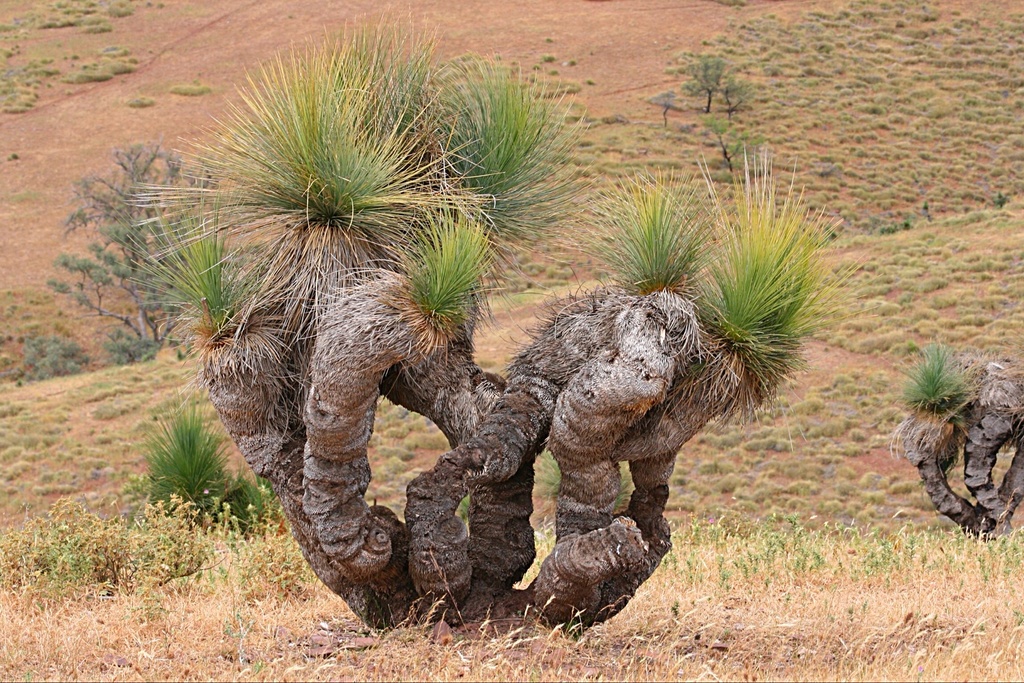
Yacka
Xanthorrhoea quadrangulata
Xanthorrhoea quadrangulata or the Mount Lofty grass tree is a plant in the genus Xanthorrhoea. It is the only species of Xanthorrhoea solely endemic to the state of South Australia.
From the article Xanthorrhoea quadrangulata on Wikipedia (CC BY-SA), quoted section by section
Description
A very slow growing plant with a thick rough trunk and blue-green foliage. In the wild, this trunk is often burnt black as a result of fire. The trunks are capable of reaching 2 m length or greater, and are frequently branched. Typical of the trunked species of Xanthorrhoea, this species is extremely slow growing, increasing in height by only 2–3 cm per year on average. Blooms occur irregularly from winter to spring, producing flower spikes between 1 and 3 m in height. These spikes bear small, nectar rich flowers, and are a source of food for nectar eating birds and butterflies.
Range & habitat
This plant occurs broadly occurs throughout the Mount Lofty Ranges, with its range extending into the Flinders Ranges. It frequently inhabits rocky sites and ridges, and is particularly tolerant of clay soil.
Wikipedia: “Distribution”
Where it lives
Recorded sightings
—
geo-referenced records in GBIF, from museums, herbaria and field observers.
Drag the globe to turn it. Dots are where records exist, not a range map; darker means more records.
In the stacks
Searching the stacks…
Every page naming Xanthorrhoea quadrangulata in the Biodiversity Heritage Library →
This page is assembled live from iNaturalist, GBIF, Wikipedia, the Source Library and the Internet Archive. It is not yet part of the hand-edited codex. iNaturalist taxon 135328.