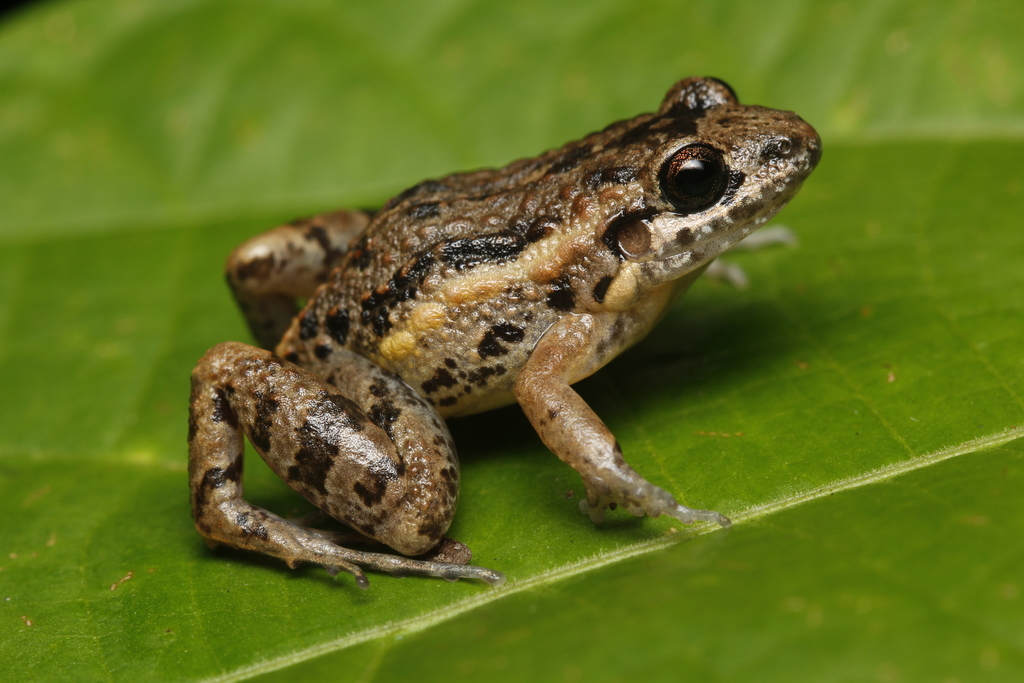
Forest Chirping Frog
Adenomera hylaedactyla
Adenomera hylaedactyla is a species of frog in the family Leptodactylidae. It is found in Argentina, Bolivia, Brazil, Colombia, Ecuador, French Guiana, Guyana, Paraguay, Peru, Suriname, Trinidad and Tobago, and Venezuela. Its natural habitats are subtropical or tropical moist lowland forests, subtropical or tropical dry lowland grassland, rivers, swamps, intermittent freshwater marshes, pastureland, rural gardens, heavily degraded former forest, and canals and ditches.
From the article Adenomera hylaedactyla on Wikipedia (CC BY-SA), quoted section by section
Description
This frog is small. The adult male measures 22-24 mm long in snout-vent length and the adult female frog 26-27 mm. The skin of the dorsum is brown in color with many dark marks. There are two distinct folds of skin on each side of the body. The belly and throat are white in color. The lower parts and fronts of the back legs are yellowish in color. The iris of the eye is bronze in color.
Range & habitat
This terrestrial frog is found in open areas, such as next to rivers and agricultural clearings. Mostly, it is associated with primary and secondary forest. Scientists have seen it between 0 and 1,000 m (0 and 3,281 ft) meters above sea level. Scientists have seen these frogs in protected places.
Wikipedia: “Habitat”
What it does
The female frog desposits her eggs in a foam nest underground. The tadpoles develop in the nest, feeding solely from the yolk sac.
Wikipedia: “Reproduction”
Listen
Looking for field recordings…
Where it lives
Recorded sightings
—
geo-referenced records in GBIF, from museums, herbaria and field observers.
Drag the globe to turn it. Dots are where records exist, not a range map; darker means more records.
In the stacks
Searching the stacks…
Every page naming Adenomera hylaedactyla in the Biodiversity Heritage Library →
This page is assembled live from iNaturalist, GBIF, Wikipedia, the Source Library and the Internet Archive. It is not yet part of the hand-edited codex. iNaturalist taxon 135018.