- Animals
- ›Chordates
- ›Vertebrates
- ›Amphibians
- ›Salamanders
- ›Lungless Salamanders
- ›Hemidactyliine Salamanders
- ›Oedipina
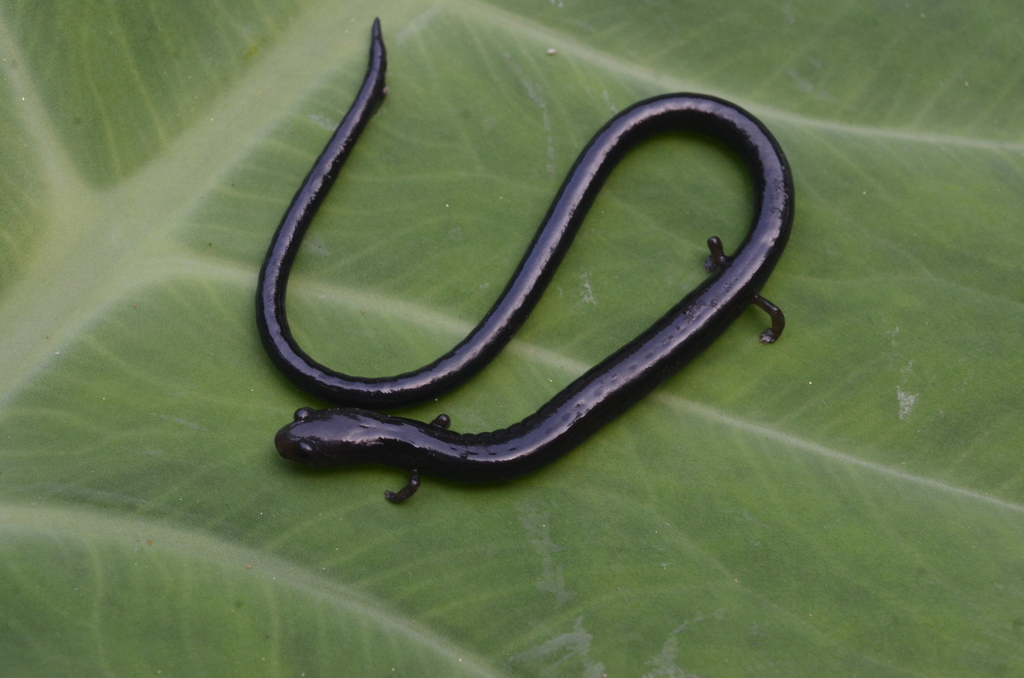
Pico Bonito Worm Salamander
Oedipina petiola
Oedipina petiola is a species of salamander endemic to Honduras. It is only known from a single specimen, hasn't been seen since 1995, and is possibly extinct.
From the article Oedipina petiola on Wikipedia (CC BY-SA), quoted section by section
Description
Oedipina petiola is a moderately sized member of its genus, with the holotype being 42 cm long. Its dorsal side is jet black in coloration, while its ventral side is slightly paler. It is distinguished from closely related species by its lack of pale markings on its head, its smaller number of coastal grooves, and its characteristic small, narrow feet.
Range & habitat
The species is known only from its type locality, Pico Bonito National Park in Honduras. It is believed to be endemic to the park. The single known specimen was collected from under a log in a primary broadleaf cloud forest.
Wikipedia: “Habitat and distribution”
In human culture
The only known specimen of Oedipina petiola was collected on February 18, 1995. Multiple amphibian surveys at the site since them have failed to find any more specimens and in 2019, the IUCN listed it as Critically Endangered and possibly extinct. It is believed to be threatened by disease, and habitat loss. Research has shown that the cloud forests these salamanders inhabit are at an increased risk of being negatively impacted by climate change. Additionally, their type locality is known to be susceptible to landslides.
== References ==
Wikipedia: “History and conservation”
Listen
Looking for field recordings…
Where it lives
Recorded sightings
—
geo-referenced records in GBIF, from museums, herbaria and field observers.
Drag the globe to turn it. Dots are where records exist, not a range map; darker means more records.
In the stacks
Searching the stacks…
Every page naming Oedipina petiola in the Biodiversity Heritage Library →
This page is assembled live from iNaturalist, GBIF, Wikipedia, the Source Library and the Internet Archive. It is not yet part of the hand-edited codex. iNaturalist taxon 134767.