- Animals
- ›Chordates
- ›Vertebrates
- ›Amphibians
- ›Salamanders
- ›Lungless Salamanders
- ›Hemidactyliine Salamanders
- ›Ixalotriton
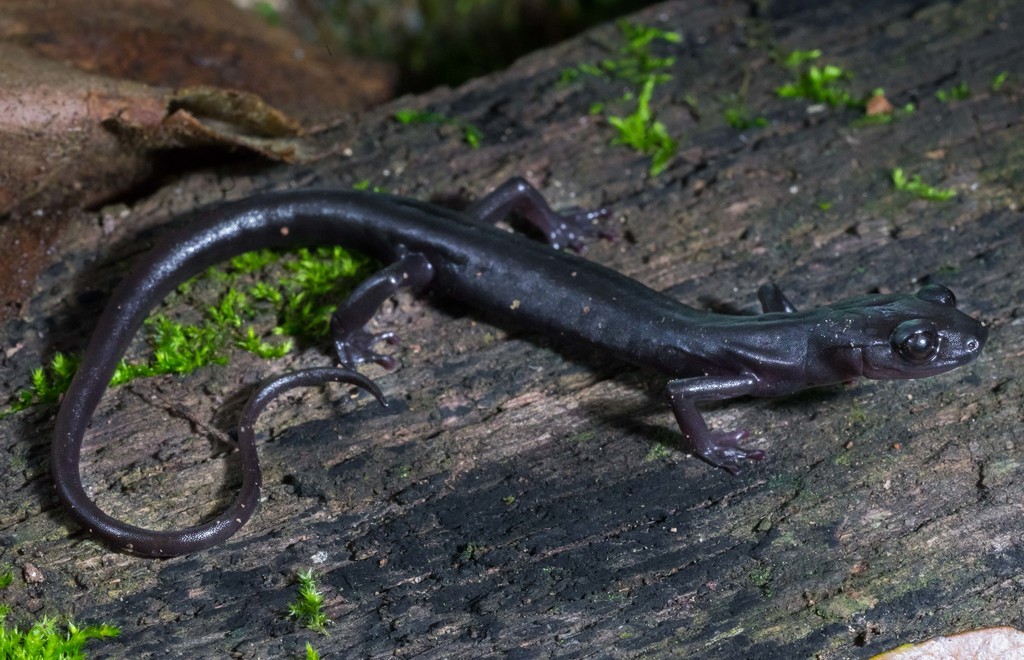
Black Jumping Salamander
Ixalotriton niger
Ixalotriton niger, the black jumping salamander, is a species of salamander in the family Plethodontidae. It is endemic to Mexico. Its natural habitats are subtropical or tropical moist montane forests and rocky areas and it is threatened by habitat loss.
From the article Ixalotriton niger on Wikipedia (CC BY-SA), quoted section by section
Description
Ixalotriton niger is a long, slender salamander with a wide head, protuberant eyes, long limbs, large hands and feet and a long, gradually tapering tail. It grows to a total length of nearly 6 centimetres (2.4 in) and is a glossy black colour. At night it changes to a chocolate brown colour. The snout may have a small white patch and the tips or the toes are red, perhaps because of an absence of pigment allowing the vascular tissue below to show through.
Range & habitat
Ixalotriton niger is found at about 1,100 metres (3,600 ft) above sea level on the Atlantic side of the Northern Highland Mountains in Chiapas State in south west Mexico. The area where it is endemic is composed of fissured limestone crags clothed in an evergreen forest rich in epiphytes including mosses, ferns, bromeliads, philodendrons and orchids.
Wikipedia: “Distribution and habitat”
What it does
Ixalotriton niger is an arboreal species that was first described in 1989. It is an elusive species and scrambles around on the trunks of trees and is capable of jumping in a lizard-like manner when disturbed. It readily autotomizes its tail to escape predators and can also produce a noxious sticky secretion from glands. There is no aquatic larval stage and the young develop directly inside the egg.
Wikipedia: “Behaviour”
Listen
Looking for field recordings…
Where it lives
Recorded sightings
—
geo-referenced records in GBIF, from museums, herbaria and field observers.
Drag the globe to turn it. Dots are where records exist, not a range map; darker means more records.
In the stacks
Searching the stacks…
Every page naming Ixalotriton niger in the Biodiversity Heritage Library →
This page is assembled live from iNaturalist, GBIF, Wikipedia, the Source Library and the Internet Archive. It is not yet part of the hand-edited codex. iNaturalist taxon 134371.