- Plants
- ›Vascular Plants
- ›flowering plants
- ›Dicots
- ›Soapberries, Cashews, Mahoganies, and Allies
- ›soapberry family
- ›Koelreuteria
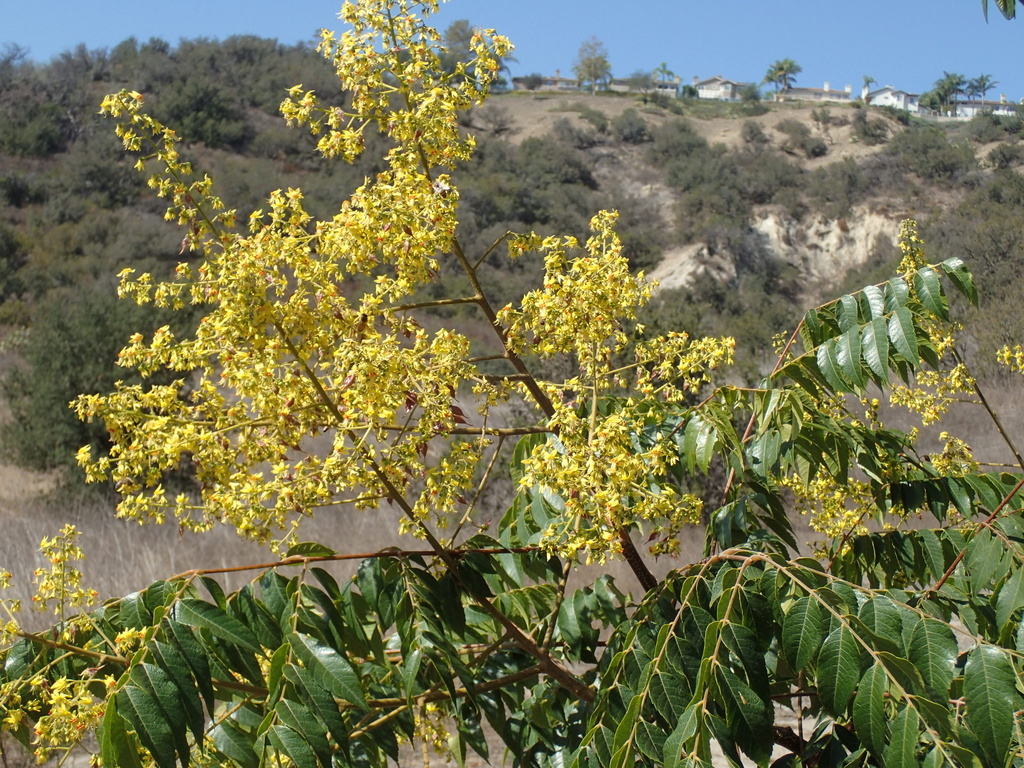
Chinese flame tree
Koelreuteria bipinnata
Koelreuteria bipinnata, also known as (Chinese flame tree, Chinese golden rain tree, Bougainvillea golden-rain tree) is a species of Koelreuteria native to Asia, particularly to China. It is a small to medium-sized deciduous tree growing between 10–20 meters tall. They are also one of the few trees that bloom in the summer. They can live from 50 to 150 years.
From the article Koelreuteria bipinnata on Wikipedia (CC BY-SA), quoted section by section
Description
The leaves are alternate, bipinnately compound leaves; with an ovate shape and a pinnate venation, they have a green color which turns yellow in fall, leavelets measuring between 5–10 cm long. The flowers are small and yellow with a touch of red at the base, with four petals, produced in large branched panicles that are 20–50 cm long. They are showy and have a pleasant fragrance. They flower in the summer from July to August, more northerly, in middle Europe, in September. Flowers are hermaphroditic, having both male and female organs. The fruit is a three-lobed inflated papery capsule that is 3–6 cm long, of a faint reddish colour, showy, containing several hard, nut-like seeds which are 5–10 mm in diameter with a pink color. The bark is thin and brown. Branches are upright growing, bend down somewhat as the tree grows, they might break due to poor collar formation, pruning is required to build a strong branching structure and a single stem, if wished, and also for the pedestrians and vehicles clearance if necessary. The tree is characterized as a weak wooded tree.
Range & habitat
The tree is native to Southern China; its discovery is credited to Delavay who collected it in Yunnan in 1886.
Wikipedia: “Distribution”
At the table
Koelreuteria bipinnata is commonly used as a focal point in landscape design in regions where they thrive; it is often used as a tree at street, highways, parking lots, for shade, garden or specimen tree. The seeds are used as beads in necklaces and the flowers can yield a yellow dye.
Wikipedia: “Uses”
Where it lives
Recorded sightings
—
geo-referenced records in GBIF, from museums, herbaria and field observers.
Drag the globe to turn it. Dots are where records exist, not a range map; darker means more records.
In the stacks
Searching the stacks…
Every page naming Koelreuteria bipinnata in the Biodiversity Heritage Library →
This page is assembled live from iNaturalist, GBIF, Wikipedia, the Source Library and the Internet Archive. It is not yet part of the hand-edited codex. iNaturalist taxon 133608.