- Plants
- ›Vascular Plants
- ›flowering plants
- ›Dicots
- ›Heathers, Balsams, Primroses, and Allies
- ›heath family
- ›typical heathers, azaleas, and allies
- ›Rhodoreae
- ›Rhododendron
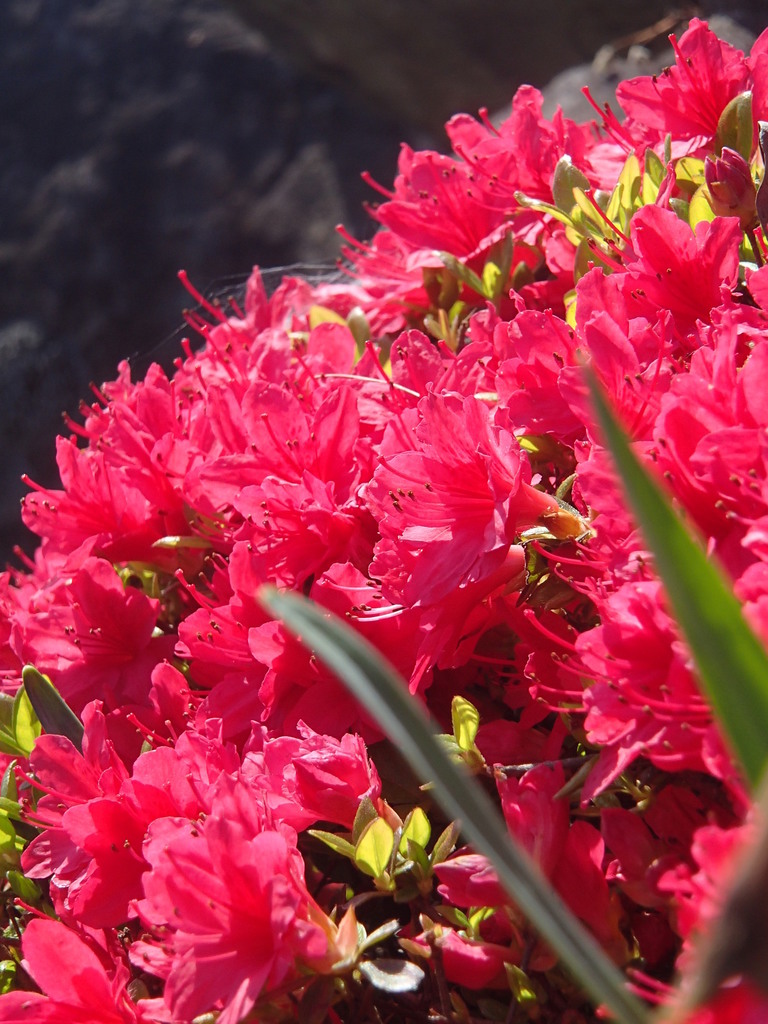
Kurume Azalea
Rhododendron obtusum
Rhododendron ponticum, called common rhododendron or pontic rhododendron, is a species of flowering plant in the Rhododendron genus of the heath family Ericaceae. It is native to the Iberian Peninsula in southwest Europe and the Caucasus region in northern West Asia.
From the article Rhododendron ponticum on Wikipedia (CC BY-SA), quoted section by section
Description
R. ponticum is a dense, suckering shrub or small tree growing to 5 m (16 ft) tall, rarely 8 m (26 ft). The leaves are evergreen, 6 to 18 cm (2.4 to 7.1 in) long and 2 to 5 cm (0.79 to 1.97 in) wide. The flowers are 3.5 to 5 cm (1.4 to 2.0 in) in diameter, violet-purple, often with small greenish-yellow spots or streaks. The fruit is a dry capsule 1.5 to 2.5 cm (0.59 to 0.98 in) long, containing numerous small seeds. It has two subspecies:
And a variegated variety:
R. p. var. heterophyllum R. Ansin – Found in Turkey.
Range & habitat
The species has two disjunct populations, one in the southwestern Iberian Peninsula (central and southern Portugal and southwestern Spain) and the other near the southern Black Sea Basin (eastern Bulgaria, northern Turkey, Georgia, and Northern Caucasus). It has also been introduced to Madeira, Myanmar, Belgium, the British Isles, Netherlands and France. In the Iberian Peninsula, the range is limited to the montane environments of the Caramulo mountains, the Monchique range and the Aljibe range. These are remnants of the original laurissilva forests that covered the peninsula 66 million years ago. Though the common rhododendron was present in Great Britain prior to the most recent ice age, it did not recolonise afterwards, meaning that the modern ecology of the island developed without it. Its presence today in Great Britain is due to human introduction, and it can easily become established and cause problems in some situations, often smothering entire hillsides (especially in Snowdonia and western Scotland). In the British Isles, it colonises moorlands, uplands and shady woodlands (alongside escaped laurels and the native holly), as well as areas with acidic soils.
Historical range. …
Wikipedia: “Distribution and habitat”
At the table
Rhododendron ponticum subsp. baeticum is one of the most extensively cultivated rhododendrons in western and central Europe. It is used as an ornamental plant in its own right and, more frequently, as a rootstock onto which other more attractive rhododendrons are grafted. The plants were first cultivated in Britain in the 1760s, supplied by Conrad Loddiges, and became widely distributed through the commercial nursery trade in the late 18th and early 19th centuries. The roots readily produce suckers below the graft, which can sometimes overtake the intended grafted rhododendron. Honey produced with pollen from the flowers of this plant can be poisonous if consumed in sufficient quantities, causing severe hypotension and bradycardia in humans. It is known as mad honey due to its toxic diterpenes (grayanotoxins). This poisonous honey plays a significant part in the 2023 film A Haunting in Venice. The sap from a freshly cut branch can be used to treat toothache.
Wikipedia: “Cultivation and uses”
Where it lives
Recorded sightings
—
geo-referenced records in GBIF, from museums, herbaria and field observers.
Drag the globe to turn it. Dots are where records exist, not a range map; darker means more records.
In the stacks
Searching the stacks…
Every page naming Rhododendron obtusum in the Biodiversity Heritage Library →
This page is assembled live from iNaturalist, GBIF, Wikipedia, the Source Library and the Internet Archive. It is not yet part of the hand-edited codex. iNaturalist taxon 133402.