- Plants
- ›Vascular Plants
- ›flowering plants
- ›Dicots
- ›Heathers, Balsams, Primroses, and Allies
- ›balsam family
- ›Impatiens
- ›Impatiens
- ›Uniflorae
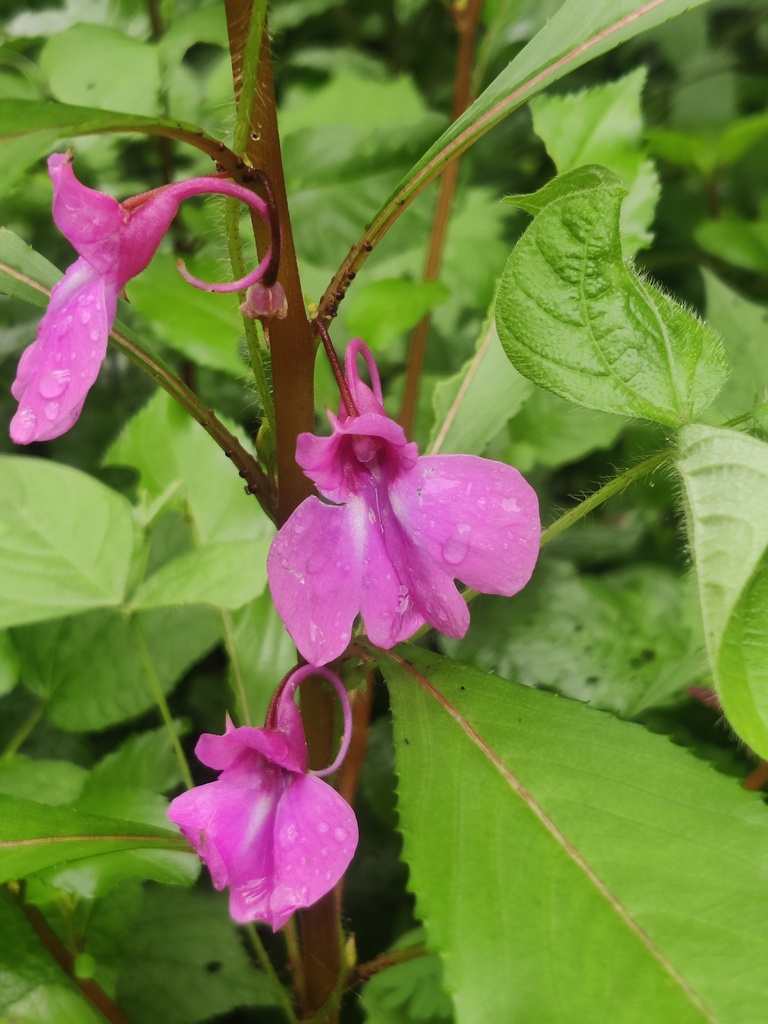
Garden balsam
Impatiens balsamina
Impatiens balsamina, commonly known as balsam, garden balsam, rose balsam, touch-me-not or spotted snapweed, is a species of plant native to India and Myanmar.
It is an annual plant growing to 20–75 cm (7.9–29.5 in) tall, with a thick, but soft stem. The leaves are spirally-arranged, 2.5–9 cm (1.0–3.5 in) long and 1–2.5 cm broad, with a deeply toothed margin. The flowers are pink, red, mauve, purple, lilac, or white, and 2.5–5 cm diameter; they are pollinated by bees and other insects, and also by nectar-feeding birds. The ripe seed capsules undergo explosive dehiscence.
From the article Impatiens balsamina on Wikipedia (CC BY-SA), quoted section by section
What it does
It is widely cultivated as an ornamental plant, and has become naturalised and invasive on several Pacific Ocean islands.
Wikipedia: “Ecology”
In human culture
Balsam flowers are referenced in the Okinawan folk song Tinsagu Nu Hana, where the way children use them to color their nails is compared to how parents color (teach and guide) the minds of their children.
The Japanese vocaloid song Housenka (鳳仙花, which translates to Impatiens balsamina) describes a person who doesn't fit in with a social group despite wanting to. In the music video, the singer laments this fate and compares herself to the plant. She references its "touch-me-not" nickname and the Hedgehog's Dilemma-esque explosive dehiscence of its seeds by saying: "Don't touch me," the balsam [says], fallen silent. And yet it can't leave seeds unless it breaks from its shell. Hong Nan-pa's 1919 "Bongseonhwa", called Korea's first Western-style song, was named for the flower (bongseonhwa [봉선화] in Korean). In it, Hong uses the analogy of a spent I. balsamina in autumn for Korea under Japanese colonial rule, with the hope for rebirth in the spring. Several South Korean films and dramas, including the 1956 movie A Touch-Me-Not (Bongseonhwa), are also named for the flower.
Wikipedia: “In popular culture”
Where it lives
Recorded sightings
—
geo-referenced records in GBIF, from museums, herbaria and field observers.
Drag the globe to turn it. Dots are where records exist, not a range map; darker means more records.
In the old herbals & bestiaries


In the stacks
Searching the stacks…
Every page naming Impatiens balsamina in the Biodiversity Heritage Library →
This page is assembled live from iNaturalist, GBIF, Wikipedia, the Source Library and the Internet Archive. It is not yet part of the hand-edited codex. iNaturalist taxon 133350.