- Plants
- ›Vascular Plants
- ›flowering plants
- ›Dicots
- ›proteas, lotuses, planes, and allies
- ›Protea family
- ›Paired Proteas
- ›Banksieae
- ›Banksiinae
- ›Banksia
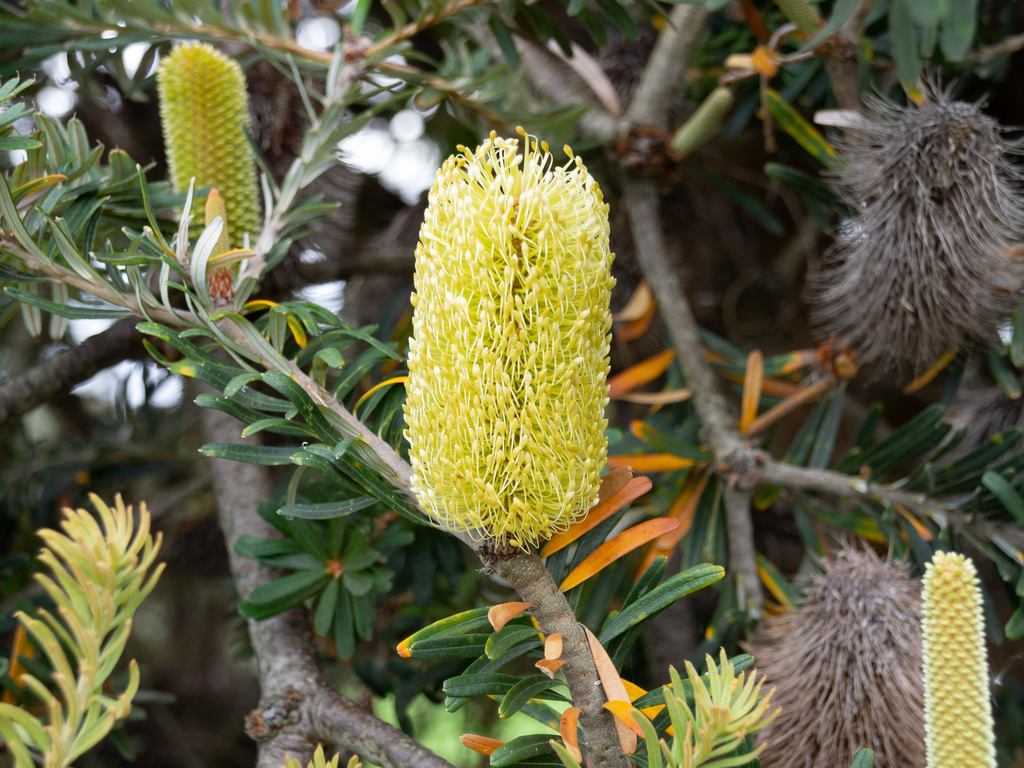
Silver Banksia
Banksia marginata
Banksia marginata, commonly known as the silver banksia, is a species of tree or shrub in the family Proteaceae found throughout much of southeastern Australia. It ranges from the Eyre Peninsula in South Australia to north of Armidale, New South Wales, and across Tasmania and the islands of Bass Strait. It grows in various habitats, including Eucalyptus forest, scrub, heathland and moorland. Banksia marginata varies widely in habit, ranging from a 20-centimetre (7.9 in) shrub to a 12-metre (40 ft) tree. The narrow leaves are linear and the yellow inflorescences occur from late summer to early winter. These flower spikes fade to brown and then grey and develop woody follicles bearing the winged seeds. Originally described by Antonio José Cavanilles in 1800, further collections of B. marginata were designated as several separate species by Robert Brown in 1810. However, all were reclassified as a single species by George Bentham in 1870. No distinct subspecies have been recognised by Banksia expert Alex George, who nonetheless concedes that further work is needed.
Many species of bird, in particular honeyeaters, forage at the flower spikes, as do native and European honeybees. The response to bushfire varies. Some populations are serotinous: they are killed by fire and regenerate from large stores of seed, which have been held in cones in the plant canopy and are released after a fire. Others regenerate from underground lignotubers or suckers from lateral roots.
From the article Banksia marginata on Wikipedia (CC BY-SA), quoted section by section
Description
Banksia marginata is a highly variable species, usually ranging from a small shrub around a metre (3 ft) tall to a 12-metre-high (39 ft) tree. Unusually large trees of 15 to possibly 30 m (50–100 ft) have been reported near Beeac in Victoria's Western District as well as several locations in Tasmania, while compact shrubs limited to 20 cm (7.9 in) high have been recorded on coastal heathland in Tasmania (such as at Rocky Cape National Park). Shrubs reach only 2 m (6.6 ft) high in Gibraltar Range National Park. The bark is pale grey and initially smooth before becoming finely tessellated with age. The new branchlets are hairy at first but lose their hairs as they mature, with new growth a pale or pinkish brown. The leaves are alternately arranged on the stems on 2–5 mm long petioles, and characteristically toothed in juvenile or younger leaves, which are 3–7 cm (1.2–2.8 in) long. The narrow adult leaves are dull green in colour and generally linear, oblong or wedge-shaped (cuneate) and measure 1.5–6 cm (0.6–2.4 in) long and 0.3–1.3 cm (0.1–0.5 in) wide. The margins become entire with age, and the tip is most commonly truncate or emarginate, but can be acute or mucronate. The cellular makeup of the leaves shows evidence of lignification, and the leaves themselves are somewhat stiff. Leaves also have sunken stomates. …
Range & habitat
Banksia marginata is found from Baradine and Gibraltar Range National Park in northern New South Wales, southwards into Victoria and South Australia, as well as across Tasmania. It is found on the major islands of Bass Strait, including King, Flinders and Cape Barren Islands. There is one report of a collection from the Springbrook Mountains southwest of Southport in southeastern Queensland. It is extremely rare in southwestern New South Wales. In Victoria, it is predominantly coastal or near-coastal east of Traralgon, but in New South Wales it is absent from coastal areas in the Sydney region. Banksia marginata often grew as a large tree on the basalt plains west of Melbourne, but has almost disappeared. In the vicinity of Adelaide, it was common in the western suburbs on old sand dunes behind the beach foredunes. It remains common in the Adelaide foothills. The annual rainfall over its distribution ranges from 400 to 1,000 mm (16 to 39 in). In the Gibraltar Range National Park, it is a dominant shrub of open heathland and a non-dominant shrub of closed heath, mostly found in swampy heath associated with sedges. Plants here have some degree of self-compatibility. In the Sydney region, it grows in association with heath banksia (Banksia ericifolia), old man banksia (B. …
Wikipedia: “Distribution and habitat”
What it does
Numerous species of birds have been observed foraging and feeding at the flowers; these include rainbow lorikeet (Trichoglossus moluccanus), musk lorikeet (Glossopsitta concinna), purple-crowned lorikeet (Parvipsitta porphyrocephala), double-eyed fig-parrot (Cyclopsitta diophthalma), red wattlebird (Anthochaera carunculata), little wattlebird (A. chrysoptera), yellow wattlebird (A. paradoxa), spiny-cheeked honeyeater (Acanthagenys rufogularis), yellow-faced honeyeater (Caligavis chrysops), singing honeyeater (Gavicalis virescens), white-plumed honeyeater (Ptilotula penicillata), black-chinned honeyeater (Melithreptus gularis), brown-headed honeyeater (M. brevirostris), white-naped honeyeater (M. lunatus), crescent honeyeater (Phylidonyris pyrrhopterus), New Holland honeyeater (P. novaehollandiae), tawny-crowned honeyeater (Gliciphila melanops), eastern spinebill (Acanthorhynchus tenuirostris), noisy miner (Manorina melanocephala), silvereye (Zosterops lateralis) and thornbills (Acanthiza species). In addition, the yellow-tailed black cockatoo (Zanda funerea) feeds on the seed. The agile antechinus (Antechinus agilis), bush rat (Rattus fuscipes), feathertail glider (Acrobates pygmaeus), and sugar glider (Petaurus breviceps) have been recorded visiting flower spikes. Both pollen and nectar are consumed by the southwestern pygmy possum (Cercarteus concinnus). …
Wikipedia: “Ecology”
At the table
The plant was often used by many indigenous clans and tribes throughout the east coast of Australia. The sweet nectar from the flowers was sucked or drained by soaking in water and in some cases mixed with some wattle gum to make a sweet lolly. The wood was also used to make needles. The Gunditjmarato peoples of the western district of Victoria used the spent flower cones to strain water by placing the cones in their mouths and using them like a straw.
Wikipedia: “Aboriginal Australian uses”
How it is grown
Banksia marginata was first cultivated in England in 1802 (and was also listed as B. australis, B. insularis and B. marcescens). It was grown at Kew, Cambridge Botanic Gardens, Woburn Abbey and private gardens in Chelsea, Hackney and Harringay House. One specimen grown in a glasshouse at Kew was described as a tree 24 feet (7.3 m) high with a trunk girth of two feet (60 cm) at 40 years of age. B. marginata is generally fairly easy to grow in a well-drained sunny or partly-shaded position in the garden. It can be leggy in shadier positions, or a more compact bushy shrub in full sun. Some varieties from drier areas seem to do poorly in areas of summer humidity. The flowers are not prominent unless they are numerous. Established plants can withstand drought, coastal exposure and temperatures as low as −10 °C (14 °F). Propagation of plants can be by seed or cuttings; the latter is essential if trying to replicate plants of particular habit (such as dwarf specimens). Some Banksia marginata seeds of subalpine provenance require stratification, namely keeping at 5 °C (41 °F) for 60 days before germination takes place over 6 to 25 days. Salkin proposed this was necessary so that seed released in a summer or autumn bushfire would lie dormant over the winter months before germinating in the spring. …
Wikipedia: “Cultivation”
Where it lives
Recorded sightings
—
geo-referenced records in GBIF, from museums, herbaria and field observers.
Drag the globe to turn it. Dots are where records exist, not a range map; darker means more records.
In the stacks
Searching the stacks…
Every page naming Banksia marginata in the Biodiversity Heritage Library →
This page is assembled live from iNaturalist, GBIF, Wikipedia, the Source Library and the Internet Archive. It is not yet part of the hand-edited codex. iNaturalist taxon 133274.