- Plants
- ›Vascular Plants
- ›flowering plants
- ›Dicots
- ›Buttercups, Poppies, and Allies
- ›buttercup family
- ›Anemones, buttercups, larkspurs and allies
- ›baneberries, cohoshes, and winter aconites
- ›Actaea
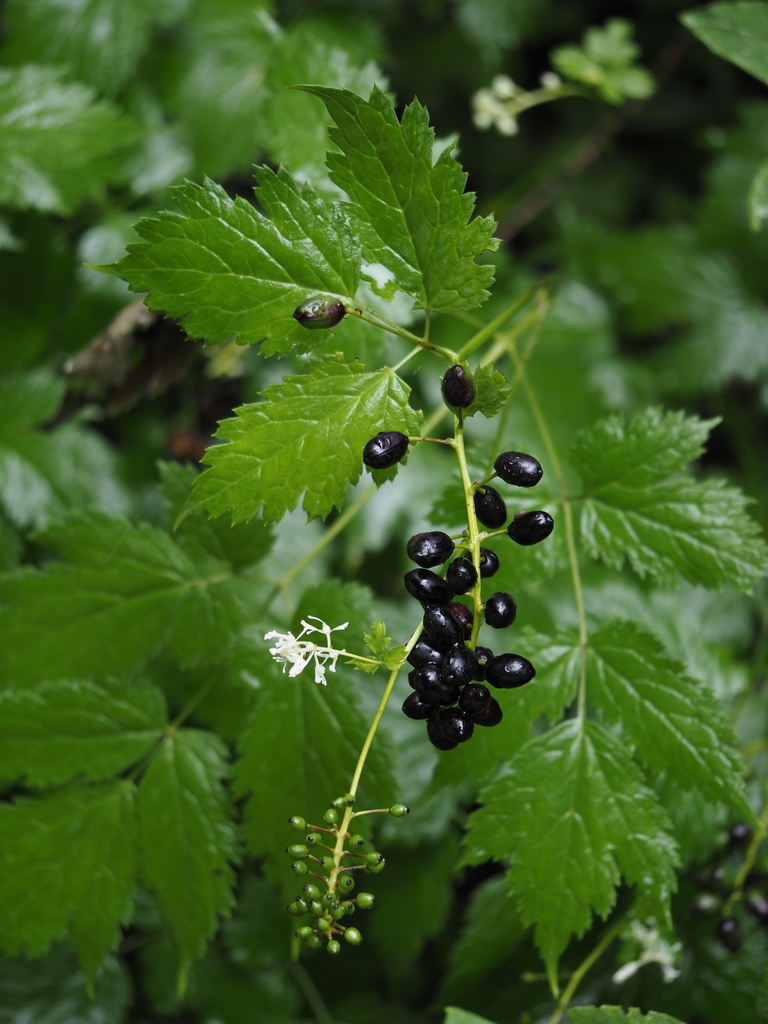
Eurasian baneberry
Actaea spicata
Actaea spicata, the baneberry or herb Christopher, is a species of flowering plant in the genus Actaea, native from Europe to western Siberia and northern Iran. It is often found on limestone edges and in deciduous woodland; key factors are shade, low competition, and a cool, protected root run.
From the article Actaea spicata on Wikipedia (CC BY-SA), quoted section by section
Description
Actaea spicata is a herbaceous perennial plant growing up to 65 cm (2 ft 2 in) tall. The basal leaves are large, biternate or bipinnate. The leaflets are more-or-less toothed. The flowers are white, with 3–6 petaloid sepals, and are produced in an erect raceme. The fruit is a berry, black when ripe and 10–13 mm (0.4–0.5 in) across. Its fruit persists for an average of 57.5 days, and bears an average of 11.4 seeds per fruit. Fruits average 90.7% water, and their dry weight includes 2.4% carbohydrates (possibly the lowest of any European fleshy fruit) and 1.0% lipids.
What it does
Granivorous rodents sometimes remove the fruits, consuming most of the seeds but only a small proportion of the fruit's pulp. As some seeds inevitably escape predation, they also act as seed dispersers.
Wikipedia: “Ecology”
How it is grown
Actaea spicata is cultivated as an ornamental plant. It is toxic by ingestion, and is also an irritant, so requires careful handling. It has been used as a homeopathic remedy for arthritis and joint pain.
Wikipedia: “Cultivation”
Where it lives
Recorded sightings
—
geo-referenced records in GBIF, from museums, herbaria and field observers.
Drag the globe to turn it. Dots are where records exist, not a range map; darker means more records.
In the stacks
Searching the stacks…
Every page naming Actaea spicata in the Biodiversity Heritage Library →
This page is assembled live from iNaturalist, GBIF, Wikipedia, the Source Library and the Internet Archive. It is not yet part of the hand-edited codex. iNaturalist taxon 133005.