- Plants
- ›Vascular Plants
- ›flowering plants
- ›monocots
- ›lilies, supplejacks, and allies
- ›Bellworts and allies
- ›Colchicum
- ›Colchicum
- ›Colchicum
- ›Colchicum autumnale
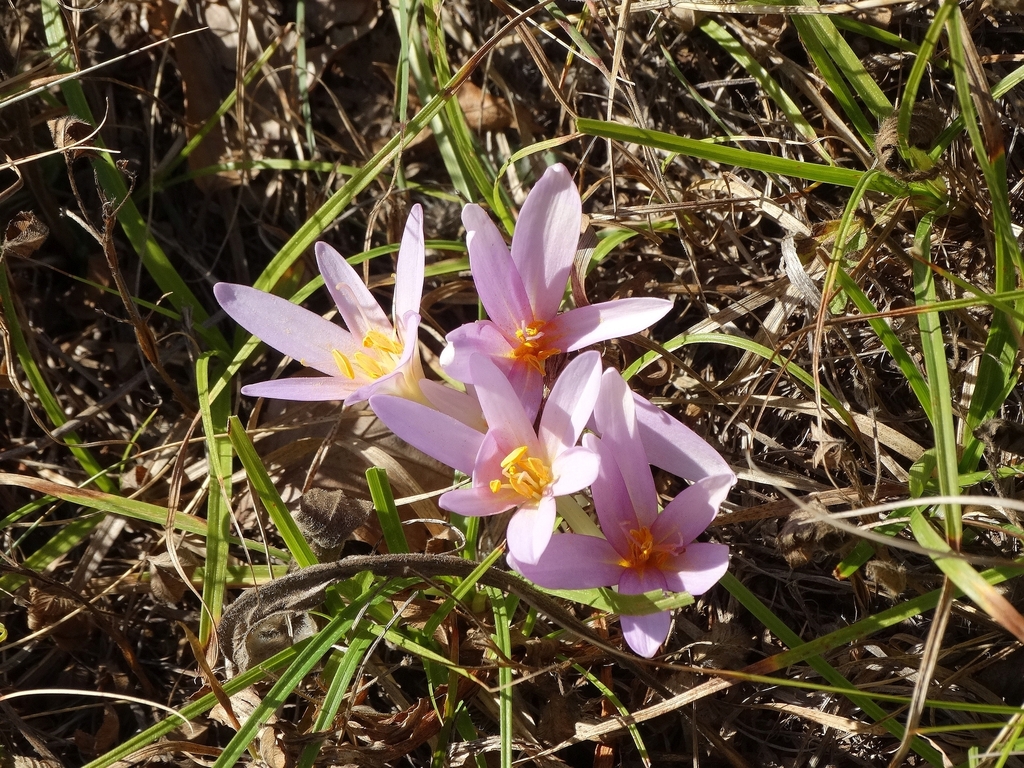
Autumn Crocus
Colchicum autumnale
Colchicum autumnale, commonly known as autumn crocus, meadow saffron, naked boys or naked ladies, is a toxic autumn-blooming flowering plant that resembles the true crocuses, but is a member of the plant family Colchicaceae, unlike the true crocuses, which belong to the family Iridaceae. It is called "naked boys/ladies" because the flowers emerge from the ground long before the leaves appear. Despite the vernacular name of "meadow saffron", this plant is not the source of saffron, which is obtained from the saffron crocus, Crocus sativus – and that plant, too, is sometimes called "autumn crocus".
The species is cultivated as an ornamental in temperate areas, in spite of its toxicity. The cultivar 'Nancy Lindsay' has gained the Royal Horticultural Society's Award of Garden Merit.
From the article Colchicum autumnale on Wikipedia (CC BY-SA), quoted section by section
Description
This herbaceous perennial has leaves up to 25 cm (10 in) long. The flowers are solitary, 4–7 cm (2–3 in) across, with six tepals and six stamens with orange anthers and three white styles. At the time of fertilisation, the ovary is below ground.
Range & habitat
C. autumnale is the only species of its family native to Great Britain and Ireland, with notable populations under the stewardship of the County Wildlife Trusts. It also occurs across mainland Europe from Portugal to Ukraine, and is reportedly naturalised in Sweden, European Russia, and New Zealand. It grows in lowland grassy meadows.
Wikipedia: “Distribution and habitat”
At the table
The bulb-like corms of C. autumnale contain colchicine, a useful drug with a narrow therapeutic index. Colchicine is approved in many countries for the treatment of gout and familial Mediterranean fever. Colchicine is also used in plant breeding to produce polyploid strains.
Wikipedia: “Pharmaceutical uses”
Toxicity
Colchicum is lethally toxic due to its colchicine content. Its leaves have been mistaken by foragers for those of Allium ursinum (ramsons or wild garlic), which they vaguely resemble. This plant (and colchicine itself) poses a particular threat to felines. The corms of meadow saffron contain the highest level of toxins, but all parts of the plant are regarded as poisonous.
Where it lives
Recorded sightings
—
geo-referenced records in GBIF, from museums, herbaria and field observers.
Drag the globe to turn it. Dots are where records exist, not a range map; darker means more records.
In the old herbals & bestiaries

Notable Commentaries on the History of Plants
Leonhart Fuchs · 1542 · p.391

Notable Commentaries on the History of Plants
Leonhart Fuchs · 1542 · p.390

Book of Herbs
Hieronymus Bock (Tragus) · 1546 · p.612

Notable Commentaries on the History of Plants
Leonhart Fuchs · 1549 · p.388

Notable Commentaries on the History of Plants
Leonhart Fuchs · 1549 · p.389

On the Names of Plants
Hieronymus Bock (Tragus) · 1552 · p.831

Commentaries on the Six Books of Pedanius Dioscorides on Medical Matter
Pietro Andrea Mattioli · 1565 · p.1280

Commentaries on the Six Books of Pedanius Dioscorides on Medical Matter
Pietro Andrea Mattioli · 1565 · p.1278

Six Groups of the History of Plants
Rembert Dodoens · 1583 · p.478

The Flowering Garden: Autumn
Crispijn van de Passe · 1616 · p.60

Herbarium Portatile, Oder Behendes Kräuter- und Gewächs-Buch: Darinn nicht allein 1363. so wol Einheimische als Außländndische Kräuter mit Lateinisch und Deutscher Benennung abgebildet, sondern auch die meisten, so in der Medicin gebräuchlich, kürtzlich erkläret werden
Panckow, Thomas · 1656 · p.75
In the stacks
Searching the stacks…
Every page naming Colchicum autumnale in the Biodiversity Heritage Library →
This page is assembled live from iNaturalist, GBIF, Wikipedia, the Source Library and the Internet Archive. It is not yet part of the hand-edited codex. iNaturalist taxon 131586.