- Plants
- ›Vascular Plants
- ›flowering plants
- ›monocots
- ›Agaves, Orchids, Irises, and Allies
- ›Orchids
- ›Orchidoid Orchids
- ›Cranichideae
- ›Ladies' Tresses Orchids
- ›Spiranthes
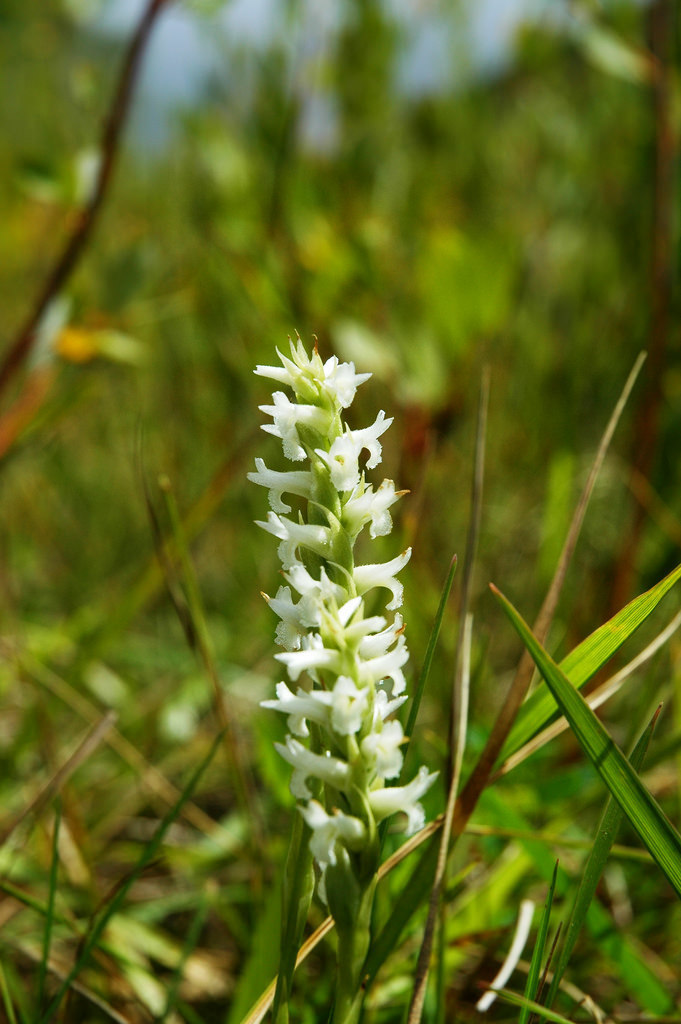
Ute Ladies'-tresses
Spiranthes diluvialis
Spiranthes diluvialis is a rare species of orchid known as Ute lady's tresses (also, Ute ladies'-tresses). The species name diluvialis means "of the flood". It is native to the western United States, where there are scattered, mostly small occurrences in the states of Colorado, Idaho, Montana, Nebraska, Nevada, Utah, Washington, and Wyoming. Two occurrences were discovered in southern British Columbia in 2006. The plant faces a number of threats to its existence. It is a federally listed threatened species of the United States but was proposed for delisting in 2025.
From the article Spiranthes diluvialis on Wikipedia (CC BY-SA), quoted section by section
Description
It is a perennial terrestrial orchid with an erect stem growing 20 to 62 centimeters in height. The narrow lance-shaped leaves are arranged around the base of the stem and are up to 28 centimeters in length. The inflorescence is a spiral of many flowers on a stalk coated in glandular hairs. The flower has narrow white or ivory-colored petals. Blooming occurs in July and August, and sometimes into September, and October. The plant reproduces sexually by seed and vegetatively by sprouting from broken-off pieces of root. The seeds are so small they are like dust; one plant can produce 100,000 individual seeds. Like other orchids, this species depends on mycorrhizal fungi to help the seeds germinate. The flowers are pollinated by bees of genus Anthophora, especially Anthophora terminalis, as well as bumblebees (Bombus spp.).
Range & habitat
This plant grows in moist wetland habitat, including bogs and riparian areas such as riverbanks, floodplains, lakeshores, riverside woodlands and forest, desert springs, and meadows, and human-made habitat such as ditches, reservoirs, and irrigated agricultural settings. In 2005 there were about 52 occurrences. The population size is difficult to count or estimate because the plant spends most of its time in a vegetative or dormant state, in which there are few or no aboveground plant parts and these may be hidden in dense surrounding vegetation or hard to identify. Some plants may be dormant underground for years at a time. What appear on paper to be larger populations are actually areas that have been more often and intensely surveyed.
Wikipedia: “Habitat”
Where it lives
Recorded sightings
—
geo-referenced records in GBIF, from museums, herbaria and field observers.
Drag the globe to turn it. Dots are where records exist, not a range map; darker means more records.
In the stacks
Searching the stacks…
Every page naming Spiranthes diluvialis in the Biodiversity Heritage Library →
This page is assembled live from iNaturalist, GBIF, Wikipedia, the Source Library and the Internet Archive. It is not yet part of the hand-edited codex. iNaturalist taxon 131217.