- Plants
- ›Vascular Plants
- ›flowering plants
- ›Dicots
- ›Roses, Elms, Figs, and Allies
- ›rose family
- ›brambles, roses, strawberries, and allies
- ›agrimonies and burnets
- ›agrimony subtribe
- ›Hagenia
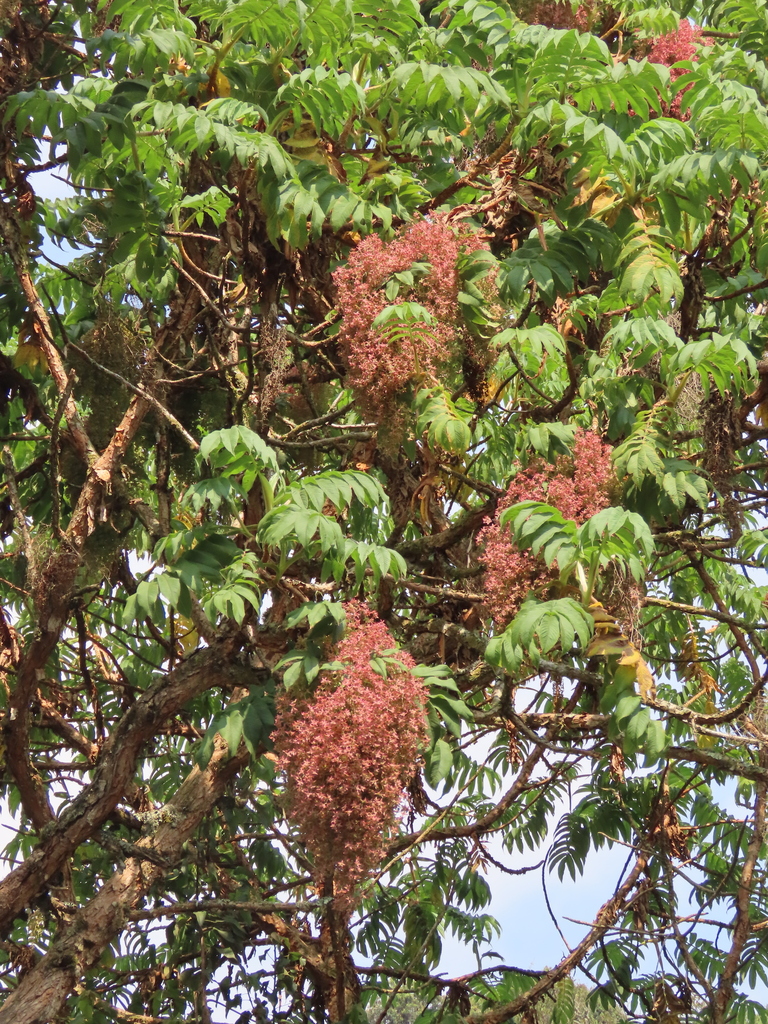
African Redwood
Hagenia abyssinica
Hagenia is a monotypic genus of flowering plant with the sole species Hagenia abyssinica, native to the high-elevation Afromontane regions of central and eastern Africa. It also has a disjunct distribution in the high mountains of East Africa from Sudan and Ethiopia in the north, through Kenya, Uganda, Rwanda, Burundi, Democratic Republic of Congo, and Tanzania, to Malawi and Zambia in the south. A member of the rose family, its closest relative is the Afromontane genus Leucosidea.
From the article Hagenia on Wikipedia (CC BY-SA), quoted section by section
Description
It is a tree up to 20 m in height, with a short trunk, thick branches, and thick, peeling bark. The leaves are up to 40 cm long, compound with 7-13 leaflets, each leaflet about 10 cm long with a finely serrated margin, green above, silvery-haired below. The flowers are white to orange-buff or pinkish-red, produced in panicles 30–60 cm long.
Range & habitat
It is generally found from 2000 to 3000 m elevation, in areas receiving 1000–1500 mm of rainfall annually. It can be found growing in mixed afromontane forest with Podocarpus, Afrocarpus, and other trees, and in drier afromontane forests and woodlands where Hagenia is dominant, or in mixed stands of Hagenia and Juniperus procera. It is often found near the upper limit of forest growth, giving way to giant heather zones above it.
Wikipedia: “Distribution and habitat”
What it does
Hagenia is used as a food plant by the larvae of some Lepidoptera species including turnip moth.
Wikipedia: “Ecology”
In medicine
A drug obtained from the tree, known as Kousso, comprises the entire inflorescence kept in form by a band wound transversely round it. The active principle is koussin or kosin, C31H38O10, which is soluble in alcohol and alkalis, and may be given directly in doses or in an infusion of the coarsely powdered flowers. It is considered to be an effectual anthelmintic for tapeworm, Taenia solium.
Wikipedia: “Medical use”
Where it lives
Recorded sightings
—
geo-referenced records in GBIF, from museums, herbaria and field observers.
Drag the globe to turn it. Dots are where records exist, not a range map; darker means more records.
In the stacks
Searching the stacks…
Every page naming Hagenia abyssinica in the Biodiversity Heritage Library →
This page is assembled live from iNaturalist, GBIF, Wikipedia, the Source Library and the Internet Archive. It is not yet part of the hand-edited codex. iNaturalist taxon 130757.