- Plants
- ›Vascular Plants
- ›flowering plants
- ›Dicots
- ›Mallows, Rock Roses, and Allies
- ›Mallow and Hibiscus Family
- ›Byttnerioideae
- ›Seringia
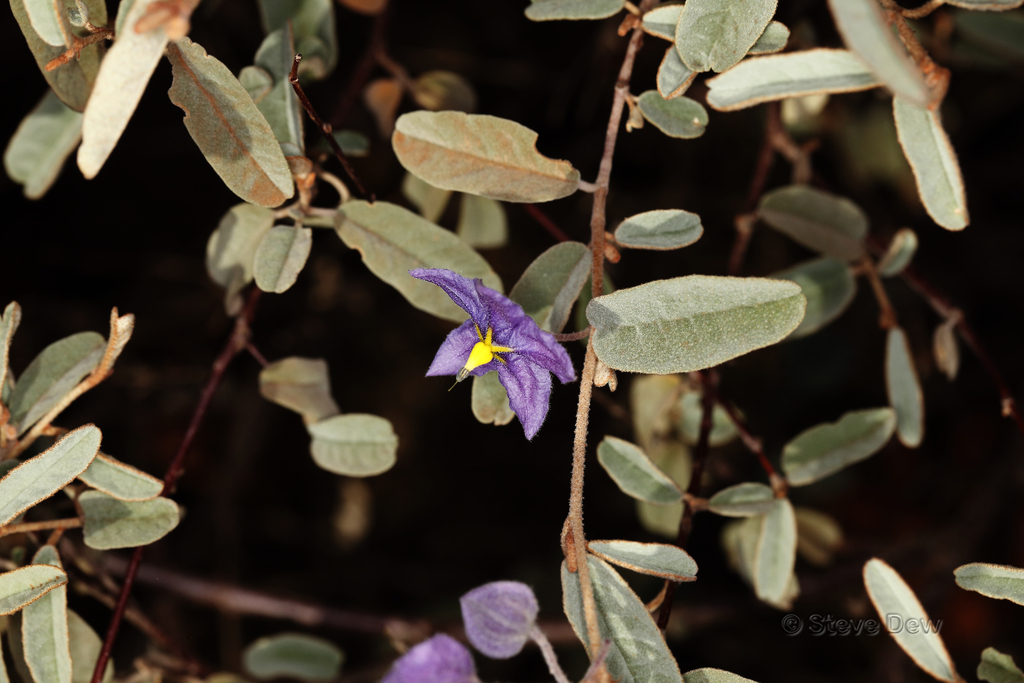
Fringed Fire-Bush
Seringia exastia
Seringia exastia, also known as fringed fire-bush, is a species of flowering plant in the mallow family and is endemic to northern Western Australia. It is an erect, compact shrub with hairy young branches, narrowly egg-shaped, elliptic or oblong leaves and purple flowers arranged in groups of 7 to 9.
From the article Seringia exastia on Wikipedia (CC BY-SA), quoted section by section
Description
The species grows as an erect, compact and multi-stemmed shrub that typically grows to a height of 70–90 cm (28–35 in) and has hairy stems. The leaves are arranged alternately, narrowly egg-shaped, elliptic or oblong, mostly 15–20 mm (0.59–0.79 in) long and 5–10 mm (0.20–0.39 in) wide on a petiole 3–6 mm (0.12–0.24 in) long with egg-shaped stipules 1.5–4 mm (0.059–0.157 in) long at the base. The flowers are arranged in a cyme 15–22 mm (0.59–0.87 in) long with 7 to 9 flowers on a peduncle 2–3 mm (0.079–0.118 in) long, each flower on a pedicel 4–7 mm (0.16–0.28 in) long. The flowers are purple with petal-like sepals 9–12 mm (0.35–0.47 in) and joined at the base to form a tube with lobes 65–80% the length of the tube. Petals are usually absent, the staminodes narrowly triangular and 1.3 mm (0.051 in) long, and the filaments and anthers are yellow. Flowering occurs from April to December.
Range & habitat
The plant is found in the Carnarvon, Central Ranges, Coolgardie, Dampierland, Gascoyne, Gibson Desert, Great Sandy Desert, Great Victoria Desert, Little Sandy Desert, Murchison, Pilbara and Yalgoo IBRA bioregions of Western Australia. It grows on pindan heathland.
Wikipedia: “Distribution and habitat”
Where it lives
Recorded sightings
—
geo-referenced records in GBIF, from museums, herbaria and field observers.
Drag the globe to turn it. Dots are where records exist, not a range map; darker means more records.
In the stacks
Searching the stacks…
Every page naming Seringia exastia in the Biodiversity Heritage Library →
This page is assembled live from iNaturalist, GBIF, Wikipedia, the Source Library and the Internet Archive. It is not yet part of the hand-edited codex. iNaturalist taxon 1296934.