- Plants
- ›Vascular Plants
- ›flowering plants
- ›Dicots
- ›Roses, Elms, Figs, and Allies
- ›Nettle Family
- ›Urticeae
- ›Urtica
Tree Nettle
Urtica ferox
Urtica ferox, commonly known as tree nettle and ongaonga, is a species of nettle endemic to New Zealand. A member of the Urticaceae, the plant is covered in trichomes (hairs), which contain toxins that are poisonous to humans and other animals. It is a large woody shrub or small tree that can grow to a height of 3 metres (10 feet). Its trichomes can cause painful stings, with effects that can last several days or weeks; the sting is strong enough to kill cattle, dogs, and horses. Two human deaths have been caused by contact with the plant.
The plant was first scientifically described by German naturalist Georg Forster in 1786. U. ferox is wind-pollinated, and its seeds are later dispersed by gravity or the wind. The plant serves as a host for several moth species, and it is the primary source of food for the larvae of the New Zealand red admiral butterfly. Despite being a plant usually avoided by people, U. ferox has some traditional and medicinal uses for the indigenous Māori people. Its 2023 assessment in the New Zealand Threat Classification System was not threatened.
From the article Urtica ferox on Wikipedia (CC BY-SA), quoted section by section
Description
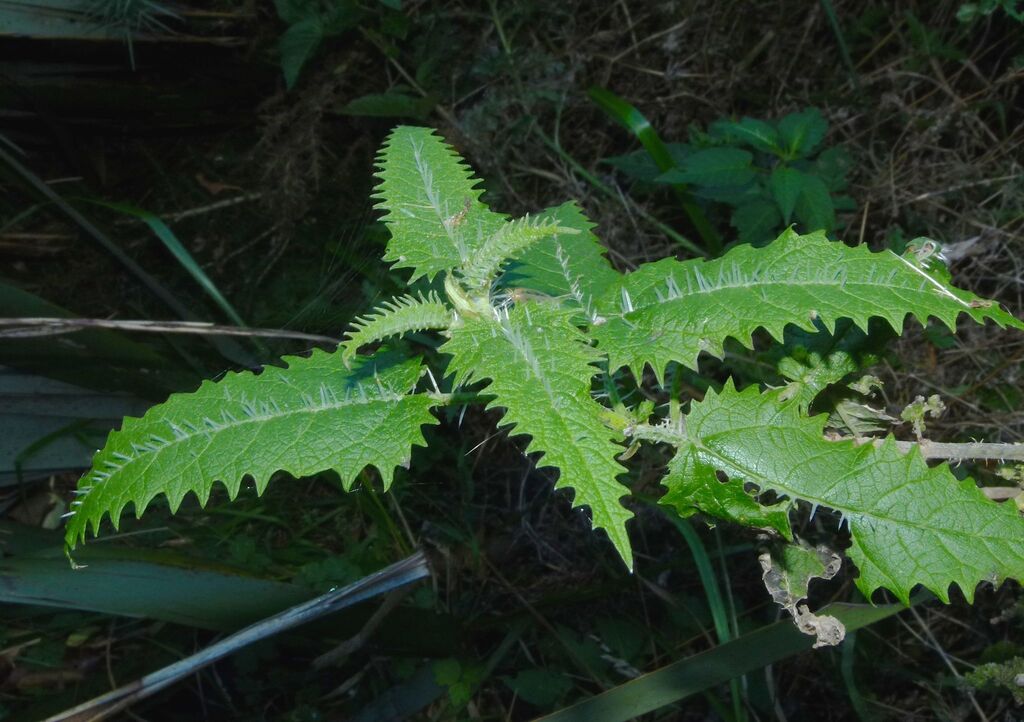
Urtica ferox (tree nettle or ongaonga) is a shrub or small tree in the nettle family Urticaceae. It can grow to a height of 3 metres (10 feet) with the base of the main stem reaching 12 cm (5 in) in thickness. The pale green leaves are thin and membranous, and the surfaces of the leaves, stems, and stalks are covered in stiff trichomes (hairs) that can grow up to 6–10 mm long. These trichomes are prominent along the salient mid-vein and leaf margin. The leaves range in size from 3–5 cm (1.2–2.0 in) in width and 8–12 cm (3.1–4.7 in) in length. They are arranged in opposite pairs. Juvenile leaves can reach up to 15 cm (5.9 in) long. The leaves vary from ovate to triangular or lance-shaped, with coarsely serrated margins. The leaf base is squared-off or nearly heart-shaped. Flowering occurs from November to March. The flowers are produced in panicles (branched flower clusters), which can reach 8 cm (3.1 in) long. The stigmas in the female flowers receive the pollen grains. Fruiting occurs from December to May; the fruits are found in achenes (dry one-seeded fruits), each containing a single seed, which is 1.5 mm long. These seeds take about one month to germinate. Like European species in the genus Urtica, U. ferox is capable of building up large seed banks (dormant soil seeds) in the soil which may survive for several years. U. ferox has a diploid chromosome count of 48.
Range & habitat
Urtica ferox is endemic to New Zealand, where it is found throughout the North and South Islands. The southernmost limit of the plant is Stewart Island, according to a 2011 book on the flora of New Zealand. Otago was thought to be the species' southern limit by botanist Thomas Cheeseman in his 1906 publication, the Manual of the New Zealand Flora. It was later recorded on the Tītī / Muttonbird Islands in 1915 by Dugald Poppelwell. The plant varies in abundance throughout its distribution area, being especially common near Wellington and Christchurch, whereas it is uncommon or absent north of Auckland (as noted by botanist Lucy Moore in 1978). The 2023 assessment of U. ferox in the New Zealand Threat Classification System was not threatened, but in the Northland Region, it has been assessed as regionally critical, meaning regionally endangered, with an estimated 250 mature U. ferox plants in the region.
Habitat. Urtica ferox is typically found in coastal to lowland environments. It is common in forest margins and shrublands and it occurs from sea level to 800–1,000 m (2,600–3,300 ft) above sea level. U. ferox grows on a variety of soil types but prefers fertile, basaltic soils. It also occurs inland, including in the Canterbury Region on the Harper Hills near Glentunnel. The plant can be found on alluvial soils in the Taramakau Valley within Arthurs Pass National Park. U. …
Wikipedia: “Distribution”
What it does
Like all Urtica species, U. ferox is wind-pollinated, although bees may visit the flowers to collect nectar. U. ferox's seeds are dispersed by gravity and the wind. During winter in some southern localities, U. ferox can be semideciduous (losing some of its leaves) or entirely deciduous (losing all of its leaves). This characteristic is uncommon in the native plants of New Zealand. The plant is the primary host for the larvae of the endemic mainland New Zealand red admiral (Vanessa gonerilla subsp. gonerilla), which begin laying eggs in early spring (September). The butterflies lay their eggs on the new growth of U. ferox leaves, typically at the tip and often on the side with the trichomes. After hatching the caterpillar larvae then spend up to six weeks feeding on those leaves. During this vulnerable stage the caterpillars use the spiny leaves for protection, wrapping the leaves around themselves like a blanket or building a small tent to hide from potential predators such as birds and insects. Populations of V. gonerilla have had a potential decline, possibly in part because of people treating U. ferox as a weed and removing it. Several moth species feed on the plant as larvae, including Mnesictena flavidalis, Diarsia intermixta, Meterana inchoata, Pasiphila urticae, Epichorista crypsidora, two species of Pseudocoremia, and species of Udea. …
Wikipedia: “Ecology”
At the table
Urtica ferox is usually avoided by people, but it has had some traditional and medicinal uses for the indigenous Māori people. In traditional medicinal practices, the bark of U. ferox and the leaves of kawakawa (Piper excelsum), boiled together, were used to treat eczema and sexually transmitted infections. The plant was also a traditional Māori food source. The inner stems were consumed after the leaves and outer bark had been removed. The thin film that makes up the inner bark was also eaten raw and had a sweet taste. In Māori mythology the plant was placed in forests to prevent people moving freely and to irritate people. In one legend the Polynesian explorer Kupe is said to have placed several obstacles, including this plant, to slow down those chasing him. In the Māori language ongaonga can be used to describe something annoying, and a frustrating or irritating person can be called he tangata ongaonga, meaning "a prickly person".
Wikipedia: “Uses”
In human culture
The etymology of the genus name Urtica is derived from the Latin word for stinging nettles, which comes from urere, meaning 'to burn'. The specific epithet ferox means 'ferocious', 'savage', or 'wild'. U. ferox is commonly known as tree nettle and ongaonga. In Māori the word ongaonga is used to describe anything 'annoying' or 'irritating'. Cognates (related words) found across different Polynesian languages, including hongohongo and okaoka, are words typically used to describe stinging insects. U. ferox has several recorded Māori names, including houhi, okaoka, puruhi, taraonga, and taraongaonga.
Wikipedia: “Etymology”
Where it lives
Recorded sightings
—
geo-referenced records in GBIF, from museums, herbaria and field observers.
Drag the globe to turn it. Dots are where records exist, not a range map; darker means more records.
In the stacks
Searching the stacks…
Every page naming Urtica ferox in the Biodiversity Heritage Library →
This page is assembled live from iNaturalist, GBIF, Wikipedia, the Source Library and the Internet Archive. It is not yet part of the hand-edited codex. iNaturalist taxon 129506.