- Plants
- ›Vascular Plants
- ›Ferns
- ›Leptosporangiate Ferns
- ›Polypod Ferns
- ›eupolypods II
- ›spleenwort family
- ›Asplenium
- ›Phyllitis
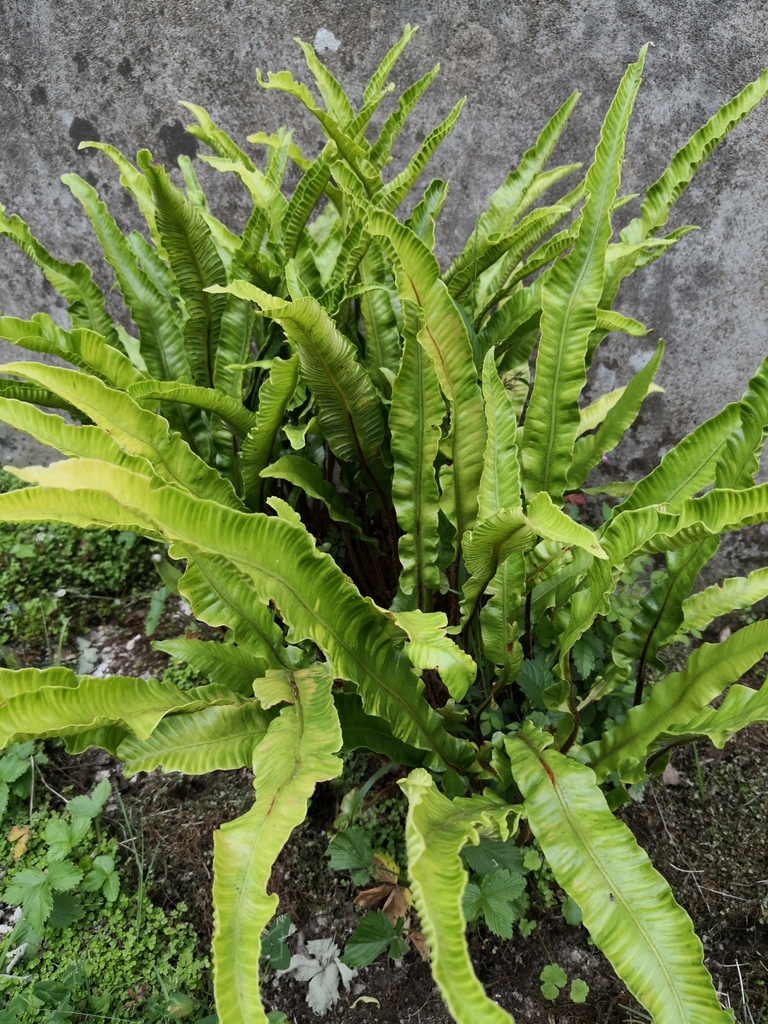
Hart's-tongue fern
Asplenium scolopendrium
Asplenium scolopendrium, known as hart's-tongue or hart's-tongue fern (syn. Phyllitis scolopendrium) is a fern in the genus Asplenium, of the Northern Hemisphere.
From the article Asplenium scolopendrium on Wikipedia (CC BY-SA), quoted section by section
Description
The most striking and unusual feature of the fern is its simple, strap-shaped undivided fronds. The supposed resemblance of the leaves to the tongue of a hart (an archaic term for a male red deer) gave rise to the common name "hart's-tongue fern".
Range & habitat
Asplenium scolopendrium is a common species in the Old World:
The subspecies scolopendrium occurs throughout Europe (including the Caucasus and the British Isles). It is absent however in northeast Europe (Finland, Belarus, Latvia, Lithuania and European Russia). Beyond Europe, it is found in the Middle East, and North Africa (in Morocco, Algeria, Tunisia and Libya, as well as the Canary Islands). It has also been introduced to the Falkland Islands. Unlike its American counterpart, the scolopendrium of Europe is used for many horticultural uses. Specimens of this variety found in North America (such as in New Brunswick and Ontario in Canada, and Maryland in the United States) are considered naturalized descendants of cultivated plants. In North America, it occurs in rare, widely scattered populations located in different locales:
in the Mexican states of Chiapas, Coahuila, Nuevo León, and Oaxaca, as well as the Caribbean island of Hispaniola (in Haiti). along the Onondaga Limestone and Niagara Escarpment geological formations in Central New York (present in two counties), southern Ontario (present in seven counties), and the eastern Upper Peninsula in Michigan (present in two counties). …
Wikipedia: “Distribution”
At the table
A manuscript written by Katharine Palmer in the 18th century contains a recipe for hart's-tongue ale.
Wikipedia: “Other uses”
In medicine
This fern was used in the 1800s as a medicinal plant in folk medicine as a spleen tonic (hence an archaic name for the genus, "spleenworts") and for other uses.
Wikipedia: “Herbal medicine”
How it is grown
Asplenium scolopendrium is often grown as an ornamental plant, with several cultivars selected with varying frond form, including with frilled frond margins, forked fronds and cristate forms. The species has gained the Royal Horticultural Society's Award of Garden Merit, as has the cultivar 'Angustatum'. The American variety is reputed to be difficult to cultivate (making conservation efforts for it even more troublesome); due to this, most, if not all, cultivated individuals are derived from the Old World subspecies.
Wikipedia: “Cultivation”
Where it lives
Recorded sightings
—
geo-referenced records in GBIF, from museums, herbaria and field observers.
Drag the globe to turn it. Dots are where records exist, not a range map; darker means more records.
In the old herbals & bestiaries

Living Images of Plants
Otto Brunfels · 1532 · p.383

Herbal of Virtues
1499 · p.287

Commentaries on the Six Books of Dioscorides
Pietro Andrea Mattioli · 1560 · p.598

Latin Herbal
1484 · p.287

Latin Herbal with German Synonyms
1484 · p.315

Herbarius
1485 · p.288

Herbarius latinus (with Dutch synonyms)
1486 · p.285

Latin Herbal with German Synonyms
1486 · p.288

Ortus sanitatis
1491 · p.439

The Book of Health: The Art of Distillation
Brunschwig, Hieronymus · 1505 · p.150

The Great Herbary with all the figures of the herbs
1532 · p.279

Book of Herbs
Hieronymus Bock (Tragus) · 1546 · p.448
In the stacks
Searching the stacks…
Every page naming Asplenium scolopendrium in the Biodiversity Heritage Library →
This page is assembled live from iNaturalist, GBIF, Wikipedia, the Source Library and the Internet Archive. It is not yet part of the hand-edited codex. iNaturalist taxon 129105.