- Plants
- ›Vascular Plants
- ›flowering plants
- ›monocots
- ›grasses, sedges, cattails, and allies
- ›Sedges
- ›Cyperoideae
- ›Cariceae
- ›Carex
- ›Vignea
- ›Carex rosea
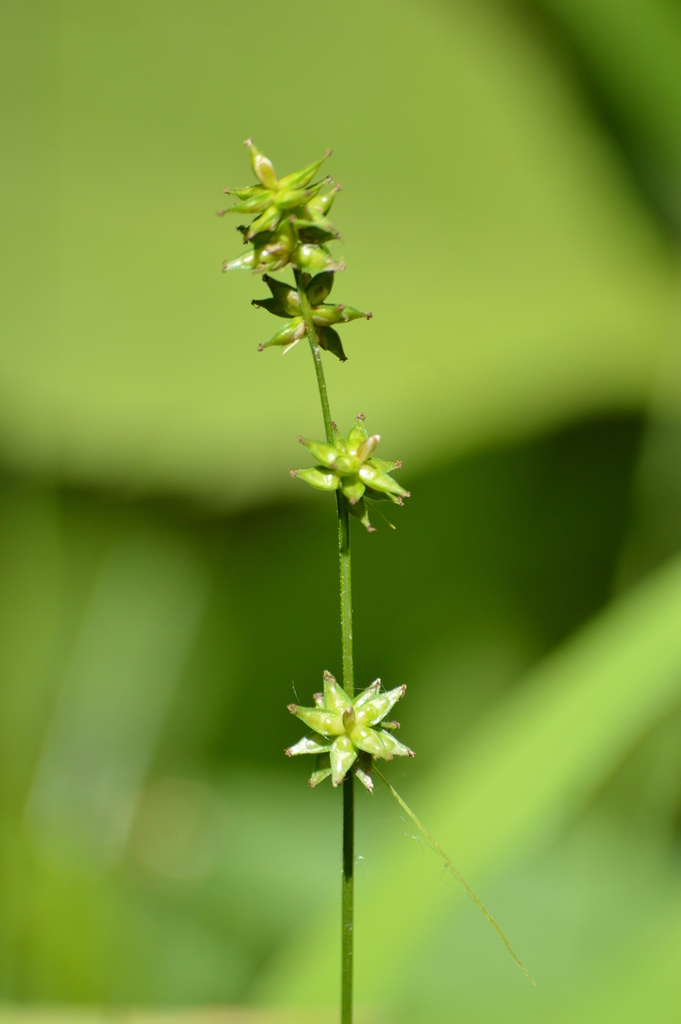
rosy sedge
Carex rosea
Carex rosea, the rosy sedge, is a flowering plant and part of the family Cyperaceae. Synonyms for Carex rosea include Carex concoluta, and Carex flaccidula. It is native to central and eastern North America and it exists in wet to dry soils. Carex rosea can be found in shores of streams and bottomlands, as well as ponds. It is known to have good adaptations to dry-shade locations. It is an evergreen plant which is easy to grow.
From the article Carex rosea on Wikipedia (CC BY-SA), quoted section by section
Description
Carex rosea flowers in the spring, and it has evergreen leaves. The styles of this Carex rosea, the stalk connecting the stigma to the ovary, are very distinctively curled, which helps to differentiate this species from other plants. The stigmas range from 0.07 to 0.10 mm thick, while the leaves are almost 1/8 mm wide. The width of the stem leaf blade ranges from 1.8 to 2.6 mm. The lowest bract either has no sheath or the sheath it has is very short up to four mm in length. The lowest spike is not borne on a peduncle, which is a stalk that supports inflorescence growth to more than one flower. The uppermost spike contains both carpels and stamens, with the carpels located below, or mixed in, with the stamens. The membrane that encloses the flower has no hairs and its length varies between 2.6 and 4.2 mm. The leaf sheath has no pink, red, or purple tinting and the leaf blade can either be, smooth and hairless, or rough and sandpapery. The leaves are all produced from the base of the plant, and the one-seeded fruit, usually ranging from 1.6 to 2.2 mm, has no folds or dimples. The spikelets found in the plant are widely spread rather than clustered together, and the culms consist of about 4–8 spikelets. Spikelets are green because of the presence of 7–14 spreading perigynia.
Range & habitat
C. rosea is distributed from Nova Scotia and southern Quebec west to Minnesota and eastern Nebraska; and south to Georgia, Tennessee, and Arkansas. Its habitat is dry-to-moist woodlands. It can adapt to various soil types and it can also live in rich ravines, and wood edges.
Wikipedia: “Distribution and habitat”
What it does
Carex rosea can complete its life cycle in a little more than two years. Even though the genus Carex has been considered nonmycorrhizal, recent evidence has demonstrated that mycotrophy may be more spread among the sedges than realized.
Wikipedia: “Ecology”
How it is grown
Plants that have already been established to a place are highly drought-tolerant. Carex rosea is unappetizing to deer and other herbivores. Many times Carex rosea, or sedge in general, are used as ground covers. This is a way to help with the maintenance of green expanses near houses since it is an evergreen plant. It is recommended for the plant to be cut completely off before the winter season starts. The more highly adaptable sedges grow in warm-weather conditions and if mowing the land is a choice, then it is recommended to do it only a few times a year, compared to regular grass which is almost every other week.
Wikipedia: “Horticulture”
Where it lives
Recorded sightings
—
geo-referenced records in GBIF, from museums, herbaria and field observers.
Drag the globe to turn it. Dots are where records exist, not a range map; darker means more records.
In the stacks
Searching the stacks…
Every page naming Carex rosea in the Biodiversity Heritage Library →
This page is assembled live from iNaturalist, GBIF, Wikipedia, the Source Library and the Internet Archive. It is not yet part of the hand-edited codex. iNaturalist taxon 129022.