- Plants
- ›Vascular Plants
- ›flowering plants
- ›Dicots
- ›Mustards, Capers, and Allies
- ›Spider Flower Family
- ›Cleome
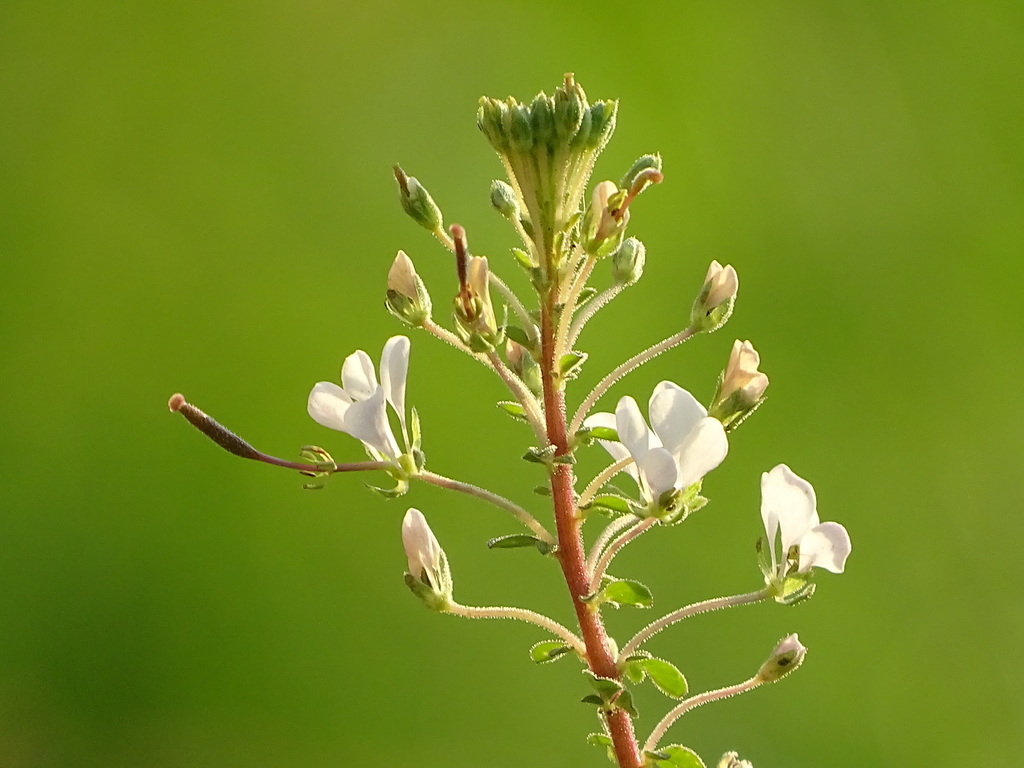
Spiderwisp
Cleome gynandra
Cleome gynandra is a species of Cleome that is used as a green vegetable. It is known by many common names including Shona cabbage, African cabbage, spiderwisp, cat's whiskers, chinsaga and stinkweed. It is an annual wildflower native to Africa but has become widespread in many tropical and sub-tropical parts of the world. It is an erect, branching plant generally between 25 cm and 60 cm tall. Its sparse leaves are each made up of 3-5 oval-shaped leaflets....
From the article Cleome gynandra on Wikipedia (CC BY-SA), quoted section by section
Description
Cleome gynandra is an erect, branching plant generally between 25 cm and 60 cm tall. Depending on environmental conditions, it can reach up to 150 cm of height. Its sparse leaves are each made up of 3–7 oval-shaped leaflets. The flowers are white, sometimes changing to rose pink as they age. The leaves and flowers are both edible. The leaves have a strong bitter, sometimes peppery flavor similar to mustard greens. The fruit is a dehiscent silique, a slender and spindle-shaped capsule, and measures 12 cm in length and 8–10 mm in width. During the ripening process, the color of the pods turns from green to yellow to brown when dry. In the dry state, they dehisce longitudinally and release their seeds. Each silique can contain as many as 100-150 seeds. The seeds are round, black and with a rough surface and measure 1.0-1.5 mm in diameter. Seeds of C. gynandra contain 17-19% oil. Cleome gynandra has a long tap root with root hairs and has few secondary roots.
Range & habitat
It is an annual wildflower native to Africa but has naturalized across tropic and sub-tropical regions across Africa, Asia and America. In those regions it grows at altitudes from 0 to 2400 m above sea level. It grows well in disturbed, well-drained soils, but is also drought-tolerant. It does not tolerate cold temperatures well, and is frost-tender. optimal growth conditions include temperatures between 18 °C and 25 °C, with high light intensity. Cleome gynandra is considered an invasive weed in many places in the U.S. and elsewhere in the Pacific.
Wikipedia: “Ecology and distribution”
At the table
Typically, the leaves and shoots are eaten boiled or in stews. The leaves are often eaten in Sub-Saharan Africa, where they are often dried for storage, then cooked with milk or butter to reduce its bitter taste. In Kenya, Uganda and Tanzania, the leaves are cooked with groundnut paste. In Northern Uganda it is known as Dek Akeo, or Akeyo. It is prepared by boiling it in hot water mixed with groundnut paste. It is served with Kalo, posho, sweet potatoes. The vegetable is sun-dried and preserved for a longer shelf-life and future medicinal consumption. The vegetable is served in local restaurants and hotels but predominantly consumed in greater Northern Uganda. The plant is useful for intercropping due to its insect repellent and anti-tick properties. Leaves exhibit repellent, destructive and antifeedant properties to some ticks species in all their life stages (larvae, nymphs, and adults). In Thailand and Malaysia, the leaves are a popular food item fermented with rice water as a pickle known as phak sian dong. The same pickle is also eaten in the northern states of Malaysia, and is known as jeruk maman. The state of Negeri Sembilan specializes in rendang maman, where the leaves are braised in spiced coconut milk for a long period of time to achieve the desirable crisp and texture. The leaves also have antioxidative properties that can help with inflammatory diseases. …
Wikipedia: “Uses”
How it is grown
Cleome gynandra is normally not a cultivated crop. Leaves are in most cases harvested from the plant found as naturally growing weed. However, some studies on the most suitable cultivation techniques have been conducted.
Soil requirements. Cleome gynandra requires deep, well drained fertile soils. It grows well on loose soils, with high humus content and with pH ranging from 5.5 to 7.
Sowing. In cultivation, propagation of the plant is done by seed sowing. Given the small seed size, the depth of sowing and the preparation of the seedbed are important factors. The seedbed requires shallow ploughing (around 15 cm deep), weed removal and harrowing to have a fine loose soil. Seeds can be dispersed unevenly by broadcasting or shallowly drilled in rows spaced around 30 cm apart and around 1 cm deep.
Weeding. Weeding is needed in the early stages of development, when the canopy coverage by C. gynandra leaves is still reduced. It can be done by hands or with suitable machinery, ensuring shallow cultivation.
Fertilization. Generous and frequent nitrogen based fertilizers can be applied to delay flowering, prolong vegetative growth and increase number and dimensions of the leaves. Yield increase is more significant when nitrogen is provided in its organic form, although also inorganic nitrogen fertilizers ensure an increase in yield. …
Wikipedia: “Cultivation”
Where it lives
Recorded sightings
—
geo-referenced records in GBIF, from museums, herbaria and field observers.
Drag the globe to turn it. Dots are where records exist, not a range map; darker means more records.
In the old herbals & bestiaries

In the stacks
Searching the stacks…
Every page naming Cleome gynandra in the Biodiversity Heritage Library →
This page is assembled live from iNaturalist, GBIF, Wikipedia, the Source Library and the Internet Archive. It is not yet part of the hand-edited codex. iNaturalist taxon 128928.