- Plants
- ›Vascular Plants
- ›flowering plants
- ›Dicots
- ›beeches, oaks, walnuts, and allies
- ›beech family
- ›Quercus
- ›Quercus
- ›Lobatae
- ›Phellos
- ›Quercus marilandica
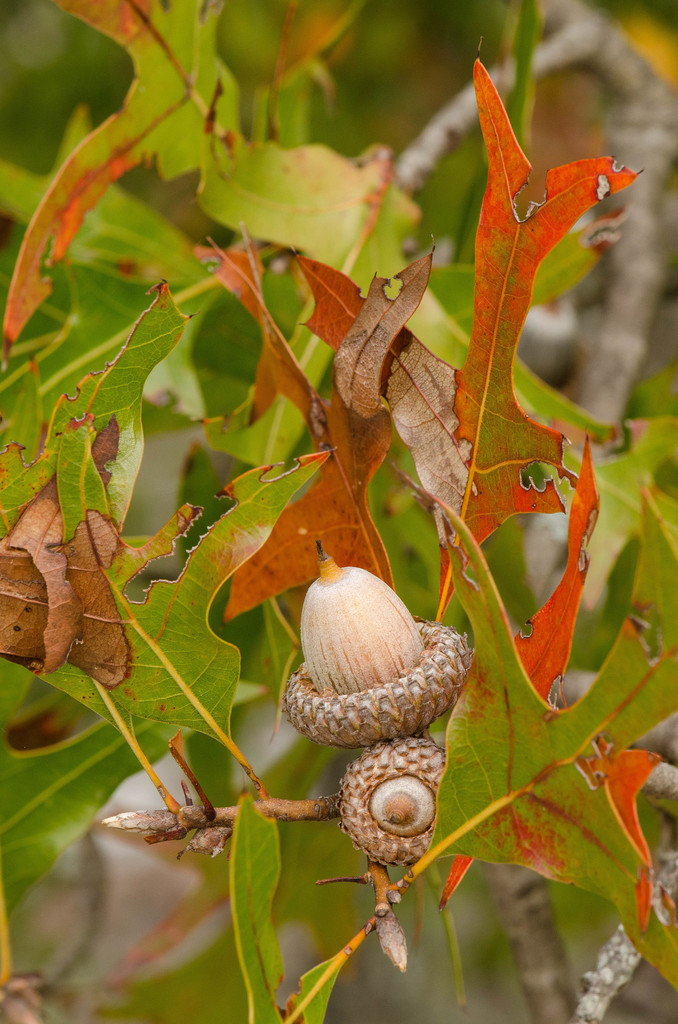
American turkey oak
Quercus laevis
Quercus laevis, the turkey oak, is a member of the red oak group of oaks. It is native to the southeastern United States, occurring on the coastal plain from Virginia south to central Florida, and west to southeast Louisiana. The name turkey oak derives from the resemblance of the leaves to a turkey's foot. A Turkish and southern European species Quercus cerris is also commonly referred to as Turkey oak, so Quercus laevis is sometimes referred...
From the article Quercus laevis on Wikipedia (CC BY-SA), quoted section by section
Description
Quercus laevis is a small tree, sometimes shrubby, typically only 8–10 meters (26–33 feet) tall, though occasionally reaching 28 m (92 ft). The leaves are variable in size, mostly 10–17 centimeters (4–6+3⁄4 inches) long but occasionally just 8 cm (3+1⁄4 in) or as much as 30 cm (12 in) long. They have 3–7 slender lobes, deeply incised between the lobes, each lobe with 1–3 bristle teeth at the tip. The leaves turn red in Autumn. The acorns are about 20–25 millimeters (3⁄4–1 in) long, and, like other red oaks, take 18 months to mature.
Range & habitat
Turkey oak occurs on the coastal plain from Virginia south to southwestern Florida, and west to southeast Louisiana, where it mingles with many tropical trees such as mature coconut palms and large Cuban Laurel (Ficus) trees. It typically grows on poor, thin, dry, rocky or sandy soils where few other oaks other than blackjack oak (Q. marilandica) can thrive. It does not have the beautiful crown form of many oaks, but is nonetheless a valuable tree for growing on infertile, dry, sandy sites. The deeply lobed leaves are also attractive. It associates as an understory tree with longleaf pine and other pine stands on sandy knolls in the southeastern United States.
== References ==
Wikipedia: “Distribution and habitat”
Where it lives
Recorded sightings
—
geo-referenced records in GBIF, from museums, herbaria and field observers.
Drag the globe to turn it. Dots are where records exist, not a range map; darker means more records.
In the stacks
Searching the stacks…
Every page naming Quercus laevis in the Biodiversity Heritage Library →
This page is assembled live from iNaturalist, GBIF, Wikipedia, the Source Library and the Internet Archive. It is not yet part of the hand-edited codex. iNaturalist taxon 128752.