- Plants
- ›Vascular Plants
- ›flowering plants
- ›monocots
- ›Agaves, Orchids, Irises, and Allies
- ›Orchids
- ›Orchidoid Orchids
- ›Orchideae
- ›Orchidinae
- ›Dactylorhiza
- ›Coeloglossum
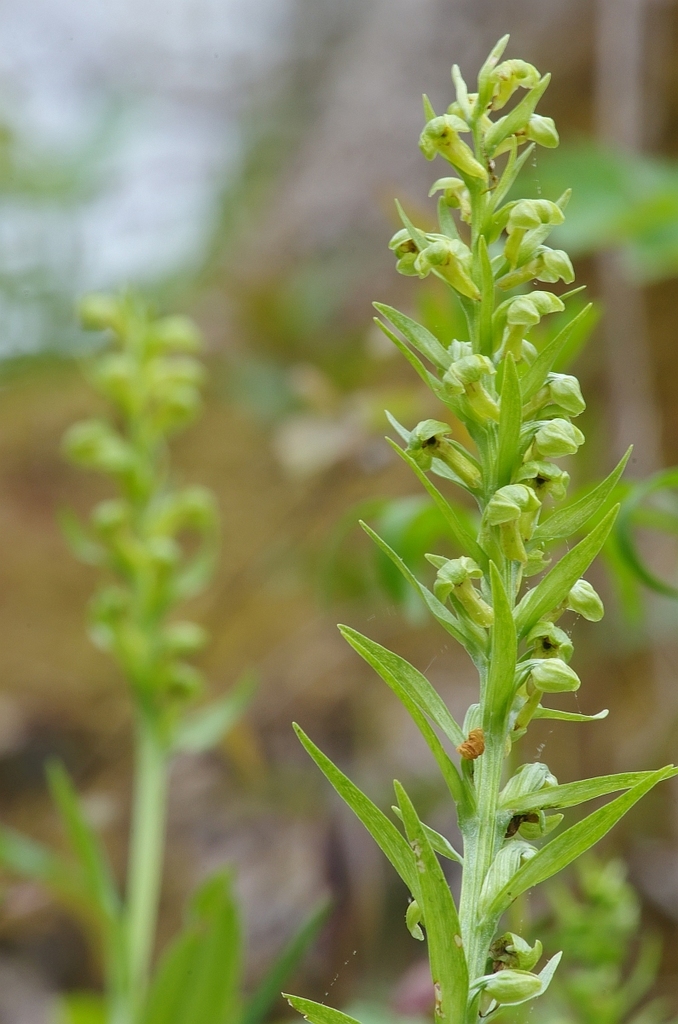
Frog Orchid
Dactylorhiza viridis
Coeloglossum is a genus of orchids. It has long been considered to have only one species, Coeloglossum viride, the frog orchid. Some recent classifications regard Coeloglossum as part of the larger genus, Dactylorhiza, so that C. viride becomes Dactylorhiza viridis. Other sources continue to keep Coeloglossum viride separate.
From the article Dactylorhiza viridis on Wikipedia (CC BY-SA), quoted section by section
Description
The plant arises from fleshy, forked roots and ranges in height from 10 to 55 cm (3.9 to 22 in). The leaves of D. viridis are 5–14 cm (2.0–5.5 in) long and 2–7 cm (0.8–2.8 in) wide; leaves at the base of the orchid are obovate to elliptical, while leaves higher on the stem become lanceolate. Two to six leaves are found on one plant, and leafing is alternate. The inflorescence of the orchid is a dense raceme (spike-like cluster) containing 7 to 70 small flowers. Flowers are greenish in color, and often tinged with purple, reddish, or red-brown color. The flowers are subtended by conspicuous long, tapering bracts which are 1–6 cm (0.4–2 in) long, with the lower bracts longer and typically greatly exceeding the length of the flower. The sepals are oval with little or no point, 3–7 mm long and 2–4 mm wide and dark green. The sepals join with the petals to form a hood opposite the labellum (lower petal) of the flower. Petals are long and narrow, 3.5–5 mm long and about 0.5 mm wide, and curve inwards. The labellum is strap-shaped and usually split at the very tip to form two or three tooth-like divisions, with the middle tooth smaller than the others. It is 5–11 mm long and 1–4 mm wide. A 2–3 mm long nectar spur projects behind the labellum. Dactylorhiza viridis flowers in late May and early June. …
Range & habitat
Dactylorhiza viridis has a wide distribution across the cooler parts of the Northern Hemisphere, covering much of Europe, non-tropical Asia (Russia, Japan, China, the upper Himalayas, etc.), much of Canada and parts of the United States (Alaska, Northeast, the Appalachians, Great Lakes Region, Northern Great Plains, and Rocky Mountains). It is typically found growing in moist, rich soil in wet meadows, moist or wet deciduous woods and thickets, and is frequently found on steep slopes.
Wikipedia: “Distribution”
What it does
Dactylorhiza viridis is mainly pollinated by beetles and a wide range of Hymenoptera including ants. This orchid species is able to form symbiotic partnerships with a variety of fungi including Ceratobasidium sp., Epulorhiza anaticulata, Moniliopsis anomala, Rhizoctonia sp., Tulasnella cucumeris and Tulasnella calospora.
Wikipedia: “Ecology”
Where it lives
Recorded sightings
—
geo-referenced records in GBIF, from museums, herbaria and field observers.
Drag the globe to turn it. Dots are where records exist, not a range map; darker means more records.
In the stacks
Searching the stacks…
Every page naming Dactylorhiza viridis in the Biodiversity Heritage Library →
This page is assembled live from iNaturalist, GBIF, Wikipedia, the Source Library and the Internet Archive. It is not yet part of the hand-edited codex. iNaturalist taxon 128599.