- Plants
- ›Vascular Plants
- ›flowering plants
- ›Dicots
- ›Buttercups, Poppies, and Allies
- ›Poppy Family
- ›Poppy Subfamily
- ›Papavereae
- ›Argemone
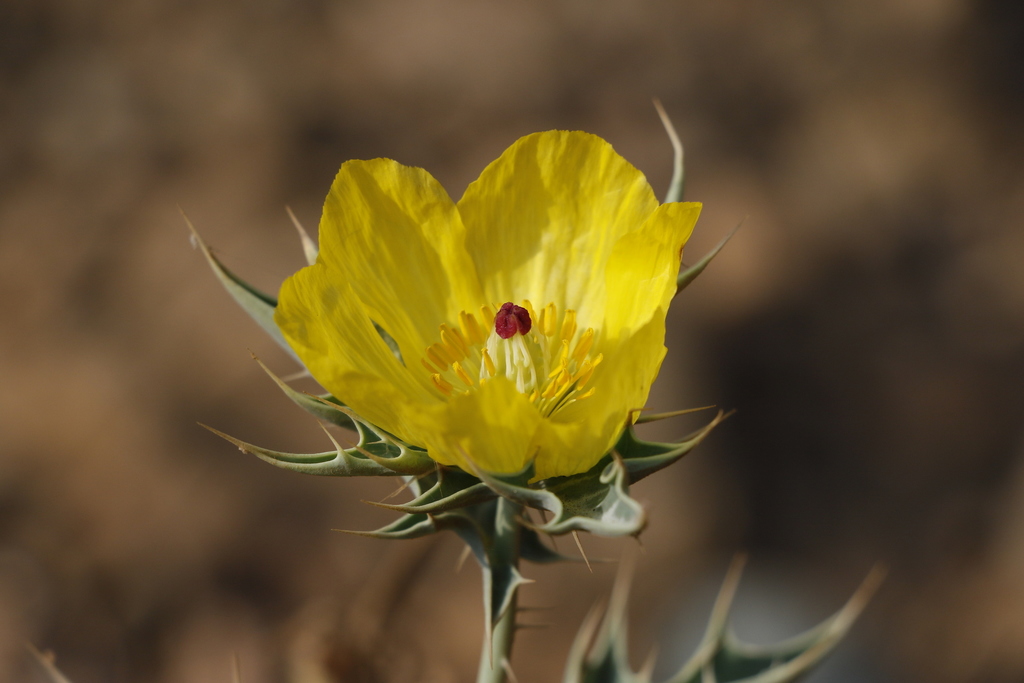
Mexican prickly poppy
Argemone mexicana
Argemone mexicana, also known by the common names Mexican poppy, Mexican prickly poppy, flowering thistle, cardo, and cardosanto, is a species of poppy found in Mexico and now widely naturalized in many parts of the world. An extremely hardy pioneer plant, it is tolerant of drought and poor soil, often being the only cover on new road cuttings or verges. It has bright yellow latex. It is poisonous to grazing animals, and it is rarely eaten, but it has been used medicinally by many peoples, including those in its native area, as well as the indigenous peoples of the western United States, parts of Mexico, and many parts of India. In India, during the colorful festival Holika Dahan, adults and children worship by offering flowers, and this species is in its maximum flowering phase during March when the Holi festival is celebrated. It is also referred to as "Kanteli Ka Phul" and "Satyanashi" in India.
From the article Argemone mexicana on Wikipedia (CC BY-SA), quoted section by section
At the table
Biodiesel production from A. mexicana seed oil using crystalline manganese carbonate has been demonstrated.
Wikipedia: “Other uses”
In medicine
The Seri of Sonora, Mexico use the entire plant both fresh and dried. An infusion is made to relieve kidney pain post-natally. When the Spanish arrived in Sonora, they called it cardosanto, taken as a laxative. An Argemone mexicana tea is used in Mali to treat malaria. In the traditional medicine of India, the yellow sap of A. mexicana and the whole plant may be used as a supposed treatment for jaundice.
Wikipedia: “Traditional medicine”
Toxicity
The seeds resemble the seeds of Brassica nigra (mustard). As a result, mustard can be adulterated by argemone seeds, rendering it poisonous. Several significant instances of katkar poisoning have been reported in India, Fiji, South Africa and other countries. The last major outbreak in India occurred in 1998. 1% adulteration of mustard oil by argemone oil has been shown to cause clinical disease. In India, Argemone oil is mixed with sunflower oil and sesame oil to increase the quantity, but this adulteration causes health disorders and renowned brands display "no argemone oil" to qualify purity. Katkar oil poisoning causes epidemic dropsy, with symptoms including extreme swelling, particularly of the legs. All parts of plants are poisonous. Ingestion of them can cause perianal itching, pneumonia myocarditis and congestive cardiac failure, ascites, sarcoid-like skin changes, alopecia, hepatomegaly
Where it lives
Recorded sightings
—
geo-referenced records in GBIF, from museums, herbaria and field observers.
Drag the globe to turn it. Dots are where records exist, not a range map; darker means more records.
In the old herbals & bestiaries

In the stacks
Searching the stacks…
Every page naming Argemone mexicana in the Biodiversity Heritage Library →
This page is assembled live from iNaturalist, GBIF, Wikipedia, the Source Library and the Internet Archive. It is not yet part of the hand-edited codex. iNaturalist taxon 128533.