- Plants
- ›Vascular Plants
- ›flowering plants
- ›Dicots
- ›pinks, cactuses, and allies
- ›Amaranth family
- ›Gomphrenoideae
- ›Gomphrena
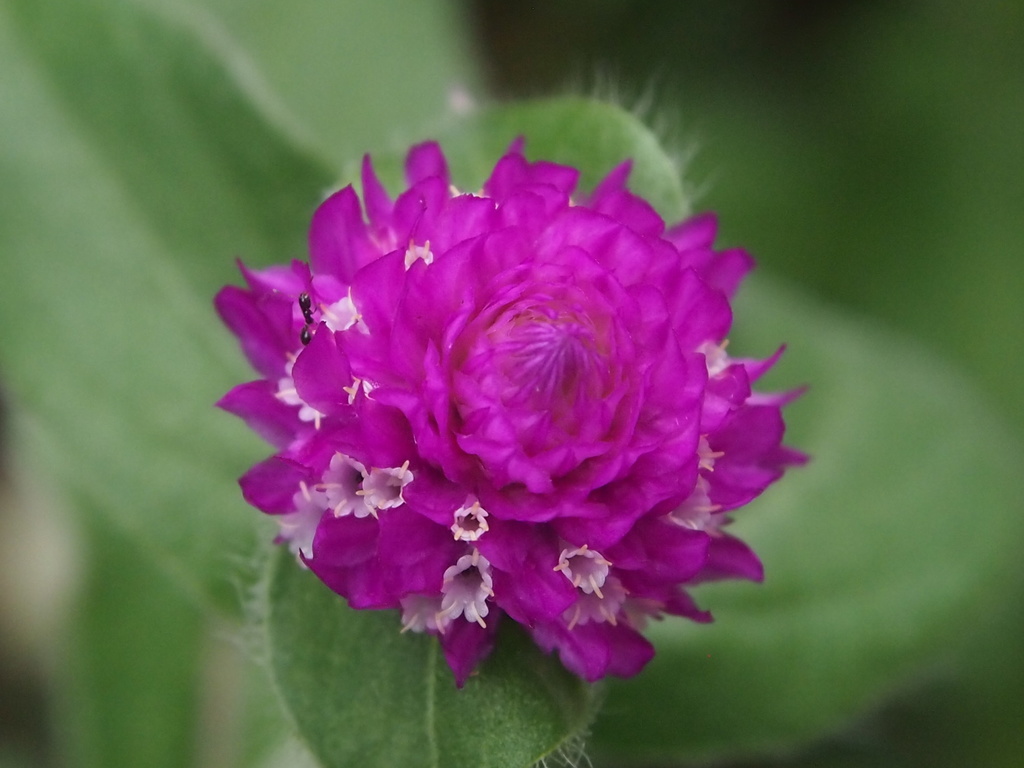
Globe amaranth
Gomphrena globosa
Gomphrena globosa, commonly known as globe amaranth, is an edible plant from the family Amaranthaceae. The round-shaped flower inflorescences are a visually dominant feature and cultivars have been propagated to exhibit shades of magenta, purple, red, orange, white, pink, and lilac. Within the flowerheads, the true flowers are small and inconspicuous.
Gomphrena globosa is native to Central America including regions Panama, and Guatemala, but is now grown globally. As a tropical annual plant, G. globosa blooms continuously throughout summer and early fall. It is very heat tolerant and fairly drought resistant, but grows best in full sun and regular moisture. The plant fixes carbon through the C4 pathway. At maturity, the flowerheads are approximately 4 centimetres (1.6 in) long and the plant grows up to 24 inches (61 cm) in height.
From the article Gomphrena globosa on Wikipedia (CC BY-SA), quoted section by section
At the table
In Hawaii, it is commonly used in long-lasting leis since it retains its shape and color after drying. In Nepal, the flower is known commonly as makhamali ful and is used to make a garland during Bhai Tika, last day of Tihar festival. The garland is put around the brother's neck by their sister for protection. The slow withering character of the flower symbolizes a long life for the brother. The flower was included in the gift sent to Britain by Jung Bahadur Rana in 1855. This flower is known as Rakta Mallika in Sanskrit. This plant is common in landscape design and cutting gardens for its vivid colors and color retention. The edible plant G. globosa has been used in herbal medicine. The flowers of G. globosa are rich in betacyanins which have a wide range of applications as additives and supplements in the food industry, cosmetics, and livestock feed. Stable between pH 3 and 7, the betacyanins in globe amaranth are well suited to be used as natural food dye and have a red-violet color.
Wikipedia: “Uses”
In medicine
At least twenty-seven phytochemicals have been detected in G. globosa including six phenolic acid derivatives and fifteen specific flavonoids. The most abundant phenolic compounds present are flavonoids. A major phenol was found to be kaempferol 3-O-rutinoside based on chromatographic and mass spectrometry techniques. Gomphrenol derivatives also contribute to phenolic content. Other flavanols include quercetin, kaempferol, and isorhamnetin derivatives.
Wikipedia: “Phytochemicals”
Where it lives
Recorded sightings
—
geo-referenced records in GBIF, from museums, herbaria and field observers.
Drag the globe to turn it. Dots are where records exist, not a range map; darker means more records.
In the old herbals & bestiaries

In the stacks
Searching the stacks…
Every page naming Gomphrena globosa in the Biodiversity Heritage Library →
This page is assembled live from iNaturalist, GBIF, Wikipedia, the Source Library and the Internet Archive. It is not yet part of the hand-edited codex. iNaturalist taxon 128268.