- Plants
- ›Vascular Plants
- ›flowering plants
- ›Dicots
- ›Roses, Elms, Figs, and Allies
- ›buckthorn family
- ›Ceanothus
- ›Ceanothus
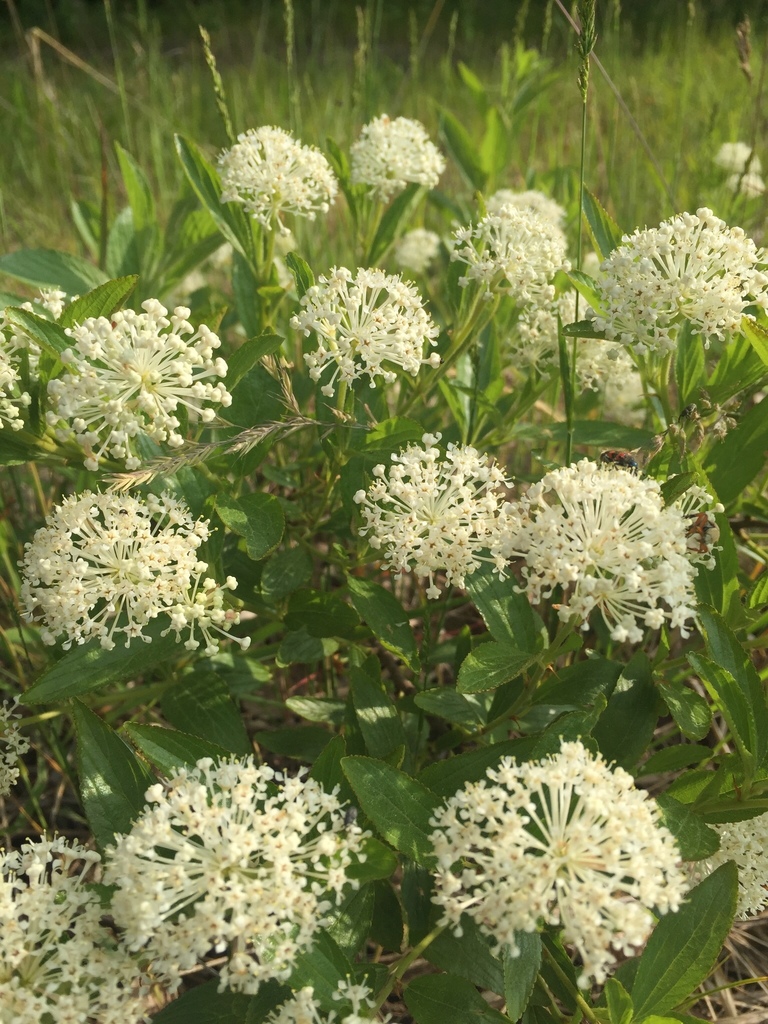
inland ceanothus
Ceanothus herbaceus
Ceanothus herbaceus, also known as Jersey tea, is a species of shrub in the family Rhamnaceae and is similar to Ceanothus americanus and Ceanothus sanguineus. It is a perennial shrub which is native to North America.
From the article Ceanothus herbaceus on Wikipedia (CC BY-SA), quoted section by section
Description
Ceanothus herbaceus is an erect shrub, ranging between 0.5 and 1 meter in height. The shrub is mainly hemispheric in shape with its branches varying from ascending to spreading. The distal branchlets, which grows from the main stem are flexible and have internodes between 12–31 mm long. They are usually smooth in texture and green in color. The bark of the stem is grayish brown, and the stipules, which are outgrowths on either side of the base of a leaf stalk, are thin and deciduous. The leaves of the shrub are alternate and deciduous. The petiole, which attaches the leaf blade to the stem, is approximately 3–5 mm long. The leaf blades vary between 35–74 mm longitudinally and 10–32 mm laterally and come in a diverse shapes, including wide, narrowly elliptic to lanceolate, eventually narrowing to acute to obtuse point at the apex. Three veins arise unevenly just above the leaf base. The leaves are serrated with rounded teeth around the margin; about 37–71 per leaf. The upper surface of the leaf is dull green and nearly glabrous. The lower surface is dull green with long, soft unmatted hair, often drying rusty brown. The shrub has a terminal inflorescence which is approximately 15–30 mm long. It is panicle-like and maintains a hemispheric shape. Holding the inflorescence and providing it support is a long stem, known as peduncle. …
Wikipedia: “Morphology”
Range & habitat
Ceanothus herbaceus naturally occurs throughout North America. It can be found in Canada from southeastern Manitoba to Quebec. Within the United States, the plant can be found from Montana east to Massachusetts and Virginia. They range south from Rocky Mountains to New Mexico, east to Arkansas and Louisiana.
Wikipedia: “Distribution”
What it does
The Jersey tea is a drought-tolerant species with roots that can develop up to 15 feet. It grows in well-drained soils and in full sun. The basal shoots grows faster following a fire. It is one of the host plants of the mottled duskywing (Erynnis martialis) in its Eastern-North American distribution.
Wikipedia: “Habitat and ecology”
Where it lives
Recorded sightings
—
geo-referenced records in GBIF, from museums, herbaria and field observers.
Drag the globe to turn it. Dots are where records exist, not a range map; darker means more records.
In the stacks
Searching the stacks…
Every page naming Ceanothus herbaceus in the Biodiversity Heritage Library →
This page is assembled live from iNaturalist, GBIF, Wikipedia, the Source Library and the Internet Archive. It is not yet part of the hand-edited codex. iNaturalist taxon 128036.