- Plants
- ›Vascular Plants
- ›flowering plants
- ›Dicots
- ›Roses, Elms, Figs, and Allies
- ›mulberry and fig family
- ›Dorstenieae
- ›Broussonetia
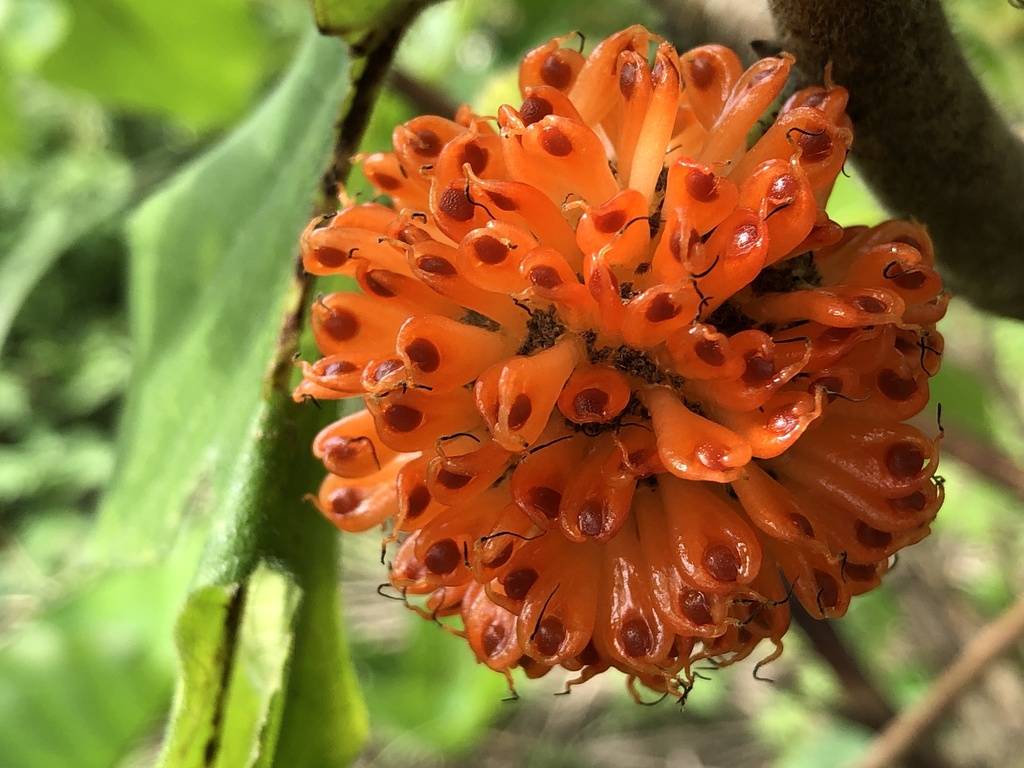
Paper mulberry
Broussonetia papyrifera
The paper mulberry (Broussonetia papyrifera, syn. Morus papyrifera L.) is a species of flowering tree in the family Moraceae. It is native to East and Southeast Asia, including mainland China, Hong Kong, India, Japan, Korea, Myanmar and Taiwan. It is widely cultivated elsewhere as an introduced species in New Zealand, parts of Europe, the United States, and Africa. The tree is valued for its versatile uses. Its inner bark is traditionally processed into barkcloth and is also an important raw material in papermaking.
Other common names include aute and tapa cloth tree. The specific Latin epithet papyrifera describes the use of its barks for papermaking.
From the article Paper mulberry on Wikipedia (CC BY-SA), quoted section by section
Description
This species is a deciduous shrub or tree usually growing 10–20 m (33–66 ft) tall, but known to reach 35 m (115 ft) at times. The leaves are variable in shape, even on one individual. The blades may be lobed or unlobed, but they usually have toothed edges, lightly hairy, pale undersides, and a rough texture. They are up to about 15–20 cm (5.9–7.9 in) long. The species has male and female flowers on separate plants. The staminate inflorescence is a catkin up to 8 cm (3.1 in) long with fuzzy male flowers. The pistillate inflorescence is a spherical head up to about 2 cm (0.79 in) wide with greenish female flowers trailing long styles. The infructescence is a spherical cluster 2–3 cm (0.79–1.18 in) wide containing many red or orange fruits. Each individual protruding fruit in the cluster is a drupe.
At the table
This plant has been cultivated in Asia and some Pacific Islands for many centuries for food, fiber, and medicine.
Barkcloth. Paper mulberry was the principal source of barkcloth, known as tapa in most Polynesian languages. Although barkcloth was also be made from members of Moraceae family, including Ficus (figs) and Artocarpus, and was occasionally made from Pipturus nettles, especially in Hawaii, the highest quality was made from paper mulberry. Among ancient Austronesians, barkcloth was a primary clothing material produced with stone or wooden beaters, which are among the most common artifacts found in Austronesian archaeological sites. Early examples from the Dingmo site in Guangxi, dated to around (c. 7,900 BP) and numerous finds in southern China, especially around the Pearl River Delta, have been cited as evidence for pre-Taiwan Austronesian homelands prior to the southward expansion of the Han dynasty. …
Wikipedia: “Uses”
Where it lives
Recorded sightings
—
geo-referenced records in GBIF, from museums, herbaria and field observers.
Drag the globe to turn it. Dots are where records exist, not a range map; darker means more records.
In the old herbals & bestiaries

農業全書 11巻. [7]
Miyazaki Yasusada · 1697 · p.12

Compendium of Materia Medica
李時珍 · 1596 · p.48

Compendium of Materia Medica
李時珍 · 1596 · p.53

Illustrated Herbal Primer
Chen Jiamo (陳嘉謨) · 1628 · p.180

Exotic Pleasures (Persia and Asia observations)
Engelbert Kaempfer · 1712 · p.542

Complete Treatise on Agricultural Administration
Xu Guangqi · 1909 · p.797
In the stacks
Searching the stacks…
Every page naming Broussonetia papyrifera in the Biodiversity Heritage Library →
This page is assembled live from iNaturalist, GBIF, Wikipedia, the Source Library and the Internet Archive. It is not yet part of the hand-edited codex. iNaturalist taxon 128032.