- Animals
- ›Cnidarians
- ›True Jellies
- ›Discomedusans
- ›Root-mouth Jellies
- ›Dactyliophoran Jellies
- ›Rhizostomatoidea
- ›Cannonball Jellies
- ›Stomolophus
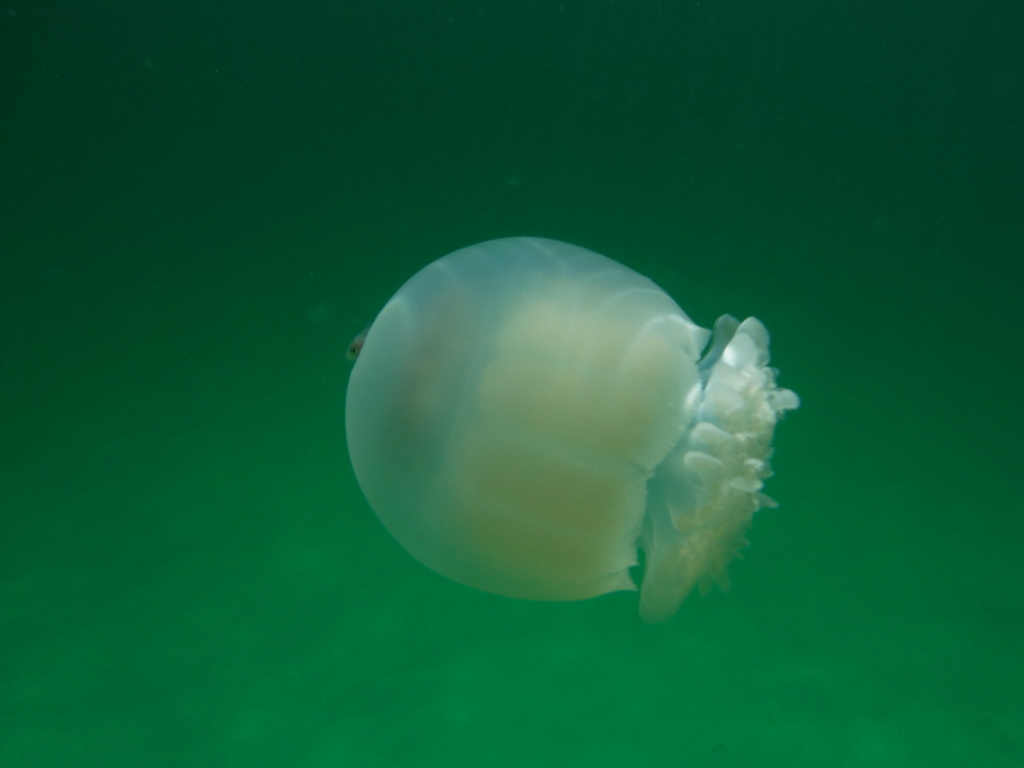
Cannonball Jelly
Stomolophus meleagris
The cannonball jellyfish (Stomolophus meleagris), also known as the cabbagehead jellyfish, is a species of jellyfish in the family Stomolophidae. Its common name derives from its similarity to a cannonball in shape and size. Its scientific name means “many mouthed hunter”. Its dome-shaped bell can reach 25 cm (10 in) in diameter. The rim is often colored with brown pigment. There are several known undescribed Stomolophus species found in the Pacific and South Atlantic that exhibit pale to blue pigment. They are genetically different from the individuals found in the North Atlantic - but are commonly misidentified as such. Underneath the body is a cluster of oral arms that extend out around the mouth. These arms function in propulsion and as an aid in catching prey. Cannonballs are prominent from North America's eastern seaboard to the Gulf of Mexico.
From the article Cannonball jellyfish on Wikipedia (CC BY-SA), quoted section by section
Range & habitat
They are common on the southeastern coast of the United States, including the Gulf Coast. They have also been found throughout the Atlantic Ocean from New England to Brazil and in the Pacific Ocean from California to Ecuador and from the Sea of Japan to the South China Sea. On the southeast coast they are extremely abundant in the fall and summer months. During these months, cannonballs make up over 16% of the biomass in the shallow inshore areas.
Wikipedia: “Habitat”
What it does
Cannonballs eat mainly zooplankton such as veligers, and also all forms of red drum larvae. Several species of Brachyura crustaceans have a communalistic relationship with scyphomedusae. Among cannonball jellyfish, they primarily have a relationship with juvenile portly spider crab usually until they reach sizes of 15-20 mm. However, adult crabs have been witnessed to live in the bell. The spiders often eat the food the cannonball catches and its tissue, but its regenerative abilities mean it does not negatively impact the cannonball. Most cannonballs have just one spider crab in their bells, but a cannonball has been witnessed with up to ten.
Wikipedia: “Diet”
Where it lives
Recorded sightings
—
geo-referenced records in GBIF, from museums, herbaria and field observers.
Drag the globe to turn it. Dots are where records exist, not a range map; darker means more records.
In the stacks
Searching the stacks…
Every page naming Stomolophus meleagris in the Biodiversity Heritage Library →
This page is assembled live from iNaturalist, GBIF, Wikipedia, the Source Library and the Internet Archive. It is not yet part of the hand-edited codex. iNaturalist taxon 126393.