- Plants
- ›Vascular Plants
- ›flowering plants
- ›Dicots
- ›Buttercups, Poppies, and Allies
- ›Poppy Family
- ›Fumitory subfamily
- ›Corydaleae
- ›Corydalis
- ›Corydalis
- ›Radix-cava
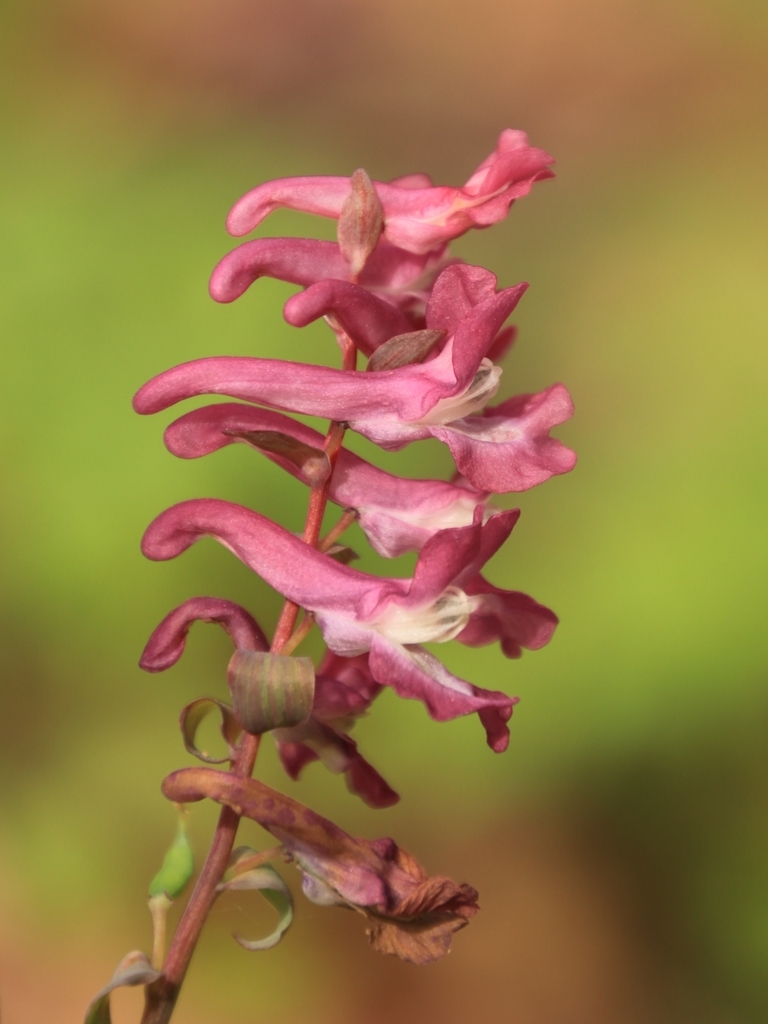
Hollowroot
Corydalis cava
Corydalis cava is a species of flowering plant in the family Papaveraceae, native to moist, shady, woodland habitats throughout most of mainland Europe, although commonest in central and southeast Europe.
Its range extends from Spain in the west to Ukraine, Belarus and the Caucasus in the east and as far north as Sweden. It is absent from (though may sometimes be found in a naturalised state in) Iceland, the UK, the Netherlands, Norway, Finland, Russia and Greece.
From the article Corydalis cava on Wikipedia (CC BY-SA), quoted section by section
Description
Corydalis cava grows 15 cm (6 in) to 30 cm (12 in) tall. It is a spring ephemeral—foliage that grows in the spring dies down to its tuberous rootstock in summer. It has long-spurred flowers which appear in spring. The flowers may be mauve, purple, red, or white. The seeds contain an elaiosome that attracts ants, which transport the seeds into their ant colony. This seed transportation is called myrmecochory.
Toxicity
Many of the species in Corydalis contain alkaloids such as canadine and corydaline, which blocks calcium. The majority of these belong to the isoquinoline alkaloid group. All parts of the plant are alkaloidal but the highest concentrations are present in the hollow root tuber. Corydalis cava and some other tuberous species contain the alkaloid bulbocapnine, which is occasionally used in medicine but for which scientific evidence is lacking in regard to correct dosage and side effects.
Where it lives
Recorded sightings
—
geo-referenced records in GBIF, from museums, herbaria and field observers.
Drag the globe to turn it. Dots are where records exist, not a range map; darker means more records.
In the old herbals & bestiaries

Notable Commentaries on the History of Plants
Leonhart Fuchs · 1542 · p.125

Notable Commentaries on the History of Plants
Leonhart Fuchs · 1549 · p.123

Six Groups of the History of Plants
Rembert Dodoens · 1583 · p.346

Six Groups of the History of Plants
Rembert Dodoens · 1583 · p.346

History of Rare Plants
Carolus Clusius · 1601 · p.283
In the stacks
Searching the stacks…
Every page naming Corydalis cava in the Biodiversity Heritage Library →
This page is assembled live from iNaturalist, GBIF, Wikipedia, the Source Library and the Internet Archive. It is not yet part of the hand-edited codex. iNaturalist taxon 126193.