- Plants
- ›Vascular Plants
- ›flowering plants
- ›Dicots
- ›Mustards, Capers, and Allies
- ›mustard family
- ›Brassicoideae
- ›Camelinodae
- ›Cardamineae
- ›Cardamine
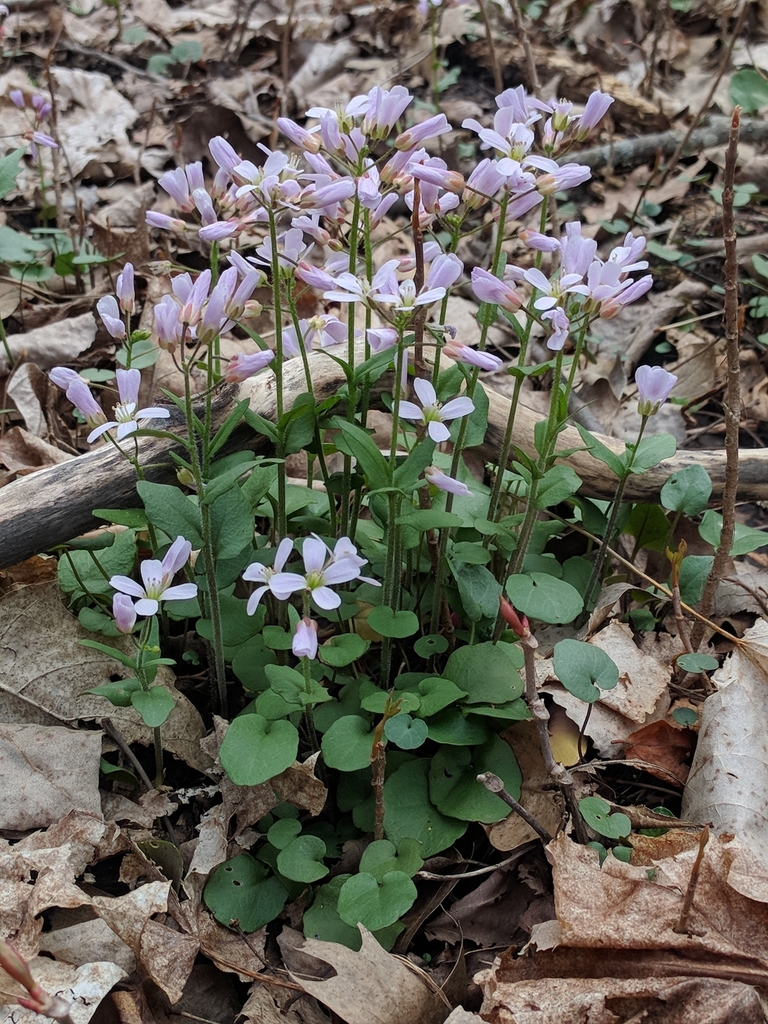
Purple Cress
Cardamine douglassii
Cardamine douglassii (known by the common names limestone bittercress and purple cress) is a perennial forb native to the eastern and central United States as well as the province of Ontario in Canada, that produces white to pink or purple flowers in early spring.
From the article Cardamine douglassii on Wikipedia (CC BY-SA), quoted section by section
Description
Cardamine douglassii has an erect unbranched stem which is 10–25 centimetres (4–10 inches) tall and sparsely to densely hairy. The basal leaves are simple, heart shaped or round, 5–15 cm (2–6 in), borne on 4–12 cm (1+1⁄2–4+3⁄4 in) long petioles. There are 3 to 8 oblong to lanceolate leaves on the stem, which are 2–5 cm (3⁄4–2 in) long and 5 to 25 millimetres (1⁄4 to 1 in) wide. The margins may be smooth or coarsely toothed. Although colors range from purple to a purplish white, entirely white petals are rare among this species. The flowers are borne in a raceme and are typically born from mid-March to late April. The petals are 7 to 15 mm (1⁄4 to 1⁄2 in) long and 3 to 5 mm wide. The fruit is linear, 1.5–4 cm (1⁄2–1+1⁄2 in) long and 1.5 to 2 mm wide.
Range & habitat
Cardamine douglassii is widely distributed in Ontario and the eastern and central United States, although local distribution may be spotty. It ranges from Massachusetts west to Ontario, Minnesota, and Missouri south as far as Arkansas, Alabama, and the Carolinas. Cardamine douglassii is listed as an endangered species by the Commonwealth of Massachusetts, and as a species of special concern by the State of Connecticut. In Virginia, it grows in habitats such as swamps and forests, generally with base rich soils. The presence of this species is dependent on appropriate habitat, and it may be eliminated from an area by development, changes in land use, or competition with invasive species.
Wikipedia: “Distribution and habitat”
Where it lives
Recorded sightings
—
geo-referenced records in GBIF, from museums, herbaria and field observers.
Drag the globe to turn it. Dots are where records exist, not a range map; darker means more records.
In the stacks
Searching the stacks…
Every page naming Cardamine douglassii in the Biodiversity Heritage Library →
This page is assembled live from iNaturalist, GBIF, Wikipedia, the Source Library and the Internet Archive. It is not yet part of the hand-edited codex. iNaturalist taxon 125902.