- Plants
- ›Vascular Plants
- ›flowering plants
- ›Dicots
- ›beeches, oaks, walnuts, and allies
- ›beech family
- ›Quercus
- ›Quercus
- ›Quercus
- ›Quercus
- ›Quercus pubescens
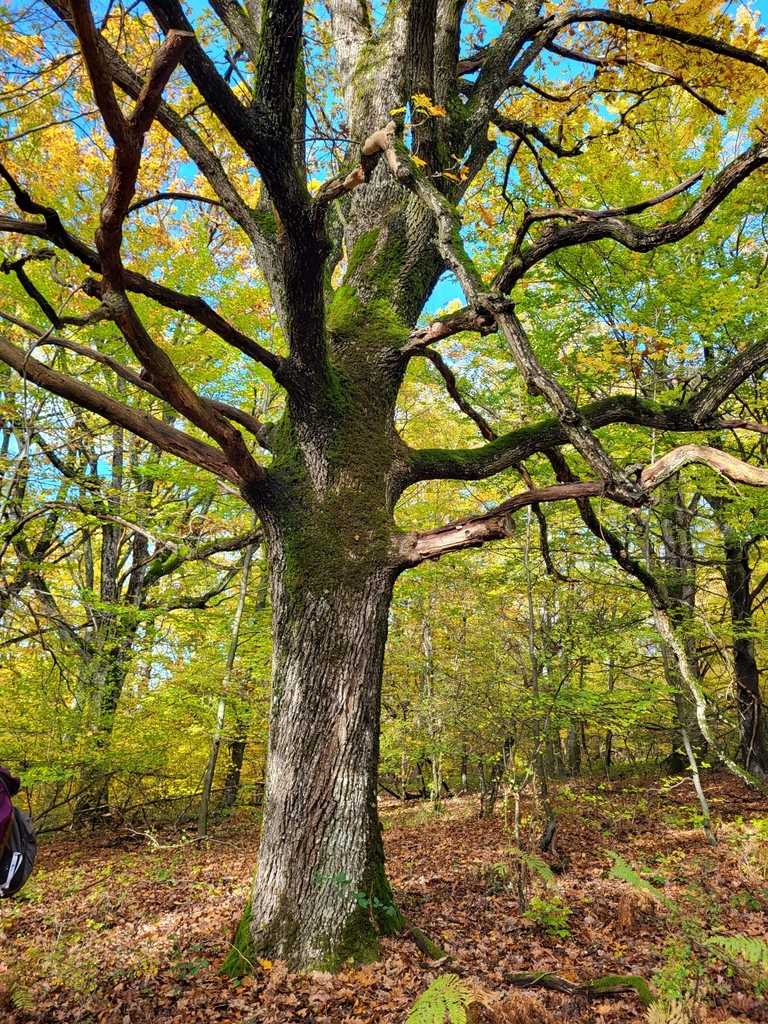
downy oak
Quercus pubescens
Quercus pubescens (synonyms virgiliana), commonly known as the downy oak, pubescent oak or Italian oak, is a species of white oak (genus Quercus sect. Quercus) native to southern Europe and southwest Asia. It is found from northern Spain (Pyrenees) and France in the West to Turkey and the Caucasus in the East.
From the article Quercus pubescens on Wikipedia (CC BY-SA), quoted section by section
Description
Quercus pubescens is a medium-sized deciduous tree growing up to 20 metres (66 feet). Forest-grown trees grow tall, while open-growing trees develop a very broad and irregular crown. They are long-lived, to several hundred years, and eventually grow into very stout trees with trunks up to 2 m (6+1⁄2 ft) in diameter. Open-grown trees frequently develop several trunks. The bark is very rough, light gray and divided into small flakes. Large trees develop very thick whitish bark cracked into deep furrows, similar to the pedunculate oak but lighter in colour. The twigs are light purple or whitish, with tomentum. The buds are small (3–6 millimetres or 1⁄8–1⁄4 inch) and blunt, light brown. The leaves are leathery usually 4–10 centimetres (1+1⁄2–4 in) long (rarely to 13 cm) and 3–6 cm wide, usually widest beyond the middle. The leaves group at the ends of twigs. The upper leaf surface is dark green and rough, the lower light green. Both leaf surfaces are covered with minute pubescence which is sometimes lost in older leaves by late summer. The young expanding leaves are whitish or pinkish with very soft tomentum. The leaf shape is very variable, divided into 3–7 pairs of deep or shallow lobes, which are usually divided into a few sublobes. The lobes are usually blunt, rarely sharp. The apex is usually wide and round. …
Range & habitat
Downy oaks typically grow in dry, lime-rich soils. It is a sub-Mediterranean species, growing from the coastline to deep in the continent. Its optimum is in transitional Mediterranean-oceanic climates, characterized by warm to hot, dry summers and cool (though not mild) winters with ample precipitation.
Wikipedia: “Habitat”
Where it lives
Recorded sightings
—
geo-referenced records in GBIF, from museums, herbaria and field observers.
Drag the globe to turn it. Dots are where records exist, not a range map; darker means more records.
In the stacks
Searching the stacks…
Every page naming Quercus pubescens in the Biodiversity Heritage Library →
This page is assembled live from iNaturalist, GBIF, Wikipedia, the Source Library and the Internet Archive. It is not yet part of the hand-edited codex. iNaturalist taxon 125849.