- Plants
- ›Vascular Plants
- ›flowering plants
- ›Dicots
- ›Roses, Elms, Figs, and Allies
- ›rose family
- ›Amygdaloideae
- ›Amygdaleae
- ›Prunus
- ›Padus
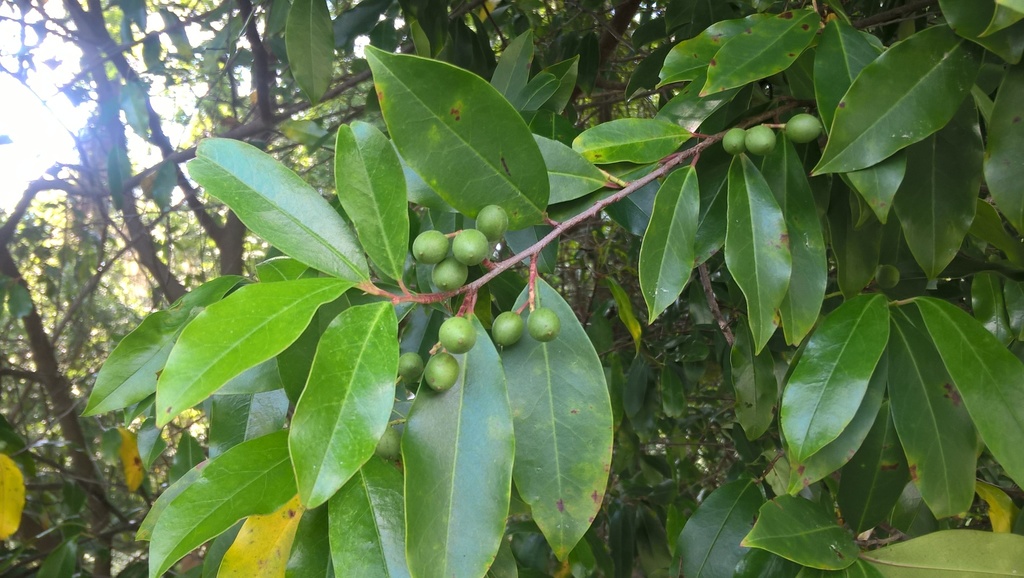
Carolina laurelcherry
Prunus caroliniana
Prunus caroliniana, known as the Carolina laurelcherry, Carolina cherry laurel, cherry laurel, or Carolina cherry, is a small evergreen flowering tree native to the lowlands of Southeastern United States, from North Carolina south to Florida and westward to central Texas. The species has also escaped into the wild in a few places in California.
From the article Prunus caroliniana on Wikipedia (CC BY-SA), quoted section by section
Description
Prunus caroliniana is a small to medium-sized evergreen tree that grows to approximately 5–13 meters (16–43 feet) tall, with a spread of about 6–9 m (20–30 ft). The leaves are dark green, alternate, shiny, leathery, elliptic to oblanceolate, 5–12 centimeters (2–4+1⁄2 inches) long, usually with an entire (smooth) margin, but occasionally serrulate (having subtle serrations), and with cuneate bases. The leaves of reproductively mature trees have entire margins, whereas those of immature trees often have subtle serrations. The twigs are red to grayish brown, slender, and glabrous. When crushed, the leaves and green twigs emit a fragrance described as resembling maraschino cherries or almond extract. Fragrant white to cream-colored flowers are produced in racemes (stalked bunches) 5–8 cm (2–3 in) long in the late winter to early spring (February–April). The fruits are tiny black cherries about 1 cm (1⁄2 in) in diameter, which persist through winter and are primarily consumed by birds.
Range & habitat
The species is native to the lowlands of Southeastern United States, from North Carolina south to Florida and westward to central Texas. The species also has escaped into the wild in a few places in California.
Wikipedia: “Distribution and habitat”
What it does
The tree is a host plant for coral hairstreak, eastern tiger swallowtail, red-spotted purple, spring azures, summer azures, and viceroy butterflies where adult butterflies nectar from the spring flowers while the fruits are eaten by songbirds, wild turkeys, quail, raccoons, foxes, and small mammals.
Wikipedia: “Ecology”
Toxicity
The leaves and branches contain high amounts of cyanogenic glycosides that break down into hydrogen cyanide when damaged, making it a potential toxic hazard to grazing livestock and children. Due to this, it is considered highly deer-resistant.
How it is grown
The species has long been an ornamental tree and landscape hedge shrub in gardens in many parts of the Atlantic states of the US. The tree is considered hardy in USDA zones 7B through 10A. It is often used in areas where a tough broadleaved evergreen tree is needed of modest size. It prefers full sun and well-drained, acidic soil, often developing chlorosis if grown in overly alkaline soil. It is known to grow to elevations of 152 m (500 ft).
Cultivars. Cultivated varieties include:
Prunus caroliniana 'Compacta' grows to about half the usual height and width of the species. Prunus caroliniana 'Cherry Ruffles' has wavy/ruffled leaf margins.
Wikipedia: “Cultivation”
Where it lives
Recorded sightings
—
geo-referenced records in GBIF, from museums, herbaria and field observers.
Drag the globe to turn it. Dots are where records exist, not a range map; darker means more records.
In the stacks
Searching the stacks…
Every page naming Prunus caroliniana in the Biodiversity Heritage Library →
This page is assembled live from iNaturalist, GBIF, Wikipedia, the Source Library and the Internet Archive. It is not yet part of the hand-edited codex. iNaturalist taxon 125845.