- Plants
- ›Vascular Plants
- ›flowering plants
- ›Dicots
- ›saxifrages, stonecrops, and allies
- ›Gooseberry Family
- ›Ribes
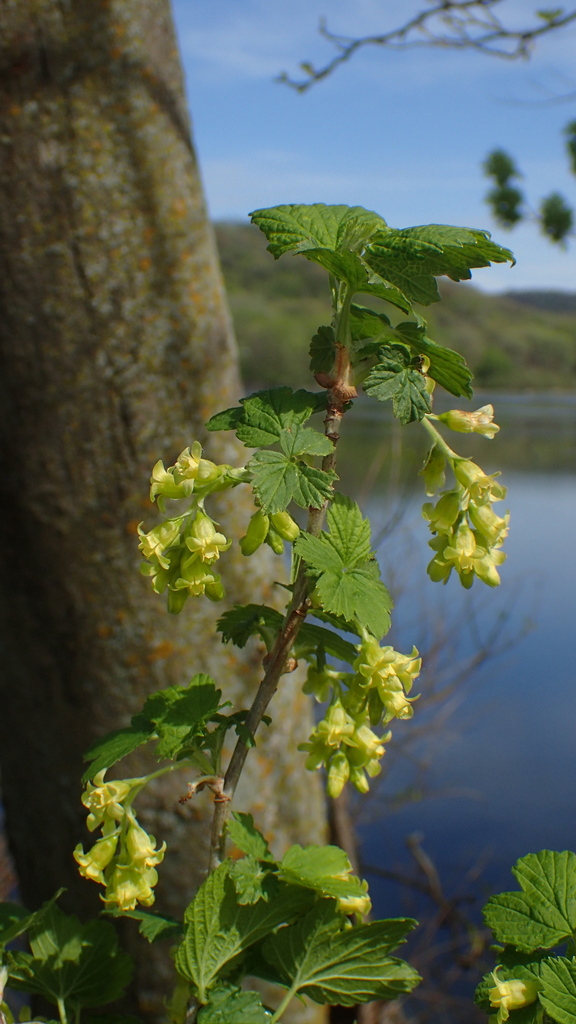
American Black Currant
Ribes americanum
Ribes americanum is a North American species of flowering plant in the gooseberry family known by the common names American black currant, wild black currant, and eastern black currant. It is widespread in much of Canada (from Alberta to Nova Scotia), the northern United States (from New England to Washington, with additional populations in Colorado and New Mexico).
From the article Ribes americanum on Wikipedia (CC BY-SA), quoted section by section
Description
Ribes americanum is a shrub growing 0.5 to 1.5 meters (20-60 inches) in height. The branches are erect and bear deciduous leaves. There are no spines. The plant may form thickets. The glandular leaves are up to 7–8 cm (3–3 in) long and have 3 or 5 lobes. They turn red and gold in the fall. The inflorescence is a spreading or drooping raceme of up to 15 flowers. Each flower has reflexed white or greenish sepals a few millimeters long and smaller whitish petals. The fruit is a smooth rounded black berry about a centimeter (0.4 inch) wide and edible when cooked. The plant reproduces mostly by seed.
Range & habitat
This shrub is native to the United States and Canada where grows in a variety of ecosystems. It occurs in many types of forests and in conifer bogs. In Manitoba it can be found in marshes. In the Great Lakes region it grows abundantly in sedge meadows (Carex spp.). Ribes americanum grows on plains and in mountains and sometimes in disturbed areas such as roadsides. It is also shade-tolerant, growing in the understory of closed-canopy woodlands and forests. It has also been introduced to northern China.
Wikipedia: “Distribution and habitat”
What it does
Several bee species visit the flowers: Augochlora pura, Augochlorella aurata, Ceratina calcarata, Ceratina dupla, and Ceratina strenua. This plant is an alternate host for the white pine blister rust (Cronartium ribicola), the vector of a pine tree disease. It is sometimes eradicated in attempts to control the rust. The cluster cup rust (Puccinia caricina) forms aecia on the leaves of Ribes americanum in the spring, later developing brown blotches of pustules. The telia are formed on sedges (Carex).
Wikipedia: “Ecology”
At the table
Native Americans made pemmican from the berries, which are also known for being made into jam and jelly.
== References ==
Wikipedia: “Uses”
Where it lives
Recorded sightings
—
geo-referenced records in GBIF, from museums, herbaria and field observers.
Drag the globe to turn it. Dots are where records exist, not a range map; darker means more records.
In the stacks
Searching the stacks…
Every page naming Ribes americanum in the Biodiversity Heritage Library →
This page is assembled live from iNaturalist, GBIF, Wikipedia, the Source Library and the Internet Archive. It is not yet part of the hand-edited codex. iNaturalist taxon 125487.