- Plants
- ›Vascular Plants
- ›flowering plants
- ›Dicots
- ›pinks, cactuses, and allies
- ›pink family
- ›Caryophylloideae
- ›Sileneae
- ›Silene
- ›Silene
- ›Siphonomorpha
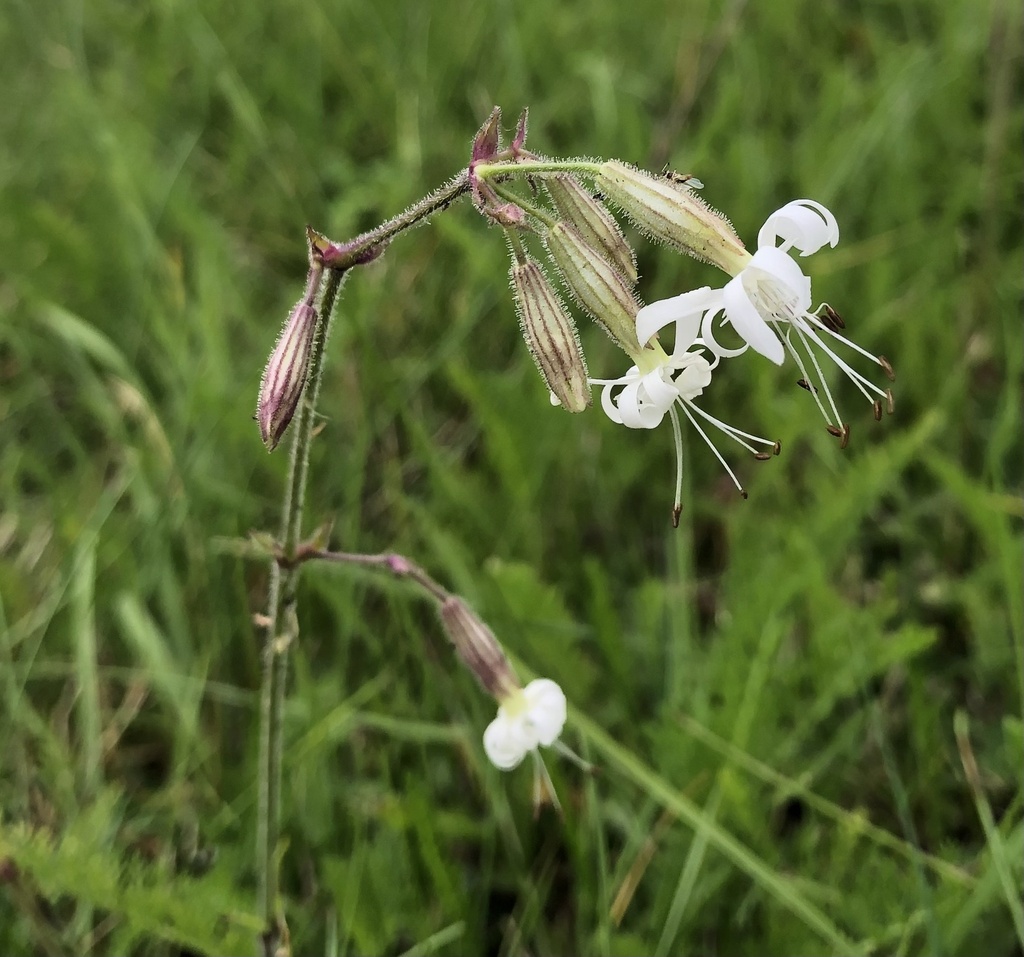
Nottingham Catchfly
Silene nutans
Silene nutans is a flowering plant in the genus Silene, most commonly known as Nottingham catchfly.
From the article Silene nutans on Wikipedia (CC BY-SA), quoted section by section
Description
Silene nutans is a diploid, mainly outcrossing, herbaceous, perennial plant. It grows up to 25–80 centimetres (10–31 in) tall, from a branching, woody stock with a thick taproot. The lower leaves are up to 75 millimetres (3 in) long, spathulate and have a long stalk, while leaves higher on the plant are lanceolate, subsessile and acute; all the leaves are covered in soft hairs. The flowers are 18 millimetres (0.7 in) wide, 12 millimetres (0.5 in) long, and drooping, on short, viscid stalks. The petals are white or pinkish and divided into two narrow lobes. Each flower remains open for three nights as a means of preventing self-fertilisation; the flower reveals one whorl of stamens on the first night, the second whorl of stamens on the second night, and the three styles on the third night. The seeds are 10–22 millimetres (0.4–0.9 in) wide and kidney-shaped.
Range & habitat
Silene nutans is widespread across Europe, from southern Spain and Italy north to the British Isles and Scandinavia, and is also found across large parts of Asia. It has been introduced to North America, where it is known as the Eurasian catchfly. It is found in the U.S. states of Michigan, Ohio, New York, Vermont and Maine. Silene nutans can sometimes be found in the very widespread MG1 (Arrhenatherum elatius grassland) community of the British National Vegetation Classification, and thus can be found where Arrhenatherum elatius (false oat grass) or Dactylis glomerata (cocksfoot) occur.
Wikipedia: “Distribution”
What it does
Silene nutans is a steppe species across most of its range. At the periphery of its distribution, it has a patchy distribution in xeric habitats, such as open grasslands and on rock outcrops at forest margins, on both acidic and alkaline substrates (pH 3.8–8.0). In the far north of its range, S. nutans is characteristic of maritime cliffs. Silene nutans flowers during the night, and produces a strong floral scent to attract its pollinators, which are mostly night-flying moths. Chemical compounds in the scent include benzyl acetate and benzaldehyde. Silene nutans is the host plant for the leaf mining moth Coleophora galbulipennella.
Wikipedia: “Ecology”
Where it lives
Recorded sightings
—
geo-referenced records in GBIF, from museums, herbaria and field observers.
Drag the globe to turn it. Dots are where records exist, not a range map; darker means more records.
In the stacks
Searching the stacks…
Every page naming Silene nutans in the Biodiversity Heritage Library →
This page is assembled live from iNaturalist, GBIF, Wikipedia, the Source Library and the Internet Archive. It is not yet part of the hand-edited codex. iNaturalist taxon 124138.