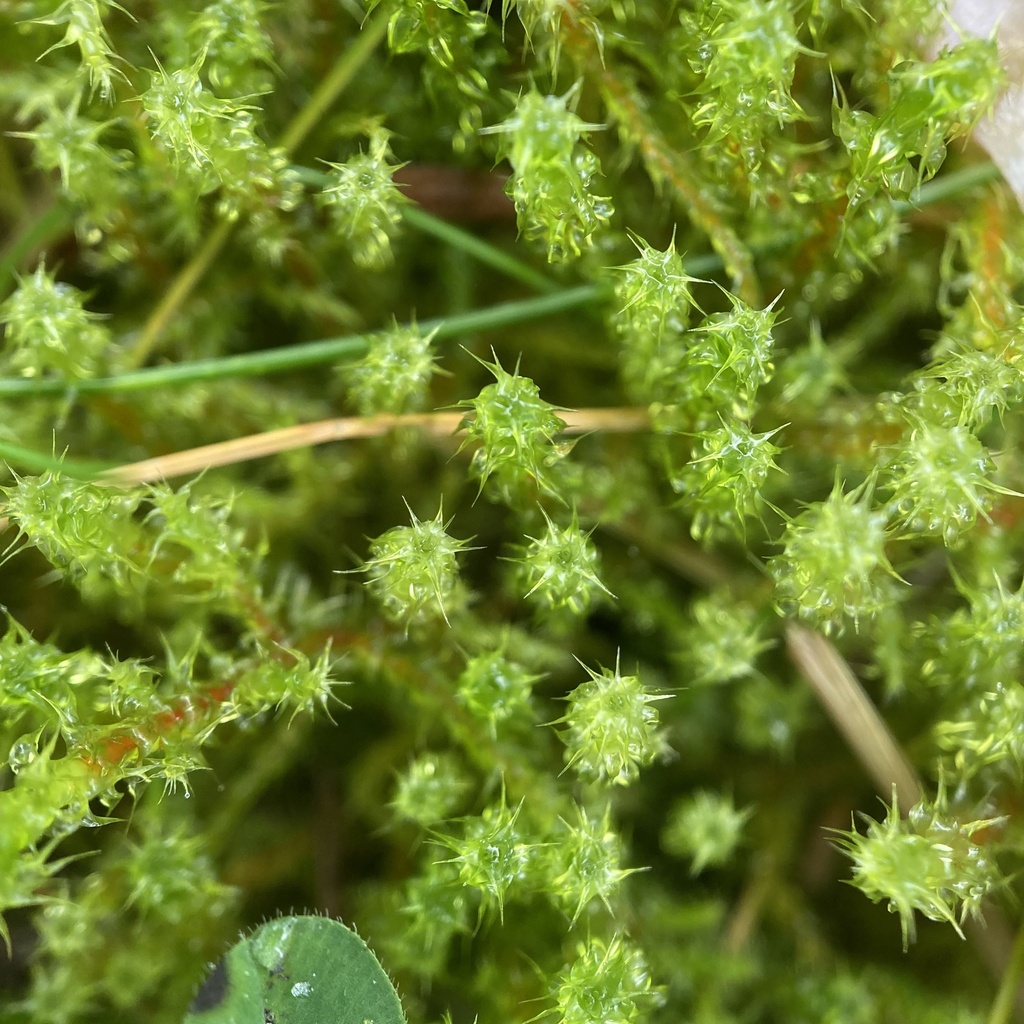
Square Gooseneck Moss
Rhytidiadelphus squarrosus
Rhytidiadelphus squarrosus is a species of moss known as springy turf-moss in the United Kingdom, and square goose neck moss in the United States. It is widespread in Eurasia and North America, and has been introduced to the Southern Hemisphere. It has broad ecological tolerances, and is usually found in man-made habitats such as lawns and golf courses. It is most closely related to R. subpinnatus, with which it is often confused.
From the article Rhytidiadelphus squarrosus on Wikipedia (CC BY-SA), quoted section by section
Description
Rhytidiadelphus squarrosus grows as an extensive mat of branching stems, up to 15 centimetres (6 in) tall, sheathed in leaves that are 2–2.5 mm (0.08–0.10 in) long and bend sharply back at a right angle, and thus spread outwards from the stem. The leaf bases are broad and include a pair of short nerves. The plant rarely produces capsules, so most of the species' reproduction is asexual.
Range & habitat
Rhytidiadelphus squarrosus has a circumpolar distribution in the Northern Hemisphere, being found across much of Eurasia, and parts of North America, including British Columbia, Alaska, Washington, Oregon, Newfoundland and Labrador and Greenland. It has also been introduced to northeastern North America, Tasmania and New Zealand, where it is now an invasive species. The first specimen to be collected in the Southern Hemisphere was taken in 1974 in Dundas Creek, western Tasmania, but the first published record came the following year, from a golf course in Dunedin on New Zealand's South Island.
Wikipedia: “Distribution”
What it does
It tolerates a wide variety of soil conditions, from calcareous grassland to acid heaths. It grows most conspicuously in heavily grazed pastures and on the regularly mown fairways on golf courses, and is the most common moss found in lawns in the United Kingdom. It is almost always found in association with humans, leaving its original habitat unclear; it may have evolved as a plant of coastal meadows.
Wikipedia: “Ecology”
In human culture
The genus name Rhytidiadelphus derives from the words Rhytidium and ἀδελφός (adelfós, brother), implying a close relationship to the genus Rhytidium. The specific epithet squarrosus refers to the leaves, which are squarrose, having a right-angled bend which causes the tips to extend away from the stem.
Wikipedia: “Etymology”
Where it lives
Recorded sightings
—
geo-referenced records in GBIF, from museums, herbaria and field observers.
Drag the globe to turn it. Dots are where records exist, not a range map; darker means more records.
In the stacks
Searching the stacks…
Every page naming Rhytidiadelphus squarrosus in the Biodiversity Heritage Library →
This page is assembled live from iNaturalist, GBIF, Wikipedia, the Source Library and the Internet Archive. It is not yet part of the hand-edited codex. iNaturalist taxon 123754.