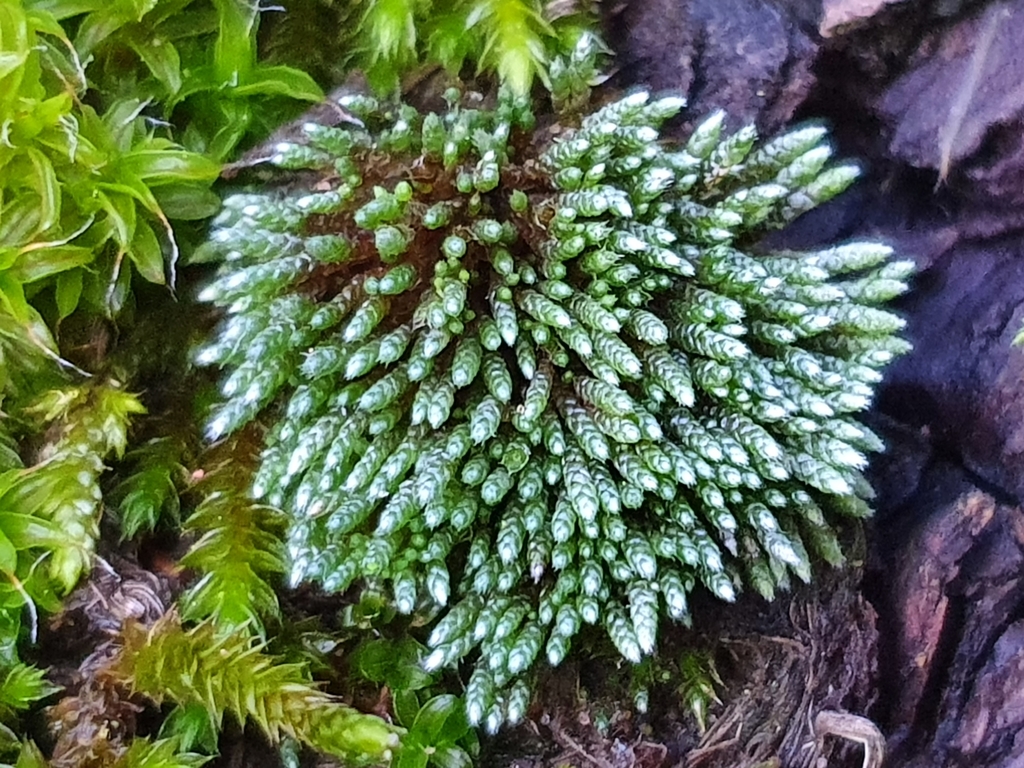
Silvery Bryum
Bryum argenteum
Bryum argenteum (common names: silver moss, silver-green moss, silvery thread moss) is a species of moss in the family Bryaceae. It is one of the most widely recognised mosses in the world and one of the most common in urban environments, identifiable without a microscope by its characteristic silvery-white sheen when dry. The species name comes from the Latin argenteum, meaning silver.
From the article Bryum argenteum on Wikipedia (CC BY-SA), quoted section by section
Description
B. argenteum is silvery-green or whitish-green colored when dry. This is because the broadly ovate-shaped single leaflets in the tip do not form chlorophyll. Shoots are typically less than 1 cm tall, with rounded, concave leaves 0.75–1.25 mm long that give each shoot a smoothly cylindrical profile. The upper cells of the leaf surface are elongated rhomboid-shaped. The leaf nerve terminates well below the leaf apex. The capsule of the sporophyte is short cylindrical, appears broader at the base and is dark red to black colour.
Morphology. The following formal treatment is based on Ohlsen (2022) via VicFlora:
Stems branching by innovations, julaceous, 5–15 mm long, pale green, orange or pink, sparsely covered with pale brown rhizoids toward base. Leaves closely imbricate when moist or dry, ovate to ovate-lanceolate, 0.5–1.5 mm long, c. 0.4 mm wide, concave; apex acute or obtuse; costa weak, percurrent or ending in apical half of leaf; margin entire or rarely denticulate at apex, plane, without a border; laminal cells in apical half rhomboidal-hexagonal, 40–70 μm long, 12–15 μm wide, hyaline in apical 1/4–1/2; basal laminal cells short-rectangular or quadrate. Seta 12–20 mm long, red. Capsules pendent, ovate, 0.85–2 mm long. Operculum convex, apiculate.
Leaf structure and the silver effect. Each leaf of B. argenteum comprises two structurally and functionally distinct zones. …
Range & habitat
B. argenteum is widespread and frequently abundant in disturbed, nutrient-enriched (particularly nitrate-rich) substrates subject to periodic desiccation. It thrives in areas of high human activity, growing on rocks, in gaps of paving stones, on asphalt, roadsides, walls, rooftops, concrete, and tarmac, and grows especially well in inner cities and industrial areas. Being a nitrogen-loving species, it is also found on nitrophilic soils in urban areas and among lawns. In less disturbed settings, the species also occurs in woodland, on sand dunes, along eroding stream and river banks, in rocky gorges, in alpine herbfields, and on unstable lowland cliff faces. The species is often spread by vegetative fragments clinging to the shoes of people and the feet or hooves of animals. It is also commonly spread through the production and sale of plant liners, which may carry B. argenteum, often in association with Marchantia polymorpha, transported across regions before being planted at foreign locations.
Wikipedia: “Habitat”
What it does
B. argenteum maintains a dioicous reproductive system, in which male and female gametophytes occur as separate, morphologically distinct plants. Sexual reproduction requires spatial proximity between individuals of both sexes, as swimming male gametes (antherozoids) must travel through a continuous surface film of water from the antheridia of the male plant to the archegonium, the female reproductive organ, where fertilisation of the egg occurs. The resulting zygote develops into the sporophyte, from which spores are produced and released. Spores are minute and lightweight, and dispersal is primarily wind-mediated. Asexual reproduction also occurs through the production of bulbils and protonema gemmae, small vegetative propagules that detach from the parent shoot and establish as genetically identical clones. This mode of reproduction is particularly significant in populations where males are absent or where abiotic conditions are insufficient for fertilisation.
Sex ratios. Natural populations consistently exhibit female-biased sex ratios, with males underrepresented relative to the 1:1 ratio expected from meiotic spore production. …
Wikipedia: “Reproduction”
Where it lives
Recorded sightings
—
geo-referenced records in GBIF, from museums, herbaria and field observers.
Drag the globe to turn it. Dots are where records exist, not a range map; darker means more records.
In the stacks
Searching the stacks…
Every page naming Bryum argenteum in the Biodiversity Heritage Library →
This page is assembled live from iNaturalist, GBIF, Wikipedia, the Source Library and the Internet Archive. It is not yet part of the hand-edited codex. iNaturalist taxon 123390.