- Plants
- ›Vascular Plants
- ›flowering plants
- ›Dicots
- ›Mints, Plantains, Olives, and Allies
- ›bladderwort family
- ›Utricularia
- ›Polypompholyx
- ›Pleiochasia
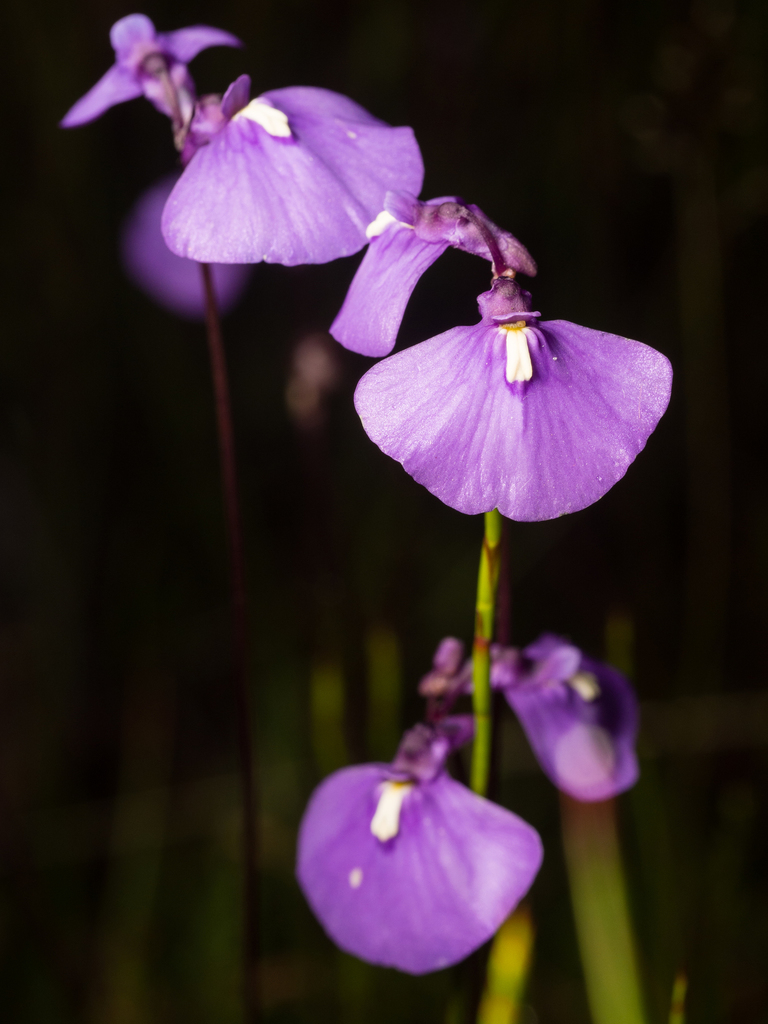
fairy aprons
Utricularia dichotoma
Utricularia dichotoma, commonly known as fairy aprons, is a variable, perennial species of terrestrial bladderwort. It has mauve or purple fan-shaped flowers on a slender stalk and usually grows in wet locations. It is a widespread species in Australia and New Zealand, and was first described in 1805.
From the article Utricularia dichotoma on Wikipedia (CC BY-SA), quoted section by section
Description
Utricularia dichotoma is a perennial herb with numerous underground trailing stems with bladders 1.5–2 mm (0.06–0.08 in) in diameter. It has absent or a few oval, spoon-shaped to narrow-lanceolate leaves 2–4 mm (0.08–0.16 in) long and up to 40 mm (1.6 in) long. The former is more typical of plants growing in wet soil, the latter of plants growing fully submerged. The flowers are borne on a slender, wiry stem 5–50 cm (2.0–19.7 in) long; they are solitary, paired or in whorls of three or four in clusters near the end of the stem. They are mauve or purple and have a small upper petal and a broader, semicircular lower lip 1–2 cm (0.4–0.8 in) wide with two or three prominent white or yellow markings, and the corolla is 12–22 mm (0.5–0.9 in) long. Flowering occurs from August to April and the fruit is a globular capsule up to 4 mm (0.16 in) wide.
Range & habitat
The fairy apron is native to New Caledonia, New Zealand and Australia. It occurs on the North and South Islands in New Zealand, as well as Stewart Island / Rakiura, the most southerly location at which a member of this genus occurs. In Australia it is found in all states, but the majority of occurrences is in New South Wales, Victoria and Tasmania. It grows in moist and wet locations.
== References ==
Wikipedia: “Distribution and habitat”
Where it lives
Recorded sightings
—
geo-referenced records in GBIF, from museums, herbaria and field observers.
Drag the globe to turn it. Dots are where records exist, not a range map; darker means more records.
In the stacks
Searching the stacks…
Every page naming Utricularia dichotoma in the Biodiversity Heritage Library →
This page is assembled live from iNaturalist, GBIF, Wikipedia, the Source Library and the Internet Archive. It is not yet part of the hand-edited codex. iNaturalist taxon 123241.