- Plants
- ›Vascular Plants
- ›flowering plants
- ›Dicots
- ›beeches, oaks, walnuts, and allies
- ›birch family
- ›Corylus
Filbert
Corylus maxima
Corylus maxima, the filbert, is a species of hazel native to southeastern Europe and southwestern Asia, from the Balkans to Ordu in Turkey.
From the article Corylus maxima on Wikipedia (CC BY-SA), quoted section by section
Description
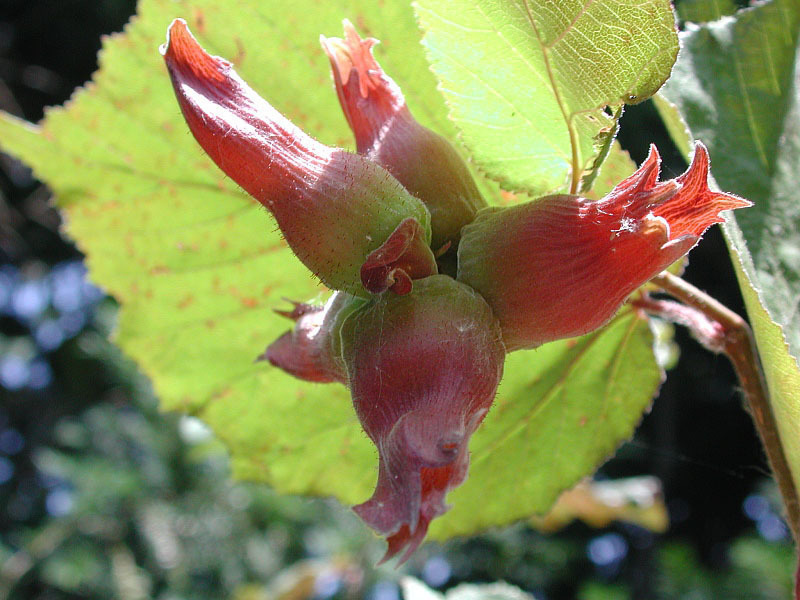
It is a deciduous shrub 6–10 metres (20–33 feet) tall, with stems up to 20 centimetres (8 inches) thick. The leaves are rounded, 5–12 cm (2–4+3⁄4 in) long by 4–10 cm (1+1⁄2–4 in) broad, with a coarsely double-serrated margin. The flowers are wind-pollinated catkins produced in late winter. The male (pollen) catkins are pale yellow, 5–10 cm (2–4 in) long, while the female catkins are bright red and only 1–3 mm (1⁄16–1⁄8 in) long. The fruit is a nut produced in clusters of 1–5 together. Each nut is 1.5–2.5 cm (1⁄2–1 in) long, fully enclosed in a 3–5 cm (1+1⁄4–2 in) long, tubular involucre (husk).
Similar species. The filbert is similar to the related common hazel, C. avellana, differing in having the nut more fully enclosed by the tubular involucre. This feature is shared by the beaked hazel C. cornuta of North America, and the Asian beaked hazel C. sieboldiana of eastern Asia.
Range & habitat
The species is native to southeastern Europe and southwestern Asia, from the Balkans to Turkey.
Wikipedia: “Distribution and habitat”
At the table
The purple-leaved cultivar C. maxima 'Purpurea' is a popular ornamental shrub in gardens. The filbert nut is edible and is very similar to the hazelnut (cobnut). Its main use in the United States is as large filler (along with peanuts as small filler) in most containers of mixed nuts. Filberts are sometimes grown in orchards for the nuts, but much less often than the common hazel.
Wikipedia: “Uses”
Where it lives
Recorded sightings
—
geo-referenced records in GBIF, from museums, herbaria and field observers.
Drag the globe to turn it. Dots are where records exist, not a range map; darker means more records.
In the old herbals & bestiaries

In the stacks
Searching the stacks…
Every page naming Corylus maxima in the Biodiversity Heritage Library →
This page is assembled live from iNaturalist, GBIF, Wikipedia, the Source Library and the Internet Archive. It is not yet part of the hand-edited codex. iNaturalist taxon 122974.