- Animals
- ›Chordates
- ›Vertebrates
- ›Mammals
- ›Therians
- ›Placental Mammals
- ›Ungulates, Carnivorans, and Allies
- ›Even-toed Ungulates and Cetaceans
- ›Ruminants
- ›Bovids
- ›Antelopes, Goats, and Sheep
- ›Goats and Sheep
- ›Ovis
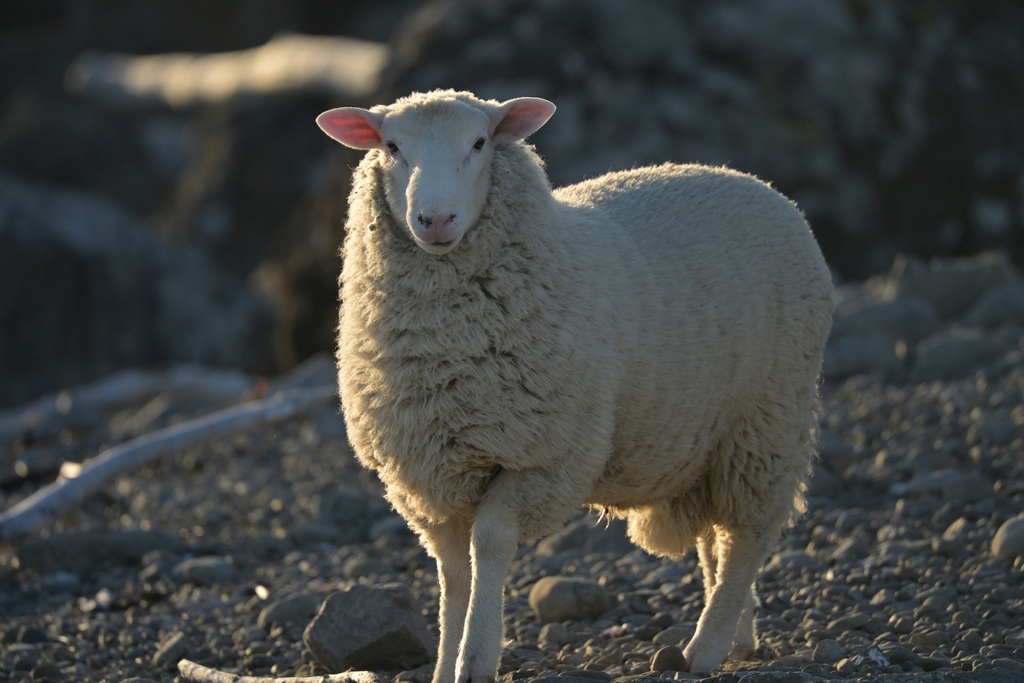
Domestic Sheep
Ovis aries
Sheep (pl.: sheep) or domestic sheep (Ovis aries) are a domesticated ruminant mammal typically kept as livestock. Although the term sheep can apply to other species in the genus Ovis, in everyday usage it almost always refers to domesticated sheep. Like all ruminants, sheep are members of the order Artiodactyla, the even-toed ungulates. There are around 1.2 billion domestic sheep as of 2019, making them easily the most common species of sheep. An adult female is referred to as a ewe ( yoo); an intact male as a ram, occasionally a tup; a castrated male as a wether; and a young sheep as a lamb.
Sheep are most likely descended from the wild mouflon of Europe and Asia, with Iran being a geographic envelope of the domestication center. One of the earliest animals to be domesticated for agricultural purposes, sheep are raised for fleeces, meat (lamb, hogget, or mutton), and sheep milk. A sheep's wool is the most widely used animal fiber, and is usually harvested by shearing. Ovine meat is called lamb and mutton, with lamb describing meat from younger animals and mutton meat from older ones. Sheep continue to be important for wool and meat today, and are also occasionally raised for pelts, as dairy animals, or as model organisms for science.
From the article Sheep on Wikipedia (CC BY-SA), quoted section by section
Description
Domestic sheep are relatively small ruminants, usually with a crimped hair called wool and often with horns forming a lateral spiral. They differ from their wild relatives and ancestors in several respects, having become uniquely neotenic as a result of selective breeding by humans. A few primitive breeds of sheep retain some of the characteristics of their wild cousins, such as short tails. Depending on breed, domestic sheep may have no horns at all (i.e. polled), or horns in both sexes, or in males only. Most horned breeds have a single pair, but a few breeds may have several horns, such as Jacob sheep. Another trait unique to domestic sheep as compared to wild ovines is their wide variation in color. Wild sheep are largely variations of brown hues, and variation within species is extremely limited. Colors of domestic sheep range from pure white to dark chocolate brown, and even spotted or piebald. Sheep keepers also sometimes artificially paint "smit marks" onto their sheep in any pattern or color for identification. Selection for easily dyeable white fleeces began early in sheep domestication, and as white wool is a dominant trait it spread quickly. However, colored sheep do appear in many modern breeds, and may even appear as a recessive trait in white flocks. …
Wikipedia: “Characteristics”
What it does
Sheep follow a diurnal pattern of activity, feeding from dawn to dusk, stopping sporadically to rest and chew their cud. Ideal pasture for sheep is not lawnlike grass, but an array of grasses, legumes and forbs. Types of land where sheep are raised vary widely, from pastures that are seeded and improved intentionally to rough, native lands. Common plants toxic to sheep are present in most of the world, and include (but are not limited to) cherry, some oaks and acorns, tomato, yew, rhubarb, potato, and rhododendron. Just a few leaves of rhododendrons such as Azaleas can be lethal. Sheep are largely grazing herbivores, unlike browsing animals such as goats and deer that prefer taller foliage. With a much narrower face and a split upper lip, sheep crop plants very close to the ground and can overgraze a pasture much faster than cattle. For this reason, many shepherds use managed intensive rotational grazing, where a flock is rotated through multiple pastures, giving plants time to recover. Sheep can both cause and solve the spread of invasive plant species. By disturbing the natural state of pasture, sheep and other livestock can pave the way for invasive plants. However, sheep also prefer to eat invasives such as cheatgrass, leafy spurge, kudzu and spotted knapweed over native species such as sagebrush, making grazing sheep effective for conservation grazing. …
Wikipedia: “Grazing behavior”
At the table
Sheep meat and milk were one of the earliest staple proteins consumed by human civilization after the transition from hunting and gathering to agriculture. Sheep meat prepared for food is known as either mutton or lamb, and approximately 540 million sheep are slaughtered each year for meat worldwide. "Mutton" is derived from the Old French moton, which was the word for sheep used by the Anglo-Norman rulers of much of the British Isles in the Middle Ages. This became the name for sheep meat in English, while the Old English word sceap was kept for the live animal. Throughout modern history, "mutton" has been limited to the meat of mature sheep usually at least two years of age; "lamb" is used for that of immature sheep less than a year. In the 21st century, the nations with the highest consumption of sheep meat are the Arab states of the Persian Gulf, New Zealand, Australia, Greece, Uruguay, the United Kingdom and Ireland. These countries eat 14–40 lbs (3–18 kg) of sheep meat per capita, per annum. Sheep meat is also popular in France, Africa (especially the Arab world), the Caribbean, the rest of the Middle East, India, and parts of China. This often reflects a history of sheep production. In these countries in particular, dishes comprising alternative cuts and offal may be popular or traditional. …
Wikipedia: “As food”
In human culture
The exact line of descent from wild ancestors to domestic sheep is unclear. The most common hypothesis states that Ovis aries is descended from the Asiatic (O. gmelini) species of mouflon; the European mouflon (Ovis aries musimon) is a direct descendant of this population. Sheep were among the earliest animals to be domesticated by humankind (along with dogs, which were domesticated 10 to 20 thousand years earlier); the date of domestication is estimated to fall between 11,000 and 9000 BC in Mesopotamia, from which it spread to Mehrgarh in the Indus Valley around 7000 BC. The rearing of sheep for secondary products, and the resulting breed development, began in either southwest Asia or western Europe. Initially, sheep were kept for meat, milk, and skins rather than fleece. Archaeological evidence from statuary found at sites in Iran suggests that selection for woolly sheep may have begun around 6000 BC, while the earliest woven wool garments have been dated to around 4000 BC, two thousand years later. Sheep husbandry spread quickly in Europe. Excavations show that in about 6000 BC, during the Neolithic period, the Castelnovien people in Châteauneuf-les-Martigues, near present-day Marseille in the south of France, were among the first Europeans to keep domestic sheep. …
Wikipedia: “History”
Listen
Looking for field recordings…
Where it lives
Recorded sightings
—
geo-referenced records in GBIF, from museums, herbaria and field observers.
Drag the globe to turn it. Dots are where records exist, not a range map; darker means more records.
In the stacks
Searching the stacks…
Every page naming Ovis aries in the Biodiversity Heritage Library →
This page is assembled live from iNaturalist, GBIF, Wikipedia, the Source Library and the Internet Archive. It is not yet part of the hand-edited codex. iNaturalist taxon 121578.