- Plants
- ›Vascular Plants
- ›flowering plants
- ›Dicots
- ›Heathers, Balsams, Primroses, and Allies
- ›heath family
- ›blueberries, cranberries, huckleberries, and allies
- ›Andromedeae
- ›Andromeda
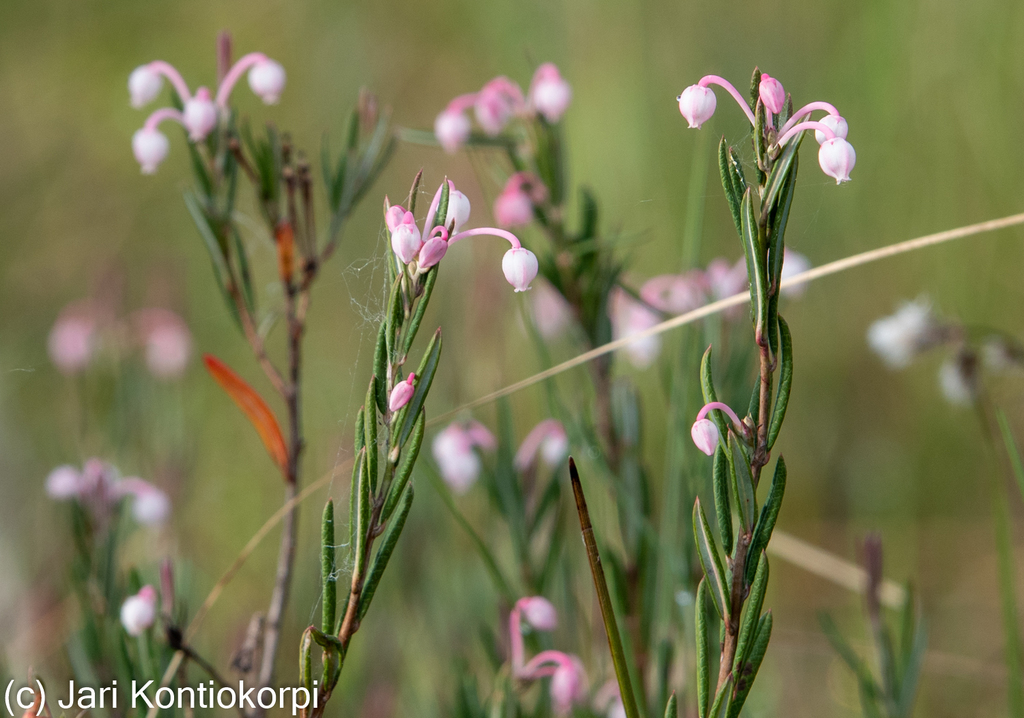
Wild Rosemary
Andromeda polifolia
Andromeda polifolia, common name bog-rosemary, is a species of flowering plant in the heath family Ericaceae, native to northern parts of the Northern Hemisphere. It is the only member of the genus Andromeda, and is only found in bogs in cold peat-accumulating areas. Andromeda glaucophylla is a synonym of A. polifolia var. latifolia.
From the article Andromeda polifolia on Wikipedia (CC BY-SA), quoted section by section
Description
It is a small shrub growing to 10–20 cm (4–8 in) (rarely to 40 cm or 16 in) tall with slender stems. The leaves are evergreen, alternately arranged, lanceolate, 1–5 cm (1⁄2–2 in) long and 2–8 mm (0.08–0.31 in) broad, dark green above (purplish in winter) and white beneath with the leaf margins curled under. The flowers are bell-shaped, white to pink, 5–8 mm (0.20–0.31 in) long; flowering is in late spring to early summer. The fruit is a small capsule containing numerous seeds. There are two varieties, treated as distinct species by some botanists:
Andromeda polifolia var. polifolia. Northern Europe and Asia, northwestern North America. Andromeda polifolia var. latifolia Aiton [1789]. Northeastern North America (syn. A. glaucophylla Link [1821], A. polifolia var. glaucophylla (Link) DC. [1839]).
How it is grown
Numerous cultivars have been developed for garden use, all of which require damp acid soil in shade. The cultivars 'Compacta' and 'Macrophylla' have gained the Royal Horticultural Society's Award of Garden Merit. Like most other members of the family Ericaceae, they are acid-loving plants (calcifuges), and must be grown in a medium with a low pH.
Wikipedia: “Cultivation”
In human culture
The genus was named by Carl Linnaeus who observed it during his 1732 expedition to Lapland and compared the plant to Andromeda from Greek mythology. The specific epithet is a noun in apposition, which Linnaeus based on Johann Christian Buxbaum's pre-Linnaean generic designation Polifolia. Buxbaum in turn derived the name from Johann Bauhin, who used it to mean "having polium-like leaves". The precise plant that Bauhin meant by polium is uncertain, but it may have been Teucrium montanum. The common name "bog rosemary" derives from the superficial resemblance of the leaves to those of rosemary, which is not closely related.
Wikipedia: “Etymology”
Where it lives
Recorded sightings
—
geo-referenced records in GBIF, from museums, herbaria and field observers.
Drag the globe to turn it. Dots are where records exist, not a range map; darker means more records.
In the old herbals & bestiaries


In the stacks
Searching the stacks…
Every page naming Andromeda polifolia in the Biodiversity Heritage Library →
This page is assembled live from iNaturalist, GBIF, Wikipedia, the Source Library and the Internet Archive. It is not yet part of the hand-edited codex. iNaturalist taxon 119892.