- Plants
- ›Vascular Plants
- ›flowering plants
- ›Dicots
- ›Soapberries, Cashews, Mahoganies, and Allies
- ›soapberry family
- ›Acer
- ›Acer
- ›Acer pseudoplatanus
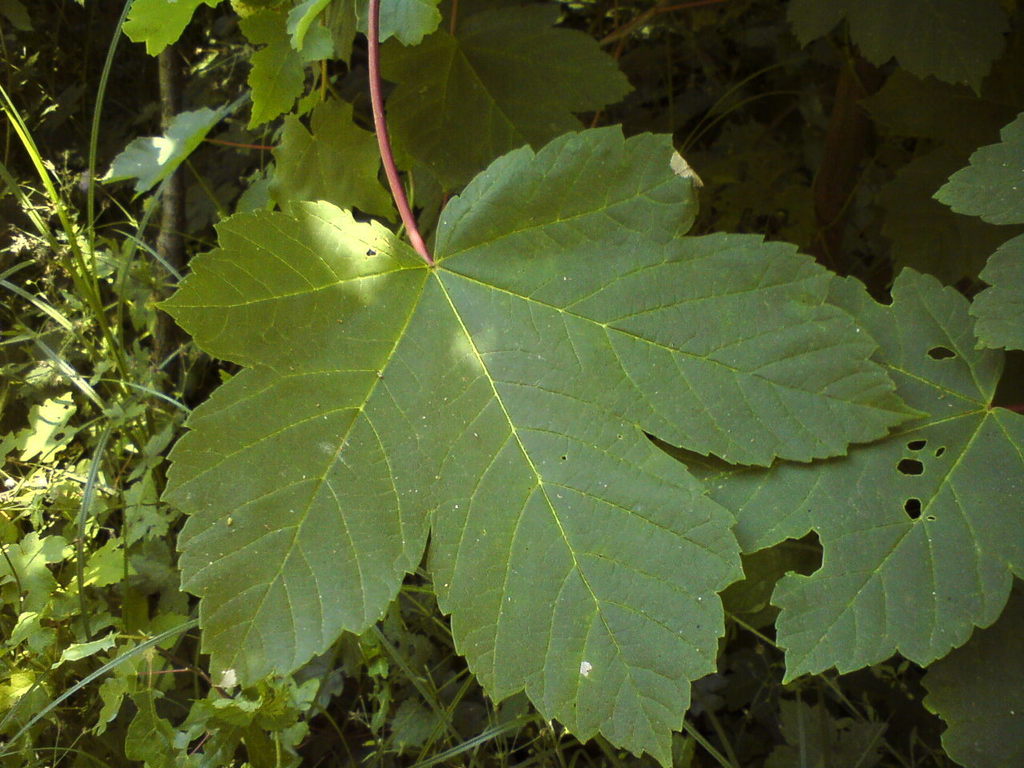
sycamore maple
Acer pseudoplatanus
Acer pseudoplatanus, known as the sycamore in the British Isles and as the sycamore maple in the United States, is a species of maple native to Central Europe and Western Asia. It is a large deciduous, broad-leaved tree, tolerant of wind and coastal exposure.
The sycamore can grow to a height of about 35 metres (115 feet) and the branches form a broad, rounded crown. The bark is grey, smooth when young and later flaking in irregular patches. The leaves grow on long leafstalks and are large and palmate, with five large radiating lobes. The flowers are greenish-yellow and hang in dangling flowerheads called panicles. They produce copious amounts of pollen and nectar that are attractive to insects. The winged seeds or samaras are borne in pairs and twirl to the ground when ripe. They germinate freely in the following spring.
From the article Acer pseudoplatanus on Wikipedia (CC BY-SA), quoted section by section
Description
The sycamore is a large, broad-leaved deciduous tree that reaches 20–35 metres (66–115 feet) tall at maturity, the branches forming a broad, domed crown. The bark of young trees is smooth and grey but becomes rougher with age and breaks up into scales, exposing the pale-brown-to-pinkish inner bark.
The buds are produced in opposite pairs, ovoid (approximately oval in shape) and pointed, with the bud scales (the modified leaves that enclose and protect the bud) green, edged in dark brown and with dark brown tips, 0.5–1 centimetre (1⁄4–3⁄8 in). When the leaves are shed they leave horseshoe-shaped marks called leaf scars on the stem. The leaves are opposite, large, 10 to 25 cm (4 to 10 in) long and broad, palmate with 5 pointed lobes that are coarsely toothed or serrated. They have a leathery texture with thick veins protruding on the underside. They are dark green in colour with a paler underside. Some cultivars have purple-tinged or yellowish leaves. The leaf stalk or petiole is 5 to 15 cm (2 to 6 in) long, is often tinged red with no stipules or leaf-like structures at the base. The functionally monoecious or dioecious yellow-green flowers are produced after the leaves in early summer, in May or June in the British Isles, on pendulous panicles 10 to 20 cm (4 to 8 in) long with about 60–100 flowers on each stalk. …
Range & habitat
The sycamore is native to central and eastern Europe and western Asia. Its natural range includes Albania, Austria, Belgium, Bulgaria, Czech Republic, France, Georgia, Germany, Greece, Hungary, Italy, Lithuania, Netherlands, Poland, Portugal, Romania, southern Russia, Spain, Switzerland, East Thrace and the former Yugoslavia. Reports of it occurring in eastern Turkey have been found to refer to A. heldreichii subsp. trautvetteri. It was probably introduced into Britain in the Tudor period by 1500 and was first recorded in the wild in 1632 in Kent. The date of its first introduction into Ireland is unclear, but the oldest specimen in Ireland is in County Cavan and dates from the 17th century. It was introduced into Sweden around 1770 with seeds obtained from Holland. The lack of old native names for it has been used to demonstrate its absence in Britain before introduction in around 1487, but this is challenged by the presence of an old Scottish Gaelic name for the tree, fior chrann which suggests a longer presence in Scotland at least as far back as the Gaelic settlement at Dál Riata in the late 6th and early 7th centuries. This would make it either an archaeophyte (a naturalised tree introduced by humans before 1500) or perhaps native if it can be seen to have reached Scotland without human intervention. …
Wikipedia: “Distribution”
What it does
In its native range, the sycamore is a natural component of birch (Betula sp.), beech (Fagus sp.) and fir (Abies sp.) forests. It readily invades disturbed habitats such as forest plantations, abandoned farmland and brownfield land, railway lines and roadsides verges, hedgerows, native and semi-natural woodland. In New Zealand, it invades the high country tussock grassland. As an introduced, invasive species, it may degrade the laurel forest in Madeira and Portugal and is a potential threat to the rare endemic Madeiran orchid, Dactylorhiza foliosa. It is tolerant of a wide range of soil types and pH, except heavy clay, and is at its best on nutrient-rich, slightly calcareous soils. The roots of the sycamore form highly specific beneficial mycorrhizal associations with the fungus Glomus hoi, which promotes phosphorus uptake from the soil. Sycamore mycorrhizas are of the internal arbuscular mycorrhizal type, in which the fungus grows within the tissues of the root and forms branched, tree-like structures within the cells of the root cortex. The larvae of a number of species of moth use the leaves as a food source. These include the sycamore moth (Acronicta aceris), the maple prominent (Ptilodon cucullina) and the plumed prominent (Ptilophora plumigera). …
Wikipedia: “Ecology”
At the table
Sycamore is planted in parks for ornamental purposes, and sometimes as a street tree, for its tolerance of air pollution makes it suitable for use in urban plantings. Owing to its tolerance to wind, it has often been planted in coastal and exposed areas as a windbreak. It produces a hard-wearing, white or cream close-grained timber that turns golden with age. The wood can be worked and sawn in any direction and is used for making musical instruments, furniture, joinery, wood flooring and parquetry. Because it is non-staining, is used for kitchen utensils, wooden spoons, bowls, rolling pins and chopping boards. In Scotland it has traditionally been used for making fine boxes, sometimes in association with contrasting, dark-coloured laburnum wood. Occasionally, trees produce wood with a wavy grain, greatly increasing the value for decorative veneers. The wood is a medium weight for a hardwood, weighing 630 kg per cubic metre. It is a traditional wood for use in making the backs, necks and scrolls of violins, and also for flamenco guitars. The wood is often marketed as rippled sycamore. Whistles can be made from straight twigs when the rising sap allows the bark to be separated, and these, and sycamore branches, are used in customs associated with early May in Cornwall. …
Wikipedia: “Uses”
Toxicity
Horses eating seeds or emergent seedlings of A. pseudoplatanus can suffer from an often fatal condition of atypical myopathy.
How it is grown
Sycamore self-seeds very vigorously, the seeds germinating en masse in the spring so that there is little, or no, seed bank in the soil. It is readily propagated from seed in cultivation, but varieties cannot be relied on to breed true. Special cultivars such as A. pseudoplatanus 'Brilliantissimum' may be propagated by grafting. This variety is notable for the bright salmon-pink colour of the young foliage and is the only sycamore cultivar to have gained the Royal Horticultural Society's Award of Garden Merit. A rare weeping form with dangling branches, A. pseudoplatanus var. pendulum, was first sold by Knight & Perry's exotic nursery in Chelsea, England, before 1850 when the name was published by W. H. Baxter in the Supplement to Loudon's Hortus Brittanicus, but no specimens of this cultivar are known to survive. The sycamore is noted for its tolerance of wind, urban pollution, salt spray, and low summer temperatures, which makes it a popular tree for planting in cities, along roads treated with salt in winter, and in coastal localities. It is cultivated and widely naturalised north of its native range in Northern Europe, notably in the British Isles and Scandinavia north to Tromsø, Norway (seeds can ripen as far north as Vesterålen); Reykjavík, Iceland; and Tórshavn on the Faroe Islands. …
Wikipedia: “Cultivation”
In human culture
The specific name pseudoplatanus refers to the superficial similarity of the leaves and bark of the sycamore to those of plane trees in the genus Platanus, the prefix pseudo- (from Ancient Greek) meaning "false". However, the two genera are in different families that are only distantly related. Acer and Platanus differ in the position in which leaves are attached to the stem (alternate in Platanus, paired or opposite in Acer) and in their fruit, which are spherical clusters in Platanus and paired samaras (winged fruit) in Acer. The common name "sycamore" was originally applied to the fig species Ficus sycomorus, the sycamore or sycomore referred to in the Bible, that is native to Africa and Southwest Asia. Other common names for the tree include false plane-tree, great maple, Scottish maple, mount maple, mock-plane, or Celtic maple.
Wikipedia: “Etymology”
Where it lives
Recorded sightings
—
geo-referenced records in GBIF, from museums, herbaria and field observers.
Drag the globe to turn it. Dots are where records exist, not a range map; darker means more records.
In the stacks
Searching the stacks…
Every page naming Acer pseudoplatanus in the Biodiversity Heritage Library →
This page is assembled live from iNaturalist, GBIF, Wikipedia, the Source Library and the Internet Archive. It is not yet part of the hand-edited codex. iNaturalist taxon 119791.