- Plants
- ›Vascular Plants
- ›flowering plants
- ›Dicots
- ›myrtles, evening primroses, and allies
- ›evening primrose family
- ›Epilobium
- ›Epilobium
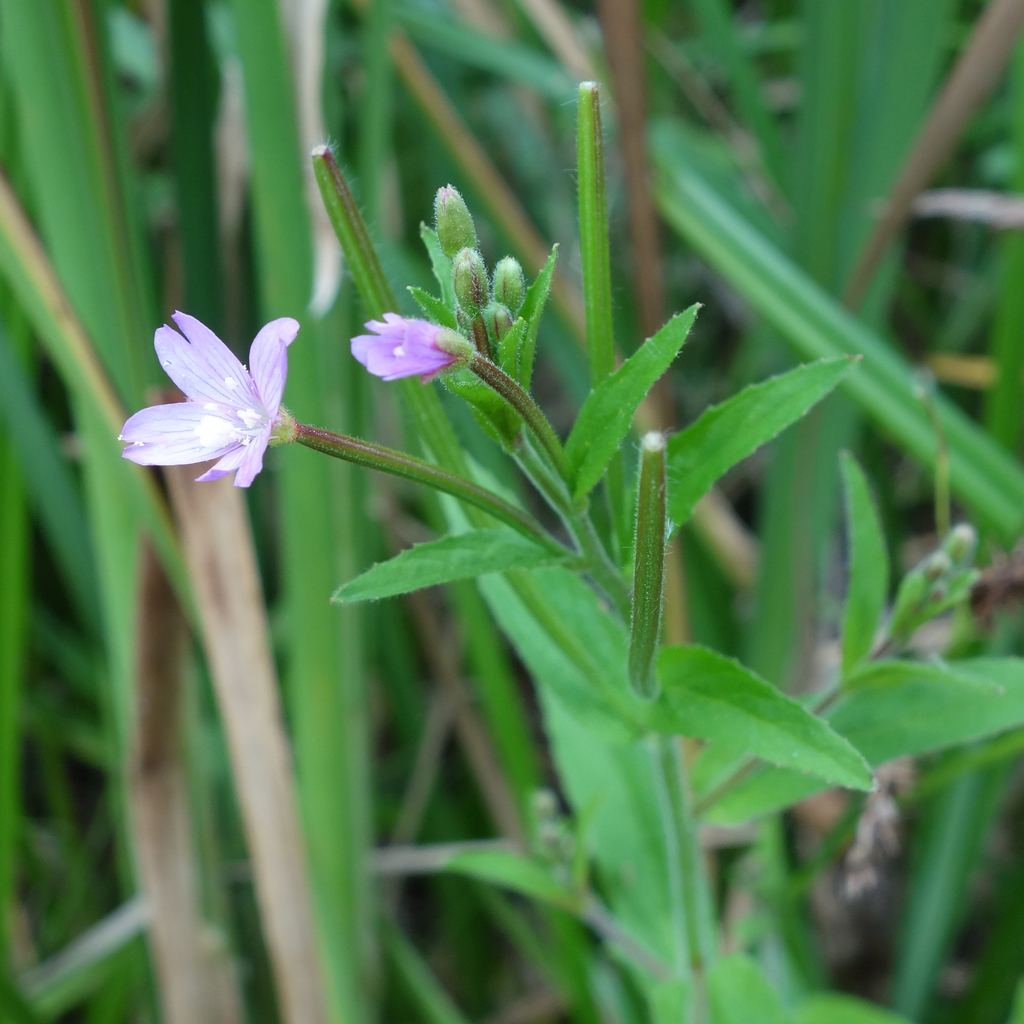
Hoary Willowherb
Epilobium parviflorum
Epilobium parviflorum, commonly known as the hoary willowherb or smallflower hairy willowherb, is a herbaceous perennial plant belonging to the Onagraceae family.
From the article Epilobium parviflorum on Wikipedia (CC BY-SA), quoted section by section
Description
The biological form of Epilobium parviflorum is hemicryptophyte scapose, as its overwintering buds are situated just below the soil surface and the floral axis is more or less erect with a few leaves. Epilobium parviflorum reaches on average 30–80 centimetres (12–31 in) in height. The stem is erect and densely covered with hairs, especially in the lower part. The leaves are opposite, unstalked but not amplexicaul, lanceolate and toothed, rounded at the base, 4–10 centimetres (1.6–3.9 in) long. The tiny flowers are pale pink or pale purple, 6–7 millimetres (0.24–0.28 in) in diameter, with four petals, eight stamens and a 4-lobed stigma. Flowering occurs from June to August in the Northern Hemisphere. The hermaphroditic flowers are either self-fertilized (autogamy) or pollinated by insects (entomogamy). Fruit is a three-to seven-centimeter long capsule containing very small black seeds (about 1 mm long), with white fibres that allow the dispersal by wind. This species is quite similar to Epilobium hirsutum, but the flowers are much smaller. Epilobium parviflorum is sometimes mistaken for E. roseum, whose clavate stigma contrasts with the 4-lobed stigma of E. parviflorum. More obviously, the undersides of and fully developed leaves of E. parviflorum are covered with up to 0.5 millimetres (0.020 in) long unglandular trichomes. Trichomes of E. …
Range & habitat
It is one of the most widespread species in its genus. It plant occurs in most of Europe, including Britain, from Sweden to Northern Africa and Western Asia up to Kashmir, in United States and Canada. In Croatia, it is found everywhere but subalpine and altimontane altitudes. It grows in very moist to wet habitats.
Wikipedia: “Distribution”
At the table
Extracts of this plant have been used by traditional medicine in disorders of the prostate gland, bladder and kidney, having an antioxidant and antiinflammatory effect . Epilobium parviflorum herb has been prescribed internally as tea in the traditional Austrian medicine for treatment of disorders of the prostate, kidneys, and urinary tract. Extracts of Epilobium have been shown to inhibit proliferation of human prostate cells in-vitro by affecting progression of the cell cycle.
Wikipedia: “Medicinal uses”
In human culture
The genus name derives from the Greek words "epi" meaning "upon" and "lobos" meaning "lobe", with reference to position of the petals above the ovary. The specific Latin name of "parviflorum" means "small flowers".
Wikipedia: “Etymology”
Where it lives
Recorded sightings
—
geo-referenced records in GBIF, from museums, herbaria and field observers.
Drag the globe to turn it. Dots are where records exist, not a range map; darker means more records.
In the stacks
Searching the stacks…
Every page naming Epilobium parviflorum in the Biodiversity Heritage Library →
This page is assembled live from iNaturalist, GBIF, Wikipedia, the Source Library and the Internet Archive. It is not yet part of the hand-edited codex. iNaturalist taxon 119602.